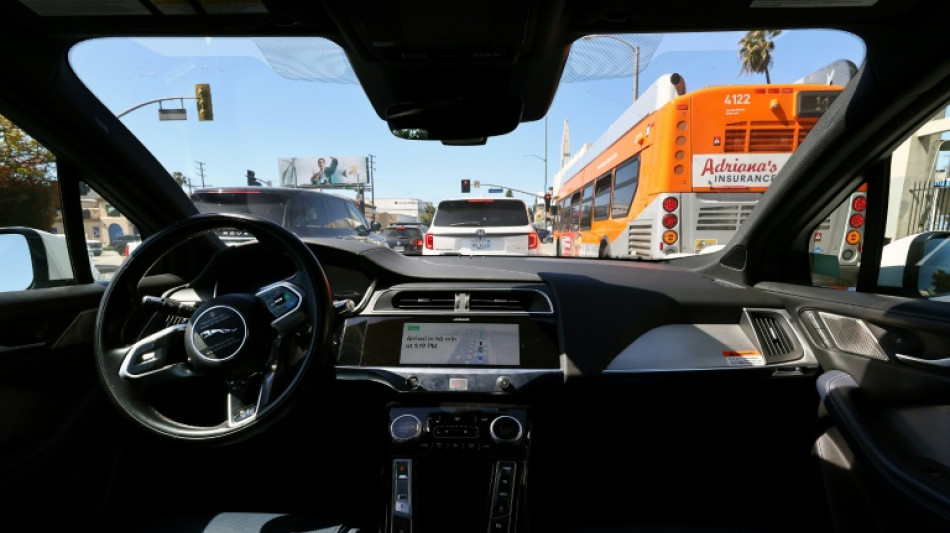
Autonomous car rules advancing faster than the vehicles themselves: UN / Photo: MARIO TAMA - GETTY IMAGES NORTH AMERICA/AFP

 Djokovic crashes out of Shanghai Masters in his first match

 EU says Turkey's crackdown on rights hampers membership bid

 Two Renoir paintings stolen in France recovered: mayor

 German leader outraged at Schroeder birthday visit to Putin

 Stocks up, oil retreats as Trump rules out pre-vote Iran attack

 South African judge Navi Pillay wins Nobel Peace Prize
 'I completely trust the club,' says Man City boss Maresca

 '10 out of 10' Quintana reminisces over dream Vuelta win

 Maddinson given shock recall but fails to score

 Navi Pillay, South African rights champion, wins Nobel Peace Prize

 Saudi Arabia says three killed at airport as Yemen war expands

 Everton's US owners mull sale of club two years after takeover

 Ukraine takes Russia fight to 'scorching sands' of Sahel
 Chinese AI tool pulled to prevent 'misuse' after South Korea hacks

 Asian stocks mostly up as traders weigh AI, oil dips after surge

 Walking through flames: orangutans rescued in Indonesia fires

 LeBron shines in pre-season debut for re-tooled 76ers

 Okinawa resolution calls for revision of US forces pact after murder

 Verdict expected Friday in Mexico trial over murders of Australia, US surfers

 New York mayor says asking Trump to withdraw ICE after shooting

 Walking through flames: orangutan rescued in Indonesia fires

 James shines in pre-season debut for re-tooled 76ers

 Fuel, fertilizer costs strain US farmers' support for Republicans in midterms

 Trump's 'super intelligence' rebrand to sell AI faces uphill battle

 Fiji demands US provide evidence Chinese official paid bribes for Beijing

Fully autonomous cars are still years away from hitting the streets, but internationally-agreed rules on their use could be ready by mid-2026, the United Nations has said.
Safety concerns and the cost of developing next-level systems have slowed down progress on autonomous vehicles, but work on regulations is motoring ahead, said the UN.
"While the hype may be slowly disappearing, the actual serious work on regulation is advancing," UNECE agency's deputy executive secretary Dmitry Mariyasin told reporters.
Established in 1952, the World Forum for Harmonisation of Vehicle Regulations meets three times a year, bringing together countries, carmakers and technology giants. This week's gathering in Geneva is the main annual session.
The forum takes place under UNECE, the UN Economic Commission for Europe, which shapes the legal framework for inland transport.
- Rules of the road -
Richard Damm, chair of the Working Party on Automated/Autonomous and Connected Vehicles (GRVA), said new UN regulations for driver control assistance systems were adopted in February and would come into force in September.
Furthermore, "we are planning to have a globally harmonised regulation on Automated Driving Systems (ADS) ready for mid-2026", he said.
Unlike some fields where regulation comes long after the roll-out of new technology, GRVA secretary Francois Guichard said getting the rules settled first was in line with previous advances in motoring.
He said regulations for electric vehicles was ready before they hit the market, and the framework is also now in place for hydrogen vehicles, should the industry move towards mass production.
- Five levels -
There are five levels of automation, with the lower levels already becoming commonplace.
At Level 2, drivers are expected to keep their attention on traffic.
At Level 3, the driver is not driving when the automated systems are engaged, but can step in at any time and must take over at the system's request.
At Level 4, a driver need not be ready to intervene quickly, at least in limited areas, while Level 5 vehicles are fully autonomous.
Guichard said Level 1 and 2 technology was probably in half of all new vehicles; "Level 3 is still rare, and Level 4 doesn't exist for sale as a mass production product", he said.
Damm said the systems on Levels 3 and 4 were "much more costly", so deeper driver assistance technology at Level 2 is likely to come first, as a bridge towards the next levels.
- Road safety -
"Is there a future for autonomous cars? I can clearly answer this with a 'yes'," said Damm.
"This technology will come, and it's partly on the road, even if it's not penetrating the mass market yet. It is still some years ahead before we see it in the mass market, because we have to resolve several issues."
Public safety concerns remain the top priority in setting the regulatory framework.
There are approximately 1.2 million road traffic deaths per year, with a further 50 million people injured.
"We don't know yet whether autonomous vehicles will be more of a problem or more of a solution," said Mariyasin.
L.Torres--PC