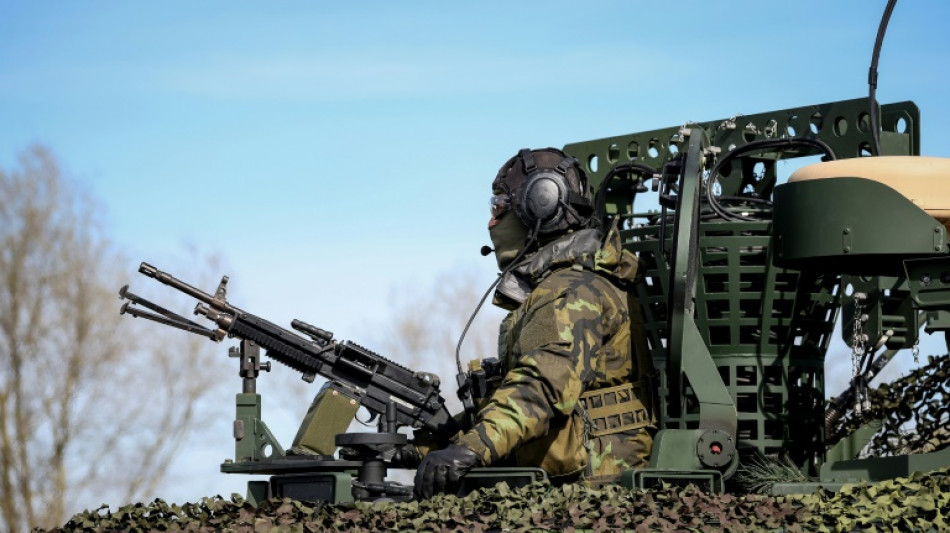
NATO is spending more on defence, but it's likely not enough / Photo: Ronny Hartmann - AFP

 'Tough to stay here': Nepal flood survivors wait for homes

 Malaysia closes schools in capital, parts of country due to haze
 Buccaneers stun Cowboys for first win of NFL season

 Activists hope trial will stop 'forever chemicals' at Italy plant

 Guardians rally for 9-5 victory over White Sox to stay alive in MLB playoffs
 Asian stocks mixed amid AI concerns, oil dips after surge

 Wallabies expect fast-paced All Blacks in Bledisloe opener

 Tech scammer Elizabeth Holmes focus of documentary by absurdist Nathan Fielder
 Climate hopes shift from politics to the courts

 Will Nobel Peace Prize pick make waves at the White House?
 Trump rules out new Iran attack before US midterm elections
 Far-right influencer shows Israel's coarse political turn
 Seals and sea lions get hearing tested at Australia zoo
 Mourinho's Real Madrid playing catch-up in Clasico countdown
 Joy as USS Lincoln back home after troubled Gulf deployment
 OpenAI says Iran, Russia influence ops busted
 Anthropic bans 'cruel' behavior against its Claude AI
 Anne Carson's Nobel literature prize 'a proud moment for Canada': PM

 Montagliani to seek CONCACAF re-election in boost for Infantino: reports
 Oil surges, stocks sink on jitters over US plans in Iran war

 John Cena and Jessica Biel hit the gas in 'Matchbox: The Movie'

 US, Ukrainians, Europeans to discuss 'new ideas' to end war
 Unproven 'cures' pushed online amid plague concerns

 Nigeria looks to ease fuel prices as election looms
 Prosecutors in Maradona death trial seek sentences up to 12 years

Spurred on by Russia's war in Ukraine and the spectre of Donald Trump's potential return to the White House, more of NATO's European members are finally hitting the alliance's defence spending target.
But as leaders gear up to celebrate at a NATO summit in Washington there is a clear feeling that will not be sufficient to tackle the challenges it faces.
"Even in countries historically reluctant to spend more on defence, there is now a growing sense of the importance of greatly increased defence spending," said Ian Lesser, from the German Marshall Fund of the United States think tank.
"I think, broadly speaking, in the next years we're looking at levels of defence spending that will begin to approach those of the Cold War."
A decade after setting a spending goal at two percent of gross domestic product, just over two-thirds of NATO's 32 countries are now expected to reach or top that threshold this year.
That is up from only three allies in 2014.
The increase in spending, which includes European heavyweights Germany and France, will be heavily showcased in Washington as NATO stages its show of unity.
That is designed to send a message to Russia's President Vladimir Putin as he wages his war in Ukraine and menaces NATO from the east.
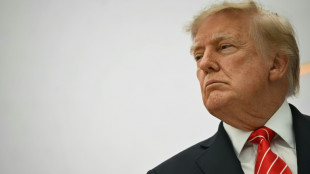
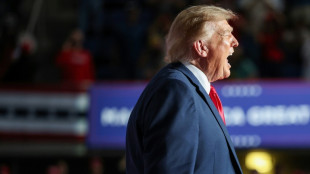
But it is also a message for former US leader Donald Trump as he seeks to reclaim the Oval Office from incumbent Joe Biden at elections in November.
Like other US leaders, upset that Washington shoulders too much of the burden with its vast defence budget, Trump spent his time in office demanding European countries do more.
On the campaign trail in February he unleashed a firestorm by saying he would encourage Russia to "do whatever the hell" it wants to NATO allies not coughing up enough.
- 'Hot war' -
A year after turning the two-percent benchmark from a target to a floor for spending at a summit in Vilnius, a growing number of NATO allies are already pushing to go further.
Chief among them are the Baltic States and Poland -- with all comfortably spending more, and Warsaw even reaching over four percent.
"In 1988 all of the allies were spending more than two percent, actually some even six percent on defence because the threat was real -- there was a Cold War going on," Estonian Prime Minister Kaja Kallas said.
"Now we have a hot war in Europe and we are not spending enough," said Kallas, who was nominated last month as the European Union's next foreign policy chief.
But the Washington summit still looks too early to set a more ambitious target.
"I think we're keen to celebrate the progress," a US defence official said. "There's not an appetite this year to change that benchmark to three percent."
- Defence plans -
A major motivation for ramping up spending is making sure NATO countries can actually fulfil ambitious new defence plans agreed last year to ward off any potential attack from Russia.
After years of slashing budgets as fears of conflict eased in the wake of the Cold War, numerous allies have major gaps in their arsenals -- including key requirements such as air defences.
As part of its planning, NATO commanders are telling capitals what they need to spend on.
"We have specific capabilities targets for each and every ally," said alliance chief Jens Stoltenberg.
"For many allies, this will mean three percent, and at least something more than two percent."
Diverting money away from issues like welfare, education and health is never an easy sell for governments.
The likes of Canada, Italy and Spain still lag behind the NATO target and are reluctant to commit to going further.
But diplomats at NATO said the direction of travel is clear -- spending targets will need to be hiked.
"Some countries are still sticking their heads in the sand," said one diplomat. "But it will happen eventually."
Another diplomat agreed -- adding that if Trump starts breathing down the necks of European allies again that could speed things up.
"This is where we are heading towards -- in order to fill the new plans it is clear that two percent won't be enough," the diplomat said.
"I think we're going to move to something beyond that, regardless of who wins the next US elections -- but if Trump wins it could come sooner."
N.Esteves--PC