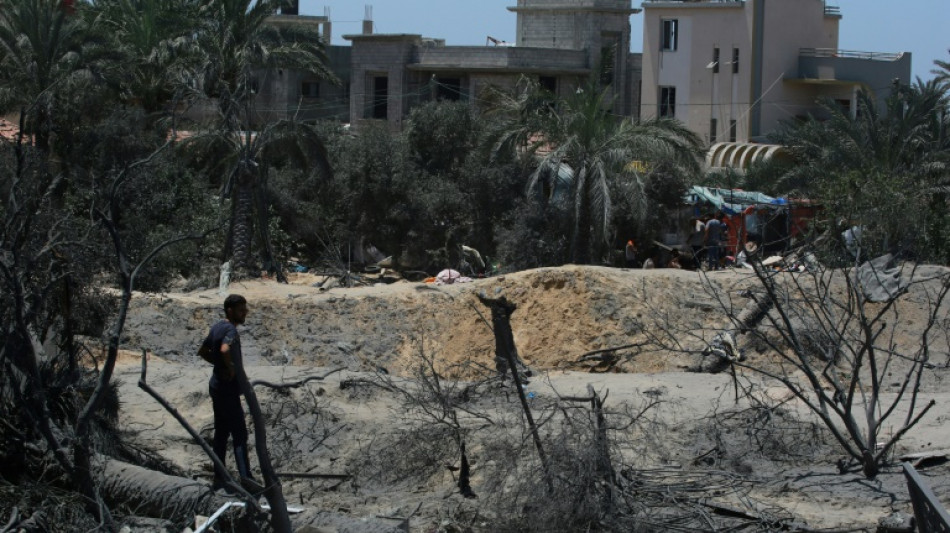
What we know about the bomb Israel used on Gaza 'safe zone' / Photo: Bashar TALEB - AFP

 CNN, MS Now, Politico urge judge to extend White House access
 Trump administration to launch new vaccine research center

 Russian strikes kill 30 in Ukraine frontline city, talks set in US

 US military to livestream firing squad execution of Fort Hood shooter

 Aces star Wilson wins record-extending fifth WNBA MVP

 Undefeated 49ers seek Seahawks revenge

 Madrid mourns evicted retiree, 'icon' of Spain housing protests

 OpenAI revenue gap report rattles AI stocks
 France pledges more teachers after school students vow no let-up
 Bordeaux confirmed in sixth tier of French football
 Trump gives 'national treasure' Musk top US medal after rift

 MLB proposes shortening season, reforming playoffs

 Crew splashes down after 8-month mission on International Space Station

 Protests, clashes as S. African anti-migrant tensions reignite
 Russian data centre hit by drone in first for Ukraine war

 'Fighting for our future': France high school students vow no let-up

 Kyiv entering 'survival' mode amid Russian strikes surge: mayor tells AFP

 Verdict due in Mexico trial over murders of Australia, US surfers

 B2PRIME Welcomes Christina Barbash as Commercial Manager

 Russia forcing Kyiv into 'survival' mode before winter, mayor tells AFP

 Closing arguments begin in Maradona death trial

 UEFA president Ceferin to stand for re-election in 2027

 Nearly 300,000 Nepalis at flood risk: study

 Riyadh kindergarten hit by interception debris as Houthis say targeted airport
 Alex Bodi mizează, alături de CRIF, pe investiții transparente și pe prevenirea riguroasă a spălării banilor

Israel's deadly strike on Al-Mawasi, one of the bloodiest attacks in more than nine months of war in Gaza, used massive payload bombs provided by the United States, according to weapons experts.
The bombing of the Israeli-declared "safe zone" transformed the tent city on the Mediterranean coast into a charred wasteland, with nearby hospitals overrun with casualties.
According to the health ministry in the Hamas-run territory, the barrage killed at least 92 people and wounded more than 300.
The Israeli military said it targeted two "masterminds" of the October 7 attacks by Hamas that triggered the war. It said a top commander, Rafa Salama, was killed in the strike, but uncertainty remains over Hamas military chief Mohammed Deif.
AFP videos of the attack showed a white mushroom cloud billowing over a busy street, leaving behind a huge crater strewn with the wreckage of tents and a building blown to bits.
Here is what we know about the weaponry used in the attack:
- US-made JDAM -
Two weapons experts told AFP that a sliver of munition seen in a video of the blast site circulating online was a tail fin from a US-made Joint Direct Attack Munition (JDAM). AFP could not independently verify the video.
The GPS-aided kit converts unguided free-fall bombs -- so-called "dumb bombs" -- into precision-guided "smart" munitions that can be directed towards single or multiple targets.
The United States developed the kit to improve accuracy in adverse weather after Operation Desert Storm in 1991.
The first JDAMs were delivered in 1997 and, according to the US Air Force, have a 95 percent system reliability.
Trevor Ball, a former US Army explosive ordnance disposal technician, concluded from images of the Al-Mawasi strike "it's 100 percent a JDAM kit" made in the United States.
He said that given the types of bombs compatible with the guidance system and the size of the fin fragment, the JDAM was most likely used with either a 1,000 or 2,000 pound (450 or 900 kilogramme) payload.
He said the fragment could also be compatible with the BLU-109 "bunker buster" warhead, which is designed to penetrate concrete.
Ball said it was not possible to definitively determine where the payload itself was made without "very specific fragments of the bomb body".
- New delivery -
Repeated use of such large bombs in the densely populated Gaza Strip has sparked humanitarian outcry and heaped pressure on US President Joe Biden to reconsider the munitions supplied to Israel.
On July 12, Israel's main military backer announced it was ending a pause on supplying 500-pound bombs, though Biden said the 2,000-pound type would be withheld.
The White House has repeatedly voiced frustration over the civilian death toll in Gaza as Israel attempts to eradicate Hamas.
US Secretary of State Antony Blinken told two top Israeli officials on Monday that the civilian toll was "unacceptably high", his spokesman said.
Israeli officials said their "precise strike" in Al-Mawasi hit an open area that housed a Hamas compound and not a civilian camp.
When contacted by AFP regarding the weapons used, the Israeli military declined to comment.
Based on Israel's stated target, Wes Bryant, a retired US Air Force master sergeant and strike and joint targeting expert, said it would have been feasible to avoid collateral damage in the surrounding area.
"My assessment is that any civilians killed in this strike were in the compound -— not in the surrounding vicinity. So the IDF either failed to assess presence of civilians, or... deemed the risk to civilians proportional to the military advantage of taking out the Hamas leaders."
- 'Absolute destruction' -
The strike left Al-Mawasi a scene of "absolute destruction" with no water, electricity or sewage treatment, the Islamic Relief charity said.
It condemned Israel for its willingness "to kill innocent men, women and children in pursuit of its end goals".
Hamas said that by arming Israel, the Biden administration is "legally and morally responsible" for spawning a "major humanitarian catastrophe".
It said US-supplied weapons used by Israel included GPS-guided bombs, dumb bombs, bunker busters and JDAMs.
After repeated high-casualty strikes in recent days, a Hamas official said the group was withdrawing from indirect talks for a truce and hostage release deal with Israel.
The war was sparked by Hamas's October 7 attack on Israel, which resulted in the deaths of 1,195 people, mostly civilians, according to an AFP tally based on Israeli figures.
Israel responded with a military offensive that has killed at least 38,664 people in Gaza, also mostly civilians, according to the Hamas-ruled territory's health ministry.
A.Santos--PC