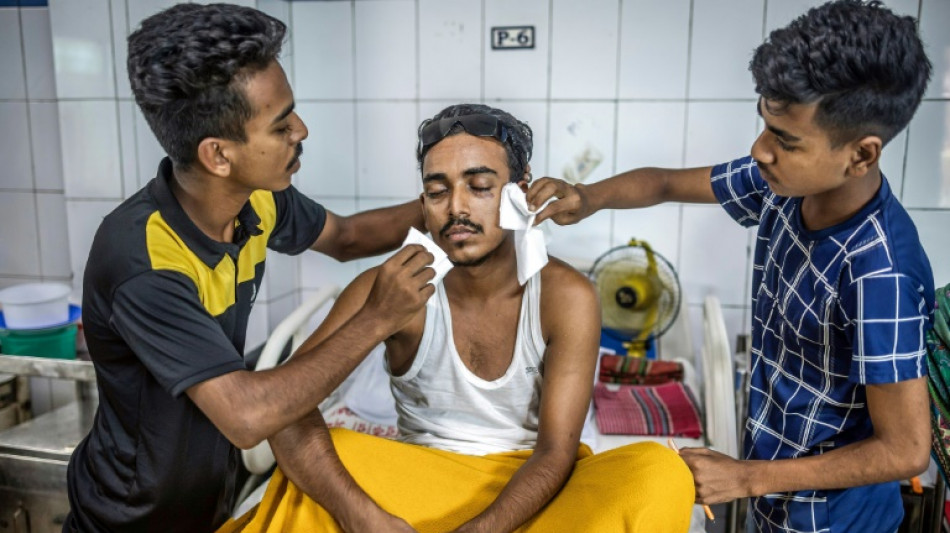
Blinded in Bangladesh protests, students hope for better future / Photo: LUIS TATO - AFP

 After botched execution, US woman was nearly taken off life support before revival
 Searing AIDS drama 'Elsinore' opens London film festival
 Evicted pensioner who sparked Spain housing protests dies: tenant union
 Golf star Rahm quitting LIV tour over 'unacceptable' terms
 Thousands march fearing return of a Bolsonaro presidency in Brazil
 French PM denies police ordered to confront student protesters
 Rubio touts US power, calls on Europe to emerge from 'slumber'
 Trump says 'we don't think' Russian plague is bio-weapon
 Five children among 26 killed in Ukraine after Russian strikes

 Man City should 'accept' punishment for rule breaches, says Lineker
 US woman who survived botched execution is awake and speaking
 From 1800s to modern pharma: a Nobel-winning chemistry quest

 Southampton boss Eckert given suspended ban over 'Spygate'
 Russia warns of 'false' information as second plague case reported
 IEA ready to release more oil reserves if necessary
 HSBC 'consults' over UK unit job cuts amid AI adoption
 UK court quashes five ex-traders' Libor rate rigging convictions
 XM Receives “Global Customer Experience Leader Award 2026” at the TrustFinance Performance Awards
 Stocks slide as oil climbs on Mideast flareup
 Heavy casualties in Ukraine after Russian strikes
 French wine harvest set to hit historic low
 Kyiv 'cannot agree' to EU membership limiting food exports: minister

 Arteta targets more Arsenal glory after signing new deal until 2030
 Russell hit with Singapore grid penalty for taking new power unit
 Spotify expands audiobooks to more than 180 markets

Bangladeshi student Omar Faruq believes the future of his country is bright but all he can see is darkness, after police trying to crush a student-led revolution blinded him with rubber pellets.
More than 450 people were killed -- many by police fire -- in the weeks of protests leading up to the ouster of ex-premier Sheikh Hasina, who fled to India on August 5 ending her 15-year autocratic rule.
But dozens of protesters were also robbed of their vision -- some in one eye, others entirely -- by the plastic or rubber grapeshot pellets police fired from shotguns.
Bangladeshi security forces are accused of having resorted to excessive force to quell the protests.
"I was bombarded with pellets all over... my nose, eyes, everywhere -- from close range," said 20-year-old Faruq.
He had hitchhiked 200 kilometres (125 miles) from the northern city of Bogura to attend the protests in the capital Dhaka.
Now he is getting treatment at the National Institute of Opthalmology and Hospital (NIOH), the country's biggest specialised eye centre.
Its records show nearly 600 people have lost at least some vision from shotgun pellets fired during the weeks of civil unrest against Hasina. Among those, 20 have been blinded completely.
Hundreds of others with pellet injuries in their eyes are undergoing treatment in smaller hospitals across Dhaka, according to local media reports.
"We were doing up to 10 surgeries at a time," said Mohammad Abdul Qadir, NIOH's acting director. "We have never seen such a situation before."
- 'Disproportionate force' -
Rights groups discourage the use of pellets for crowd control against unarmed protestors, calling the cluster clouds of shots indiscriminate.
US-based Physicians for Human Rights has called their use "inherently inaccurate", and potentially "lethal to humans at close range".
The United Nations last week said there were "strong indications" Bangladeshi security forces used "unnecessary and disproportionate force", with a team expected to visit Dhaka to investigate.
Those in the NIOH hospital, where ward after ward is filled with protesters with impaired vision, say they are witnesses to the violence.
Mohammad Abdul Alim, 34, lay writhing in pain in his bed at the hospital, several pellets still lodged in his body. His left eye was swollen and bloodshot.
"Sometimes I wish I could just cut off the left side of my face," said Alim, visibly anguished.
"I can't even properly see how much rice there is on my plate when I eat."
An X-ray image of Alim's skull seen by AFP bore testimony to his agony -- dozens of pelletslodged all over.
Alim said the police gave him and his fellow protesters 20 seconds to disperse before raining them with pellets.
He said scores of people "immediately collapsed" after the shots.
- 'Sacrifice for my country' -
Alim said he hoped the new authorities -- an interim administration led by Nobel laureate Muhammad Yunus -- would "take care" of his treatment.
Yunus's government said Tuesday it was setting up a foundation to "take care of the wounded and the families of the dead and wounded" who took part in the protests.
"We can never forget the contributions of the students and people who sacrificed their lives and who were grievously wounded while participating in the protests against the dictatorship," Yunus said in a statement.
He vowed his government would do "whatever is needed to take good care of the wounded and families of the deceased" as soon as it could.
But, for now, the injured have only their families to fall back on.
In another ward at NIOH, Nazrul Islam stroked the hair of his younger brother Rahmatullah Sardar Shabbir, trying to comfort him.
Doctors had managed to extricate two of the three pellets that pierced the 26-year-old's left eye on August 4 -- but failed to restore his vision.
"I cannot see anything with my left eye," said Shabbir, a law student.
But Shabbir -- and almost everyone else at NIOH who have lost their vision to pellets fired at them while participating in the protests -- said they had no regrets.
"It is a sacrifice for my country," he said, a Bangladeshi flag unfurled above his bed. "We have created a new Bangladesh."
H.Silva--PC