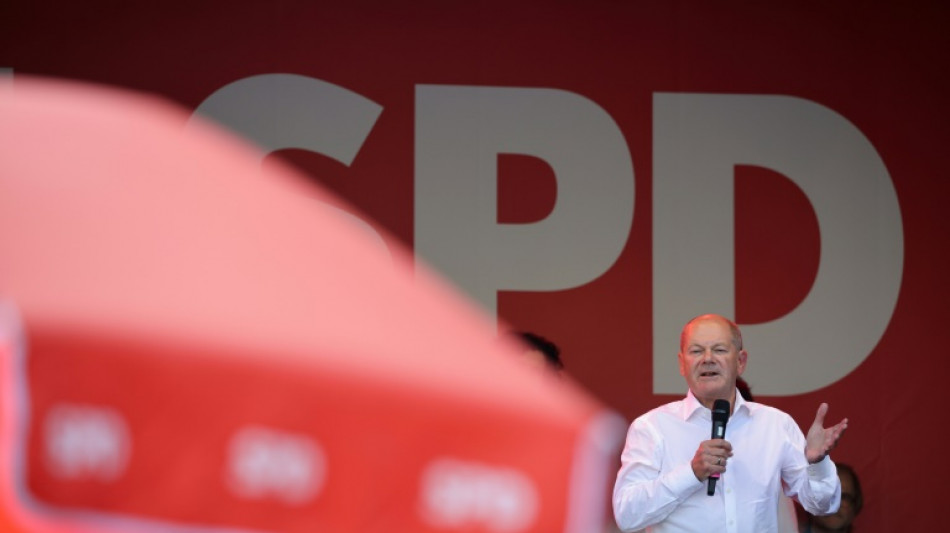
Far right poised for gains at key German regional polls / Photo: Jens Schlueter - AFP

 Southampton boss Eckert given suspended ban over 'Spygate'

 Russia warns of 'false' information as second plague case reported

 IEA ready to release more oil reserves if necessary
 HSBC 'consults' over UK unit job cuts amid AI adoption

 UK court quashes five ex-traders' Libor rate rigging convictions

 XM Receives “Global Customer Experience Leader Award 2026” at the TrustFinance Performance Awards

 Stocks slide as oil climbs on Mideast flareup

 Heavy casualties in Ukraine after Russian strikes

 French wine harvest set to hit historic low

 Kyiv 'cannot agree' to EU membership limiting food exports: minister

 Arteta targets more Arsenal glory after signing new deal until 2030

 Russell hit with Singapore grid penalty for taking new power unit

 Spotify expands audiobooks to more than 180 markets

 French-Japanese duo wins chemistry Nobel for solving molecular 'mystery'

 England's Nations League surge helps heal World Cup wounds

 Mayor of opposition stronghold Izmir defects to Erdogan party

 Mertens beats Gauff to set up Swiatek clash at China Open

 Benin full of pride at role in Messi's last dance

 France suspends stun grenade use at student protests ahead of PM speech

 Indonesian court hears 'negligence' complaint against state over fires, haze
 Rubio in Greece to urge against Western civilisation 'decline'
 Micron workers at Taiwan plant vote in favour of strike
 In 'The Social Reckoning,' Jeremy Allen White takes on Facebook's 'frightening' ambition

 Chip industry activists call for South Korea to recognise cancer cases
 Famine-scarred southern Madagascar braces for El Nino
Voters in two former East German states will go to the polls Sunday in what could be a bad night for Chancellor Olaf Scholz's government, with the far-right AfD expected to make big gains.
The elections in Thuringia and Saxony come just a week after three people were stabbed to death in the western city of Solingen, allegedly by a Syrian asylum seeker, in an attack that has shocked Germany and fuelled a bitter debate about immigration.
Opinion polls have the anti-immigration Alternative for Germany (AfD) as the biggest party in Thuringia on around 30 percent, while in Saxony it is running neck-and-neck for first place with the conservative CDU.
The AfD is unlikely to come to power in either state, even if it wins, as other parties have ruled out collaborating with it to form a majority.
But the result would still be a humiliating slapdown for Scholz's Social Democrats (SPD) and the other parties in his governing coalition, the Greens and the liberal FDP, as they look ahead to Germany's national election next year.
In both states, Scholz's SPD is polling at around six percent.
A third former East German state, Brandenburg, is also due to hold an election later in September, with the AfD also leading there on around 24 percent.
The picture in each state is slightly different but "in any case, it is clear that the AfD will unite a very strong number of votes behind it", Marianne Kneuer, a professor of politics at the Dresden University of Technology (TU Dresden), told AFP.
Besides causing a headache for Scholz's coalition, the election could also have international implications if it gives a boost to parties that oppose continued support for Ukraine.
- 'Dissatisfied protest voters' -
Created in 2013 as an anti-euro group before morphing into an anti-immigration party, the AfD has enjoyed a resurgence over the past 12 months as Germany struggles with a rise in migration and a stumbling economy.
The AfD has also capitalised on dissatisfaction with the three-way coalition government in Berlin that has been plagued by disagreements and stalemate, most recently a protracted dispute over the 2025 budget.
In June's EU Parliament elections, the party scored a record 15.9 percent overall and did especially well in eastern Germany, where it emerged as the biggest force.
The AfD has also notched up several local successes including its first city mayor, but a victory in Thuringia or Saxony on Sunday would be the first time it has won a state election.
The AfD is especially strong in the former communist East Germany partly "because it has a core of voters there who can identify with its nationalist and authoritarian positions", according to Kneuer.
But the party's popularity there can also be put down to "a large proportion of dissatisfied protest voters who turn to the AFD because they don't want to vote for any other party", she said.
Saxony is the most populous former East German state, with around four million inhabitants and several large cities including Leipzig, Dresden and Chemnitz.
Thuringia, which has a population of around two million and whose biggest city is Erfurt, is the only state to currently have a leader, Bodo Ramelow, from the far-left Die Linke party.
- 'The right party' -
After struggling economically for years after reunification, eastern Germany has recently seen higher growth than western Germany and wage increases have also been higher.
But "despite these positive economic developments, differences and injustices persist (between east and west)", according to Carsten Schneider, the government's commissioner for East German affairs.
Stefan Angelov, 35, a security guard from Jena, the second-largest city in Thuringia, said the AfD was "the right party" to vote for, "especially after the attack in Solingen".
"Open borders, anyone can come in... with who-knows-what in their hands," said Angelov, who is originally from Bulgaria but has been living in Jena for 10 years.
BSW, a new party formed by popular left-wing politician Sahra Wagenknecht after she defected from the Die Linke, is also polling well in all three states.
BSW has enjoyed a swell of support for its stance against weapons deliveries to Ukraine and won six percent in June's EU elections.
"It is possible that BSW could become an important factor in forming a coalition in Brandenburg, Thuringia and Saxony," Kneuer said.
E.Borba--PC