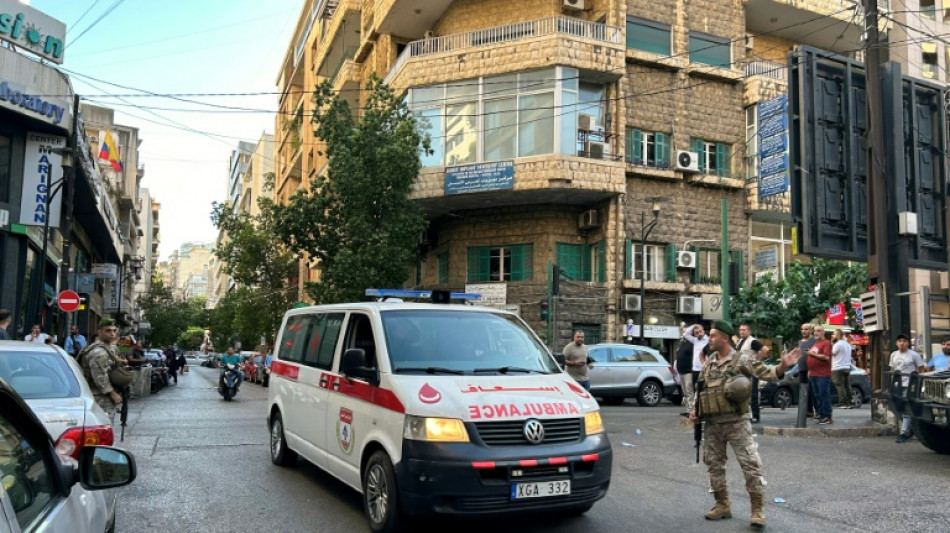
Israeli supply chain infiltration likely behind Hezbollah pager blasts: analysts / Photo: Anwar AMRO - AFP

 Turkey, Australia's joint COP31 leadership raises doubts

 For Turkish NGOs, COP31 offers rare space for action

 Sleep, appetite, gene-editing experts contend for Nobel chemistry prize

 Nobel Peace Prize haunted by the 'spectre' of Trump

 Africa launches own credit agency in bid for cheaper borrowing

 US, China, EU: three paths to regulating AI

 Australia's High Court rules against coal mine in landmark climate case

 Australia touts new funds for Pacific infrastructure at Fiji 'pre-COP'

 Eva Marie Saint, Oscar winner of Hollywood classics, dies at 102

 Australia probes app used in cheap smart glasses over privacy fears

 England needed to 'move on' from World Cup pain, says Tuchel

 O'Neill to stay at Celtic after period of "reflection"

 Kane marks 125th England cap with Wembley Nations League double

 Quebec's incoming separatist leader wants to block Crown from swearing-in

 Emmys gala will now stream its premier television awards

 Paramount completes Warner Bros takeover, creating Skydance

 Trump blames France unrest on Islam, migration

 Apple's Cook praises EU over efforts to protect children online

 Nobel winner Halzen says years of October 'misery' finally over

 Quebec separatist win rattles Carney's unity push

 'Itching' for change: Shiffrin cuts back slaloms this season

 'Gen Z has risen up': Tens of thousands mass for tense France school protests

 Caribbean tourism hotspot loses men to Russian war machine

 Danish reservists practice war games to respond to 'aggression'

 Bhuvneshwar returns to India's T20 squad for New Zealand tour

Israel has scored a major intelligence success by apparently infiltrating a supply chain to cause the simultaneous explosion of hundreds of Hezbollah pagers in a blow for the Lebanese militant group and its Iranian backers, analysts say.
At least nine people were killed and some 2,800 wounded, including the Iranian ambassador to Lebanon, when the pagers exploded in Hezbollah strongholds across the country in an unprecedented simultaneous attack.
With Hezbollah appearing to prefer the use of pagers for internal communications over smartphones for security reasons, analysts said it appeared Israel had corrupted the devices before delivery, allowing them to explode at a specific time.
A source close to Hezbollah, asking not to be identified, told AFP that "the pagers that exploded concern a shipment recently imported by Hezbollah of 1,000 devices", which appear to have been "sabotaged at source".
"For Israel to embed an explosive trigger within the new batch of pagers, they would have likely needed access to the supply chain of these devices," said Brussels-based military and security analyst Elijah Magnier.
"Israeli intelligence has infiltrated the production process, adding an explosive component and remote triggering mechanism into the pagers without raising suspicion," he said, raising the prospect the third party which sold the devices could have been an "intelligence front" set up by Israel for the purpose.
Charles Lister of the Middle East Institute said: "This was more than lithium batteries being forced into override. A small plastic explosive was almost certainly concealed alongside the battery, for remote detonation via a call or page."
"Mossad infiltrated the supply chain," he concluded, referring to Israel's intelligence agency.
- 'Their big comeback' -
The Wall Street Journal cited people familiar with the matter as saying the affected pagers were from a new shipment that the group received in recent days.
Hezbollah has already blamed Israel for the explosions. Israel, which traditionally does not comment on security operations outside the country, has yet to confirm or deny its involvement.
It remains unclear whether the action could tip the region into a regional war between Israel and Hezbollah that the West has been battling to avoid ever since Hamas's October 7 attacks on Israel sparked war in Gaza.
But the images captured on camera of pagers exploding are a major security blow for Hezbollah and an illustration of Israel's reach even into its members' pockets.
The action comes after senior Hezbollah commander Fuad Shukr was killed in a targeted Israeli air strike on July 30 that indicated Israel had precise information about his whereabouts.
Just a day later, the political leader of Hamas, Ismael Haniyeh was killed in a residence in Tehran, reportedly using an explosive device that had been placed by Israeli operatives weeks before.
French defence expert Pierre Servent said the latest action against Hezbollah would help Israeli intelligence services restore their reputation, which was badly dented by the October 7 attack.
"The series of operations conducted over the past few months marks their big comeback, with a desire for deterrence and a message: 'we messed up but we're not dead,'" he told AFP.
The Hamas attack that sparked the war resulted in the deaths of 1,205 people, mostly civilians, according to an AFP tally based on Israeli official figures.
Palestinian militants also seized 251 hostages, 97 of whom are still held in Gaza, including 33 the Israeli military says are dead.
Israel's retaliatory military offensive has killed at least 41,226 people in Gaza, according to the Hamas-run territory's health ministry.
- 'Classic sabotage' -
Former CIA analyst Mike Dimino of the US-based Defense Priorities think tank said that judging by images of the injuries a "very small explosive" implanted inside the devices was the most likely cause, rather than an overheating battery.
"This was a classic sabotage operation," he said on X, adding such an operation takes "months if not years" to orchestrate.
Dubai-based analyst Riad Kahwaji said that Israel had taken advantage of Hezbollah's move away from smartphones to pagers.
Israel intelligence had conducted a "most professional operation", he said.
"Without a doubt, one of the factories it (Israel) owns manufactured and shipped these explosive devices that exploded today," he said.
P.L.Madureira--PC