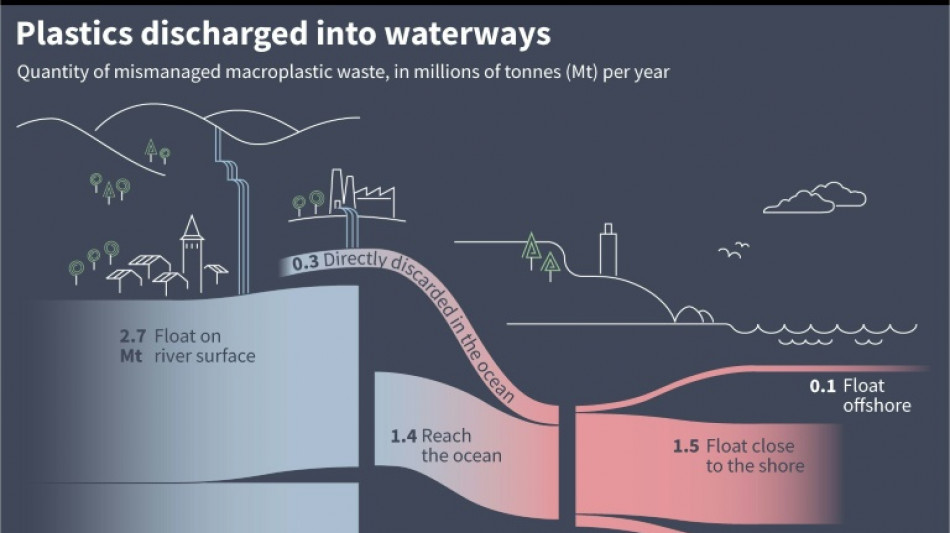
So where does the oceans' plastic waste come from?
/ Photo: Valentin RAKOVSKY, Valentina BRESCHI - AFP

 N. Korea's Kim pledges 'invariable support' in Putin birthday letter
 OGRD Alliance Advances PLPC Multi-Asset Platform Following APHELAR Milestone, Expanding Licensing and Strategic Capital Frameworks

 Emotion, tears as Messi prepares for Argentina farewell

 Kane eyes Ronaldo record after matching England cap mark

 Spain fight back to beat Croatia, Kane adds to record for England

 Merino double helps Spain beat Croatia, reach Nations League quarters

 US stocks hit fresh records as oil stabilizes on rising supplies

 As Messi bows out, Argentines say 'thank you'

 Ronaldo opens door for Portugal return, apologises for walkout
 'Nobody seems to care': Russian city shrugs off plague reports

 Hundreds arrested in French school protests as Macron summons ministers
 WADA seeks tough anti-doping stance from Kenya
 German ex-spy chief arrested for suspected espionage, treason

 Furyk vows US will 'do more' to end Ryder Cup losing streak

 Iyer hits ton as India hammer West Indies in T20 opener

 Mandhana named India women's team captain after Kaur quits

 'The sound keeps coming back': children maimed in Ethiopia's Tigray clashes

 Paris Women's Fashion Week: the key trends

 i-payout Introduces a New Approach to Payments, Closing the Beneficiary Information Gap

 New Generation of Crypto Miners Released by ASICID

 New investor forecasts LIV Golf teams could be worth $100 mn each

 Shakira, Pique return to court over children visit arrangements

 Nobel physics prize hails 'ghostly messengers' from space

 France's Mistral unveils latest model in sovereign AI push

 Stocks climb as oil prices retreat

In the form of bottles, tyres, packaging and piping, millions of tonnes of plastic waste are dumped every year in the world's waterways, often ending up in the oceans.
And their amount could almost double by 2060, unless strong measures are taken against the pollution, the Organisation for Economic Cooperation and Development (OECD) warns.
Due to mass production of the material from the 1950s to 2019, 140 million tonnes have already accumulated in the rivers, lakes and oceans, the OECD said in a 2023 report.
Some 22 percent of this forms a "plastic soup" in the oceans and 78 percent is found in freshwater ecosystems.
- Poor waste management -
Plastic burned in open pits or tossed in uncontrolled or unauthorised dumpsites is the main source of pollution of the aquatic environment.
Most of this plastic waste ends up in freshwaters, with a large part, including bottles and plastic used in the construction sector, sinking in waterways and lakes.
The rest, including food packaging and closed bottles, floats for "years, even decades", before ending up in the oceans, the OECD says.
Waste from shipping activity, including nets and fishing gear, is to a much lesser extent another source of plastic waste in the oceans, as well as so-called microplastics, pieces of plastic which measure less than five millimetres.
So called macroplastic, which is bigger than five millimetres, has an average life cycle of six months to 35 years and slowly decomposes to become microplastic, which is "more likely to be ingested by aquatic species", the OECD says.
- Asia's rivers -
The risk of plastic moving from land to the waterways, and then into the sea, differs from location to location.
Out of some 100,000 waterways, only 1,000 are responsible for four-fifths of the macroplastic waste in the oceans, according to a 2021 study by researchers for NGO Ocean Cleanup published in the Science Advances journal.
The remaining fifth comes from 30,000 other rivers.
Out of the 50 main rivers carrying plastic to the oceans, including small urban waterways, 44 are in Asia, "due to population density and bad waste management", Laurent Lebreton, Ocean Cleanup's director of research, told AFP.
The Philippines, which has thousands of islands, dumps the most plastic into the sea. Its Pasig River, which flows into Manila Bay, is "the most (plastic) polluted" in the world.
With the Philippines' Tullahan and Meycauayan Rivers, India's Ulhas River and Malaysia's Klang River, it is one of the top five carrying plastic into the oceans.
- Gloomy forecast -
Driven by rising population and economic growth, the global use of plastics should almost triple between 2019 and 2060, to 1,231 million tonnes (Mt) per year, according to the OECD.
That is a gloomy outlook for the aquatic environment where 493 Mt of plastic could pile up by 2060, of which more than half from sub-Saharan Africa, China, India, and other developing Asian countries, it says.
In Europe and the United States, on the contrary, plastic industrial waste in the aquatic environment should decrease, due to improved waste management, the OECD forecasts.
Ferreira--PC