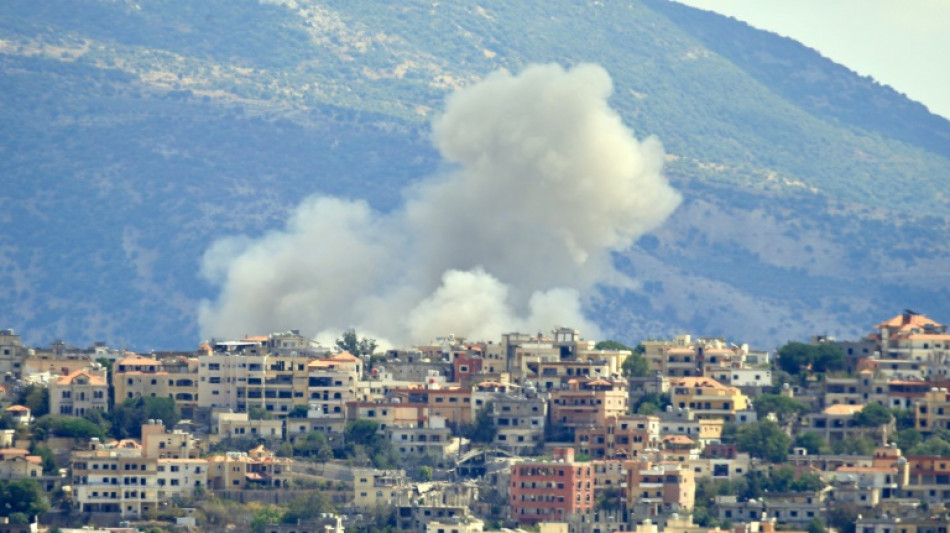
Why is Israel focusing on border with Lebanon? / Photo: - - AFP

 N. Korea's Kim pledges 'invariable support' in Putin birthday letter

 OGRD Alliance Advances PLPC Multi-Asset Platform Following APHELAR Milestone, Expanding Licensing and Strategic Capital Frameworks

 Emotion, tears as Messi prepares for Argentina farewell

 Kane eyes Ronaldo record after matching England cap mark

 Spain fight back to beat Croatia, Kane adds to record for England

 Merino double helps Spain beat Croatia, reach Nations League quarters

 US stocks hit fresh records as oil stabilizes on rising supplies

 As Messi bows out, Argentines say 'thank you'

 Ronaldo opens door for Portugal return, apologises for walkout

 'Nobody seems to care': Russian city shrugs off plague reports

 Hundreds arrested in French school protests as Macron summons ministers

 WADA seeks tough anti-doping stance from Kenya

 German ex-spy chief arrested for suspected espionage, treason
 Furyk vows US will 'do more' to end Ryder Cup losing streak

 Iyer hits ton as India hammer West Indies in T20 opener

 Mandhana named India women's team captain after Kaur quits
 'The sound keeps coming back': children maimed in Ethiopia's Tigray clashes
 Paris Women's Fashion Week: the key trends

 i-payout Introduces a New Approach to Payments, Closing the Beneficiary Information Gap

 New Generation of Crypto Miners Released by ASICID

 New investor forecasts LIV Golf teams could be worth $100 mn each

 Shakira, Pique return to court over children visit arrangements

 Nobel physics prize hails 'ghostly messengers' from space

 France's Mistral unveils latest model in sovereign AI push
 Stocks climb as oil prices retreat

A series of deadly explosions targeting Hezbollah members this week in Lebanon came only days after Israel announced plans to expand its war in Gaza to its northern border with Lebanon.
Hezbollah and its main backer Iran have blamed Israel for the blasts, but Israeli officials have neither confirmed nor denied responsibility.
The explosions have raised the likelihood of full-scale war with Hezbollah, and experts interviewed by AFP offered insights on how that might unfold.
- Why now? -
Since the Gaza war began almost a year ago, Israel and Hamas ally Hezbollah have engaged in near-daily cross-border clashes.
Hundreds have been killed in Lebanon, mostly Hezbollah militants, and dozens have died in Israel, with tens of thousands displaced on both sides.
Prime Minister Benjamin Netanyahu and other Israeli officials have stressed the need to secure the north so uprooted residents can return home.
"We will use all means necessary to restore security to our northern border and to safely return our citizens to their homes," Netanyahu said during a recent trip to the north.
But a return to peace in the north remains unlikely in the short term, said Calev Ben-Dor, a former Israeli foreign ministry analyst.
Ben-Dor said both Israel and the United States had hoped a Gaza ceasefire would lead to calm in the north, but the chances of such a ceasefire were fading.
"The chances for a ceasefire in Gaza are receding" just as "most of Israel's military goals in Gaza have been achieved", leaving Israel room to reassign units, he said.
Kobi Michael, an analyst for the Institute for National Security Studies and Misgav think-tanks, said the army had more flexibility to shift its forces to the northern front.
"(The army) can run the situation with less forces, and therefore we can move the focus and the concentration to the north," he told AFP.
"The idea that Israel cannot realise its sovereignty over the northern parts of the country is something that cannot be tolerated".
- What are Israel's goals? -
There have been calls from within the Israeli government to push Hezbollah out of southern Lebanon, beyond the Litani river, but Israel's current strategy remains unclear.
The United States, through its envoy Amos Hochstein, favours a diplomatic solution that keeps Hezbollah and its vast arsenal of rockets away from the border.
Ben-Dor said neither the United States, France nor Lebanon's government held enough sway over Hezbollah to push it back from the border, as called for in a UN resolution that urges its withdrawal from south of the Litani river.
For Michael, the Israeli military objectives would be to clear Hezbollah militants from the area between the Litani and the border, and to prevent their return.
He compared the situation to Israel's 18-year occupation of southern Lebanon until 2000, saying he expected a different form of "military control over south Lebanon" this time.
Without a diplomatic solution, he predicted a ground invasion.
- How much support for war? -
Hezbollah's removal from the border was widely supported by the Israeli public, said Ben-Dor.
But he acknowledged the Netanyahu government "suffers from a deficit of trust which may make it harder to undertake a major military operation".
Michael, for his part, said: "The Israeli constituency fully supports an all-out war against Hezbollah".
A survey by INSS, conducted in August, showed 44 percent of Israelis supported a wide-scale military operation in Lebanon, rising to 52 percent for Jewish Israelis.
Meanwhile, 23 percent preferred "limited military action", and 21 percent a "limited" response to avoid an escalation, the survey published on Tuesday found.
E.Raimundo--PC