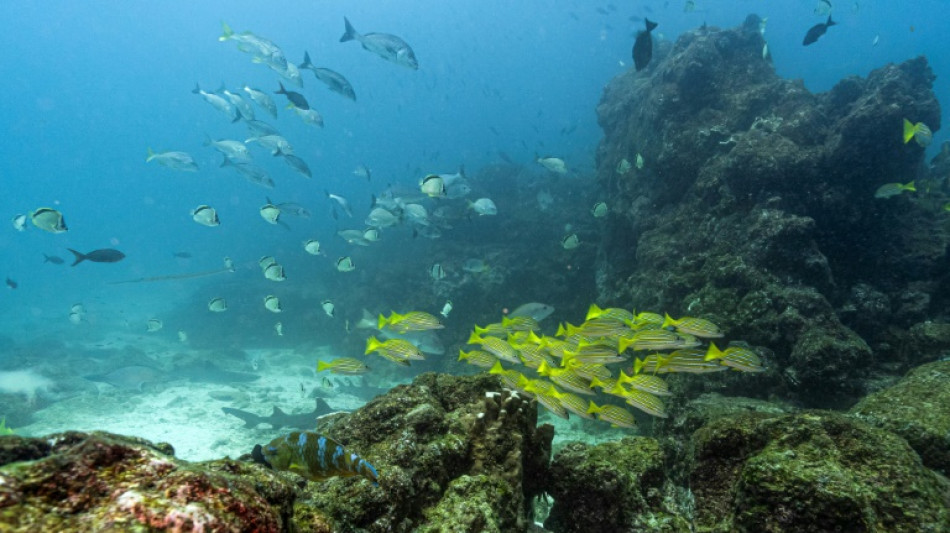
World's oceans near critical acidification level: report / Photo: Ernesto BENAVIDES - AFP

 Australia probes app used in cheap smart glasses over privacy fears

 England needed to 'move on' from World Cup pain, says Tuchel

 O'Neill to stay at Celtic after period of "reflection"

 Kane marks 125th England cap with Wembley Nations League double

 Quebec's incoming separatist leader wants to block Crown from swearing-in

 Emmys gala will now stream its premier television awards

 Paramount completes Warner Bros takeover, creating Skydance

 Trump blames France unrest on Islam, migration

 Apple's Cook praises EU over efforts to protect children online

 Nobel winner Halzen says years of October 'misery' finally over

 Quebec separatist win rattles Carney's unity push

 'Itching' for change: Shiffrin cuts back slaloms this season

 'Gen Z has risen up': Tens of thousands mass for tense France school protests

 Caribbean tourism hotspot loses men to Russian war machine

 Danish reservists practice war games to respond to 'aggression'

 Bhuvneshwar returns to India's T20 squad for New Zealand tour

 Asos says probing 'unauthorised activity' after phone alerts

 Stocks climb as oil prices retreat under $100 per barrel

 Neutrinos: space particles that change our view of universe

 'Destined' Djokovic wins China Open, extending unbeaten record
 Iceland is 'critical outpost' for security, says Rubio during visit

 Israeli settlers beat AFP photographer covering West Bank

 'Gen Z has risen up': Tens of thousands demand better education in France

 $10 Million and Counting: Hola Prime Hits Major Trader Payout Milestone

 UEFA investigate Ireland-Israel tunnel bustup after spitting claim

The world's oceans are close to becoming too acidic to properly sustain marine life or help stabilise the climate, a new report said on Monday.
The report by the Potsdam Institute for Climate Impact Research (PIK) details nine factors that are crucial for regulating the planet's ability to sustain life.
In six of these areas, the safe limit has already been exceeded in recent years as a result of human activity.
The crucial threshold for ocean acidification could soon become the seventh to be breached, according to the PIK's first Planetary Health Check.
The safe boundaries that have already been crossed concern crucial -- and related -- factors including climate change; the loss of natural species, natural habitat and freshwater; and a rise in pollutants, including plastics and chemical fertilisers used in agriculture.
The sustainable level of ocean acidification is now also set to be exceeded, largely as a result of ever-increasing emissions of carbon dioxide (CO2) created by burning fossil fuels like oil, coal and gas.
"As CO2 emissions increase, more of it dissolves in sea water... making the oceans more acidic," Boris Sakschewski, one of the lead authors, told reporters.
"Even with rapid emission cuts, some level of continued acidification may be unavoidable due to the CO2 already emitted and the time it takes for the ocean system to respond," he explained.
"Therefore, breaching the ocean acidification boundary appears inevitable within the coming years."
- Tipping points -
Acidic water damages corals, shellfish and the phytoplankton that feeds a host of marine species.
This means it also disrupts food supplies for billions of people, as well as limiting the oceans' capacity to absorb more CO2 and thus help limit global warming.
The only one of the nine planetary boundaries that is not close to being crossed concerns the state of the planet's protective ozone layer.
Man-made chemicals have damaged this shield, causing acid rain, but it has started recovering since a number of these chemicals were banned in 1987.
A ninth threshold -- concerning concentrations of minute particles in the atmosphere that can cause heart and lung diseases -– is close to the danger limit.
But the researchers said the risk showed signs of receding slightly due to efforts by several countries to improve air quality, such as banning the most pollutant petrol and diesel cars.
They warned, however, that concentrations of fine particles could still soar in countries that are rapidly industrialising.
The PIK set these nine planetary danger levels to warn humans against tipping Earth's natural systems past points of no return.
"These tipping points... if crossed, would lead to irreversible and catastrophic outcomes for billions of people and many future generations on Earth," they said.
All nine planetary boundaries are "interconnected" so breaching one crucial limit can destabilise Earth's entire life system, Sakschewski said.
But that also presents an opportunity because addressing one problem -– such as preventing the Earth's average temperature rising more than 1.5 degrees Celsius above pre-industrial levels -- "can lead to significant benefits across different issues", the report said.
V.F.Barreira--PC