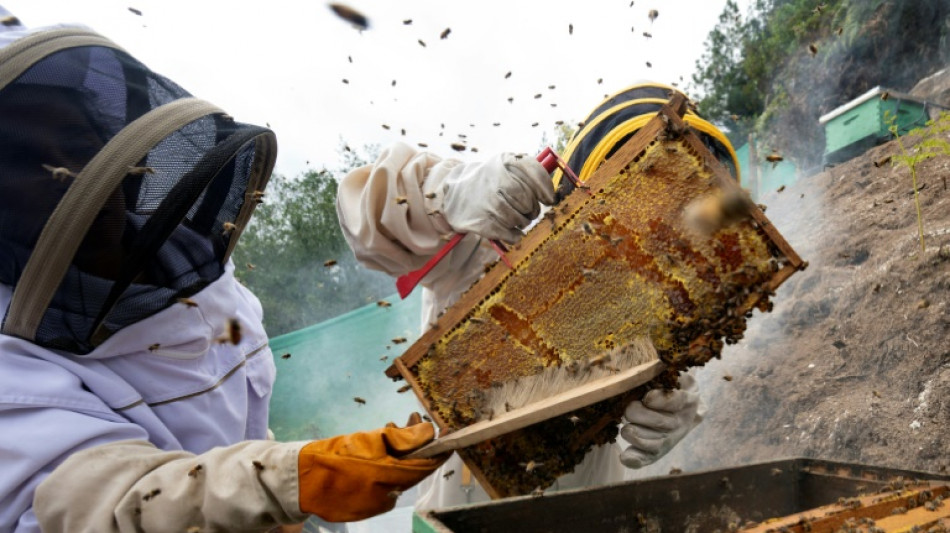
How climate funds helped Peru's women beekeepers stay afloat / Photo: Cris BOURONCLE - AFP

 FIFA chief Infantino hit by Norwegian double complaint

 Exiled Catalan separatist leader Puigdemont cleared to return to Spain

 Stock markets climb as oil prices retreat

 'No future': Thousands mass in France for high school protests

 Nobel physics prize honours work on 'ghostly messengers' from outer space

 Bulgaria searches for missing crew after drones hit two more ships in Black Sea

 Le Pen vows drastic cost savings to prevent French 'default'

 'Eats through a straw': French teens wounded in high school protests

 Thousands mass in France for high school protests

 Moscow denies sanitary measures over plague reports

 Samoa look to recreate 2022 final run at Rugby League World Cup

 Asian stocks mostly up after tech-led Wall St record

 German factory orders plunge as recovery still fragile

 Coco Gauff calls out online racism following China open video review

 KVB Accelerates Middle East Footprint with Strategic MENA Regional Expansion

 Purple reign: Philippines seeks to keep grip on ube throne

 Seoul weighs steps to force North Korea landmine apology

 Yemen's Houthis say struck Riyadh airport, other Saudi sites

 Changer+ Launches Stablecoin-First Self-Custodial Wallet to Make Stablecoins Easier to Use

 White Sox down Guardians, Yankees on brink after Rays loss

 COP31 eyes modest steps as climate disasters multiply

 American Nobel laureate in medicine hopes to illuminate the brain

 Trump approves firing squad for convicted US military base shooter

 Grappling with 'homework scams,' US universities shun AI detectors
 Separatists win Quebec election in test for Canada PM

In the mountains of northeast Peru, a group of women beekeepers have plucked millions of bees from the jaws of death and saved their own livelihoods with the help of UN climate funding.
The women not only rescued their hives from extreme weather events linked to climate change, but built a thriving honey business.
Chilal de la Merced, a village of some 800 souls perched at over 2,600 meters (8,500 feet) in the Andes, in Peru's Cajamarca region, has been battered in recent years by recurring heavy rains, droughts, frosts and hail storms linked to a changing climate and warming oceans.
The weather has played havoc with the bees' ability to forage for nectar and pollen.
In early 2022, the rains were so heavy that they didn't venture out of the hive at all, and began to starve.
"When we checked the hives, we found the boxes full of dead bees," Karina Villalobos, the 28-year-old spokeswoman for the Hojuelas de Miel (Honey Flakes) beekeepers association, recalled.
A year earlier, she and 14 other beekeepers applied for a grant from Avanzar Rural, a program founded by the Peruvian government and the United Nations International Fund for Agricultural Development (IFAD) to help small-scale food producers in rural areas vulnerable to climate change.
It almost didn’t work -- climate change doesn’t wait for grant money, and even when funds arrive, projects take time to implement.
Months after they secured $27,000 in climate funding -- a topic that will be at the center of discussions at the COP29 climate conference in Baku next month -- they were staring ruin in the face.
"We asked ourselves, what are we going to do? If we don't take action, the bees will disappear, the project will collapse and our organization will fail," Villalobos said.
- Syrup and lilies -
Around the world, bee populations are seen as a bellwether of healthy ecosystems but experts warn they are increasingly vulnerable to climate change as well as pesticide use and habitat loss.
Hojuelas de Miel decided to try to adapt to the changing weather cycles, which were disrupting flowering seasons -- hampering the ability of the bees to collect nectar and pollen.
To compensate for the bees' depleted food resources, the women fed them with a syrupy mix of sugar and vitamins.
But they also planned for the future.
Using the grant, they surrounded the hives in native plants and flowers, including arum lilies and coffee plants, that are more resistant to drought and rain.
When the plants grew, they transplanted them into the forest to expand the bees' habitat.
- Uplifting rural communities -
Less than 2 percent of all international climate finance goes to rural communities, small-scale farmers and Indigenous populations, Juan Diego Ruiz, IFAD's chief for the Andean region and the Southern Cone, told AFP.
In Peru, women particularly struggle to secure funding for their businesses.
"Because the owner of the land is the man, so how can we get a loan?" Villalobos explained.
Yet, women like her are "on the frontline of the impact of climate change," Ruiz argued.
Avanzar Rural has funded 1,031 small businesses in Peru in the last four years, to the benefit of 17,557 people.
IFAD contributed $24 million dollars, with the Peruvian state, which identifies projects in remote areas to support, adding another $45 million.
Chilal de la Merced's beekeepers had to come up with 10 percent of the cost of their business plan -- $3,800 -- before receiving a first tranche of aid, which they used to buy equipment and hire technical, financial and environmental advisors.
The association currently operates 89 beehives and makes about $13,000 a year.
"Today we are empowered and resilient women," Villalobos said proudly.
Ferreira--PC