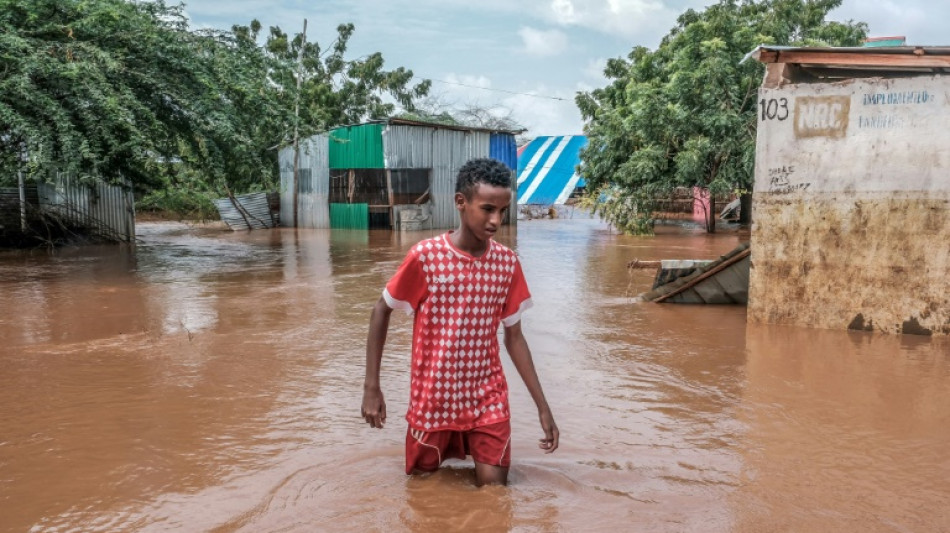
Paying out disaster relief before climate catastrophe strikes / Photo: Hassan Ali Elmi - AFP

 FIFA chief Infantino hit by Norwegian double complaint

 Exiled Catalan separatist leader Puigdemont cleared to return to Spain
 Stock markets climb as oil prices retreat

 'No future': Thousands mass in France for high school protests
 Nobel physics prize honours work on 'ghostly messengers' from outer space

 Bulgaria searches for missing crew after drones hit two more ships in Black Sea
 Le Pen vows drastic cost savings to prevent French 'default'

 'Eats through a straw': French teens wounded in high school protests
 Thousands mass in France for high school protests

 Moscow denies sanitary measures over plague reports
 Samoa look to recreate 2022 final run at Rugby League World Cup

 Asian stocks mostly up after tech-led Wall St record

 German factory orders plunge as recovery still fragile
 Coco Gauff calls out online racism following China open video review

 KVB Accelerates Middle East Footprint with Strategic MENA Regional Expansion
 Purple reign: Philippines seeks to keep grip on ube throne

 Seoul weighs steps to force North Korea landmine apology

 Yemen's Houthis say struck Riyadh airport, other Saudi sites

 Changer+ Launches Stablecoin-First Self-Custodial Wallet to Make Stablecoins Easier to Use

 White Sox down Guardians, Yankees on brink after Rays loss

 COP31 eyes modest steps as climate disasters multiply

 American Nobel laureate in medicine hopes to illuminate the brain
 Trump approves firing squad for convicted US military base shooter
 Grappling with 'homework scams,' US universities shun AI detectors
 Separatists win Quebec election in test for Canada PM

Beyond the complex byways of international finance, a simple solution is gaining ground to protect populations caught in the path of destructive extreme weather: transfer a little money via their mobile phones before disaster strikes.
Faced with a flood, superstorm or mega-fire, "the earlier you get the money, the better", Ranil Dissanayake, a researcher at the Center for Global Development, told AFP. "Recipients can use the cash to prepare dwellings, stockpile food, or temporarily move to areas expected to be unaffected."
"Imagine what a difference that can make for manual labourers," he added. "If you can get cash to them ahead of a 50 degree Celsius (122 degree Fahrenheit) heatwave in northern India, for example, they don't have to work through that" to put food on the table.
- Timing is critical -
Cash-in-advance assistance is part of the toolkit in other disaster-relief scenarios but should now be extended to extreme weather events made worse by global warming, according to experts such as French economist Esther Duflo.
The UN has run a dozen pilot schemes, including in drought-stricken Ethiopia and Somalia. And in Bangladesh, more than 23,000 households received $53 one week before the peak of catastrophic flooding in 2020.
"Providing cash earlier definitely has higher welfare benefits and gives support to households at a critical point in time," noted Ashley Pople, a researcher at Oxford University's Centre for the Study of African Economies.
According to a study led by Pople of the flood response in Bangladesh, beneficiaries were able to stock up on provisions, shelter their animals and protect possessions critical to their livelihood.
By comparison, households without access to cash injections saw the risk of going a day without food increase by more than half.
When disaster strikes, "multilateral development banks think about how to get cash to governments quickly, but not a lot of thought has gone into how we get money out quickly to households and the people most affected", said Pople.
- $100 to avoid the worst -
Since 2020, the American GiveDirectly programme has intervened in Bangladesh, the Democratic Republic of Congo and Malawi, transferring money by mobile phones to populations facing crises and displacement, primarily due to conflict.
In Nigeria, where renewed flooding is expected in the coming weeks, 20,000 households have been pre-registered for assistance. Those most at risk will receive $320 at least three days before flooding peaks.
To identify potential recipients GiveDirectly -- in partnership with Google -- uses satellite images, artificial intelligence, flood maps, administrative data and field surveys.
In Mozambique, more than 7,500 families received $225 three days before a flood in 2022. In Bangladesh, 15,000 people received $100 in 2024 before the Jamuna River caused major flooding.
This type of action is not without its limitations and challenges, experts caution.
"You need fairly accurate forecasts at quite a granular level, ideally at a village or community level," said Pople.
- More investment needed -
Certain types of bad weather are more difficult to forecast, notably tropical storms that can unpredictably change direction.
"We can predict some disasters accurately in time, but for others more investment is needed in weather stations and infrastructure, especially in poor countries," Dissanayake said.
The effectiveness of micropayments in anticipation of extreme weather impacts also "needs to be recognised as part of our toolkit for responding to climate change, and to be financed accordingly", he added.
But giving cash to individuals does not remove the need for public investment in things like better roads and transport networks, collective flood barriers, and other things households cannot deliver on their own.
"Anticipatory cash can be a big part of the solution but will rarely be all of it," Dissanayake said.
L.Carrico--PC