War piles pressure on roads, services in crisis-hit Beirut / Photo: IBRAHIM AMRO - AFP

 EU vows AI rules will protect Europeans. Will they?

 Myanmar leader to visit Malaysia after migrant returns begin
 Germany's AfD poised to preside over state assembly for first time
 Australia's opposition vows 'largest cut to immigration' in country's history
 Ready, set, snooze: Sleep-deprived Japanese compete for best-rested

 Falcons thump Saints 45-24 as New Orleans marks Katrina anniversary

 Tuvalu govt adviser says Australia overstepped in pre-COP visit

 Asian stocks mixed despite tech-led Wall St record
 Tens of thousands expected in Paris for high school protests
 AI borrowing binge rattles US markets

 Young Canadians sue government over alleged climate failures

 White Sox down Guardians to take 2-0 series lead

 NHL record-breaker Ovechkin says current season will be his last
 France roar back in Nations League as Italy beat Turkey

 Messi readies for final farewell in Argentina send-off
 Esposito seals Italy win over Turkey in Nations League

 Russia downplays plague reports as Trump offers US help

 Trump says US moved bombers from UK base after 'threats'
 Brazilian stocks surge to record after Bolsonaro election lead
 Leaders to visit Pacific atoll at frontline of climate change

 ICC gives more details about arrest warrants for Taliban ministers
 Nigeria's Tinubu confirms 32 dead after military plane crash

 'Reckless' AI firms can't control models, says whistleblower

 Switching on brain cells: the Nobel-winning science of optogenetics
 Quebec votes as separatist surge poses test for Canada PM

The potholed streets of the Lebanese capital, sometimes plunged into darkness at night due to regular state power outages, were already busy before the displacement crisis sparked by the Israel-Hezbollah war.
Now, with tens of thousands of people having fled to Beirut in their cars and on their motorbikes due to Israeli bombardment, parts of the city and its roads have become overwhelmed.
"Before there were traffic problems" but now "Beirut has become a parking lot," said Jamal Adada, who has worked as a taxi driver for 25 years.
The streets have swelled with vehicles since families desperately fled the war that erupted in late September, with Israel bombing Hezbollah's once densely populated south Beirut bastion, as well as towns and villages across eastern and southern Lebanon.
"This road is supposed to have two lanes... but there's just one" now, Adada said, pointing to the line of cars parked down one side of Hamra street in Beirut's main commercial district.
Fadi Baghdadi, a member of the city's disaster management unit, said its already-ailing infrastructure is now "in a deplorable state" due to the crisis.
He said more than 55,000 people forced to flee their homes were staying in 169 shelters dotted around Beirut, adding that all the centres were now full.
Another estimated 200,000 people have found shelter in apartments and houses, he added.
Many have been taken in by friends and families, and other are paying rent in temporary apartments using their savings. Some have taken shelter in uninhabited buildings and flats.
- Overflowing dumpsters -
All these people "need water, (extra) rubbish is being dumped, the sewage is increasing", Baghdadi said, adding that the traffic was so bad that emergency vehicles were sometimes struggling to reach their destinations.
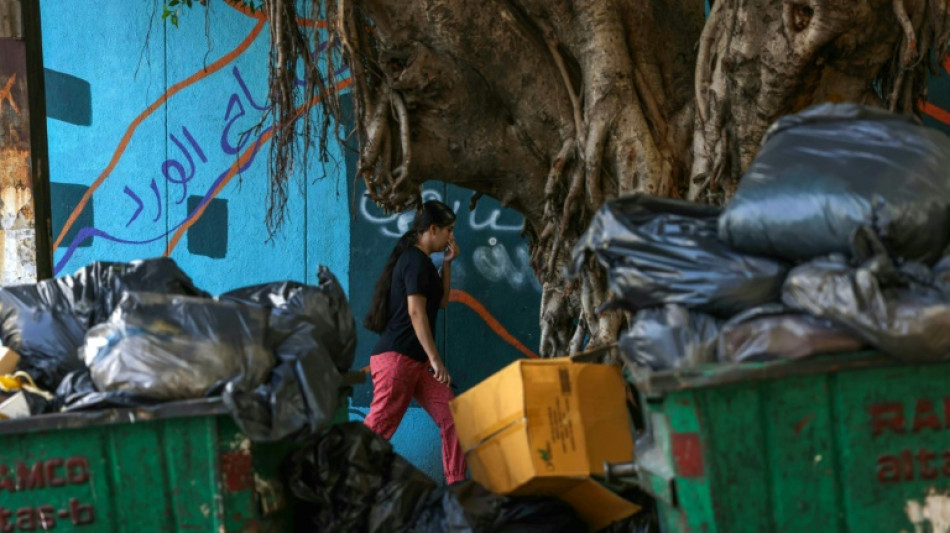
Trash has piled up around overflowing dumpsters, a worrying sight in a country that has been hit by past garbage crises and a five-year economic collapse that has left many living in poverty.
"The problem is not simply the increase in (the amount of) rubbish," said Walid Bou Saad, general manager of local waste management company RAMCO.
The sheer number of vehicles lining the roads has made work harder for rubbish collectors, he told AFP, with trucks unable to access narrower streets.
"Most people don't move their vehicles," he said, adding that rubbish that piles up in the meantime must be collected by hand, which "takes much more time".
AFP journalists saw rubbish collectors trying to clear large mounds of trash near overflowing dumpsters, with trucks sometimes struggling to manoeuvre around vehicles.
The crisis has also had an impact on water distribution, with the number of water trucks on the streets also increasing in recent weeks.
Beirut's public water network has long been patchy and most people rely on bottled water for drinking. Many use water trucked in for bathing, washing and cleaning.
The UN children's agency UNICEF told AFP last week it had provided 172,500 litres of bottled water and 2.2 million litres of trucked water to support displaced people in shelters nationwide.
- 'Extreme stress' -
Fouad El-Semelawy, whose company delivers water across Beirut, says demand for his services have spiked.
Before, "I was being asked for 20 deliveries", now it's more than 30 a day, said Semelawy, an Egyptian living in Lebanon for more than three decades.
Most of the deliveries are to schools-turned-shelters and other places hosting large numbers of displaced people, he said.
Nadim Farajalla, chief sustainability officer at the Lebanese American University, said Beirut's water network is "under extreme stress".
"Demand for water is extremely high," but "groundwater tables are very low" due to the lack of rain over the summer, he said.
The displaced themselves are on the frontlines of the crisis, with some finding shelter in long-abandoned buildings.
Such buildings are not always connected to the water grid, and their old wastewater pipes may run into storm-water drains instead of the sewage network, Farajalla said.
UNICEF said the majority of Beirut's wastewater network was "implemented decades ago", making it "susceptible to cracks and breaks due to the heavy shelling on the city".
More broadly, the large numbers of people now living in Beirut also means there is an increased chance of blockages and overflows, which could pose "a substantial public health risk", the agency said.
T.Batista--PC