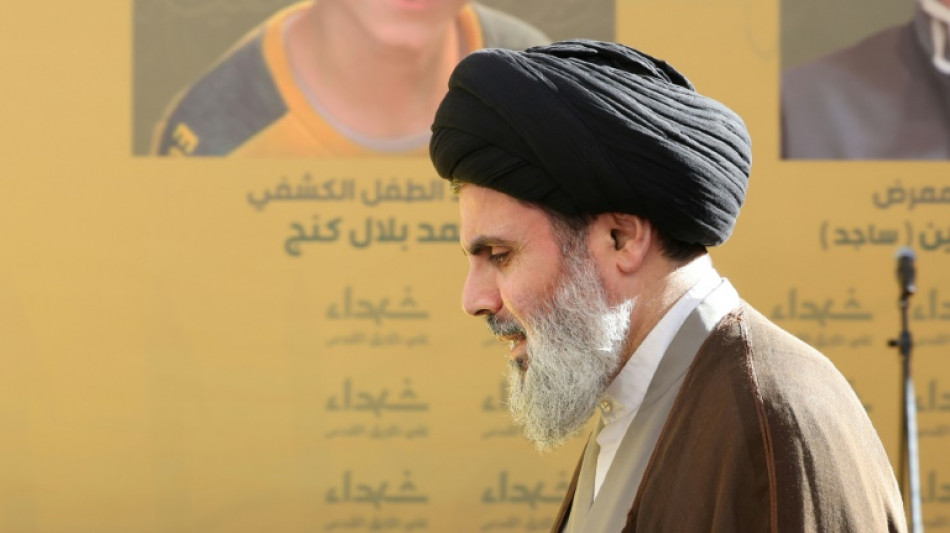
Safieddine, the apparent Hezbollah heir who was killed by Israel / Photo: ANWAR AMRO - AFP

 American Nobel laureate in medicine hopes to illuminate the brain
 Trump approves firing squad for convicted US military base shooter

 Grappling with 'homework scams,' US universities shun AI detectors
 Separatists win Quebec election in test for Canada PM
 Leaders visit Pacific atoll at frontline of climate change
 Yemen's Houthis claim striking Riyadh airport, other Saudi sites

 Best-selling British author Jeffrey Archer dies aged 86

 Military plane crash kills 32 in Nigeria

 Olise powers France to win over Belgium in Nations League
 High-flying Blazy turns to birdlife at Chanel
 Riyadh's allies pledge troops as Yemen, Saudi Arabia attack Houthis

 Clashes erupt outside Kosovo parliament over war crimes court

 Milan's Saelemaekers suffers ankle setback, faces lengthy spell out
 Rubio arrives in Iceland to push for greater US presence in Arctic
 Putin allows Italy's UniCredit to sell part of Russian business
 Djokovic into China Open final as Medvedev out for hitting fan with ball

 ICC unseals arrest warrants for Taliban education ministers
 Modric hopes fans back Croatia against Spain after England shame

 Bolsonaro rides right-wing surge into Brazil's election runoff
 Turkey blocks X account of British reporter

 Ukraine says using AI robot guns to shoot down new Russian drones
 At Oct 7 memorial, Netanyahu says will be no Hamas rule in Gaza
 Ukraine blames Russia for deadly sinking of Turkish ship in Black Sea
 UN rights council slams Taliban's 'oppression' of women
 Norway eyes partial ban of smart glasses
Hashem Safieddine, whose death in an Israeli strike was announced Tuesday, was widely considered the potential successor to the group's assassinated leader Hassan Nasrallah.
Israel said he was killed along with other Hezbollah leaders in an airstrike in southern Beirut three weeks ago. Hezbollah has yet to communicate about the claim.
Contact with Safieddine had been lost after Israeli attacks targeted him on October 4, Hezbollah officials said at the time.
The deeply religious Safieddine, a cleric with family ties to Nasrallah and good relations with its backer Iran, had been the "most likely" candidate for the party's top job, officials had told AFP after Nasrallah's death September 27.
Grey-bearded and bespectacled, Safieddine bore a striking resemblance to his distant cousin Nasrallah, but was several years his junior, aged in his late 50s or early 60s.
"It can now be confirmed that in an attack approximately three weeks ago, Hashem Safieddine, the head of Hezbollah's Executive Council, and Ali Hussein Hazima, the head of Hezbollah's Intelligence Directorate, were killed along with other Hezbollah commanders," the Israeli army said in a statement.
On October 8, Israeli Prime Minister Benjamin Netanyahu suggested Safieddine had been killed, without naming him.
In an address to the people of Lebanon, Netanyahu said Israeli forces "took out thousands of terrorists, including Nasrallah himself and Nasrallah's replacement and the replacement of his replacement."
Israel's air force three weeks ago "conducted a precise, intelligence-based strike on Hezbollah's main intelligence headquarters," in the southern Beirut suburb of Dahiyeh, Hezbollah's stronghold in the Lebanese capital, the army said late Tuesday.
Safieddine, a member of the group's governing Shura Council, had strong ties to the Islamic republic after undergoing religious studies in Iran's holy city of Qom.
His son married the daughter of General Qasem Soleimani, the commander of Iran's Revolutionary Guards foreign operations arm who was killed in a 2020 US strike in Iraq.
Safieddine bore the title of Sayyed, his black turban marking him -- like Nasrallah -- as considered to be a descendant of the Prophet Mohammed.
The United States and Saudi Arabia had put him on their respective lists of designated "terrorists" in 2017.
- 'Strongest contender' -
Unlike Nasrallah, who lived in hiding for years, Safieddine continued to appear openly at recent political and religious events.
Foregoing his usual calm demeanour, he often broke into fiery rhetoric at the funerals of Hezbollah fighters killed in nearly a year of cross-border clashes with Israel.
Amal Saad, a Lebanese researcher on Hezbollah based at Cardiff University, said that for years people had been saying that Safieddine was "the most likely successor" to Nasrallah.
Nicholas Blanford, a Beirut-based Hezbollah expert and senior fellow at the Atlantic Council, also said Safieddine had "been touted as a potential successor to Nasrallah for years".
He had "the right credentials", Blanford said, being a religious figure, from Lebanon's south, from where "most of Hezbollah's leadership tends to come", and also heading Hezbollah's powerful executive council.
Hezbollah's leaders are chosen by its seven-member Shura Council
Hezbollah was created at the initiative of Iran's Revolutionary Guards and gained its moniker as "the Resistance" by fighting Israeli troops who occupied southern Lebanon from 1982 until 2000.
The movement was founded during the Lebanese civil war after Israel besieged the capital Beirut in 1982.
Following the 1990 end of Lebanon's civil war, Hezbollah was the only faction allowed to keep its weapons, in the name of "resistance" to Israel's continued occupation of southern Lebanon.
In July, in a speech in Beirut's southern suburbs, Safieddine alluded to how Hezbollah views its leadership succession.
"In our resistance, when any leader is martyred, another takes up the flag and goes on with new, certain, strong determination," he said.
But for several months, Israel has landed a succession of hard blows, eliminating one commander after the other and targeting its installations in Lebanon.
Still, Hezbollah continues to fire rockets at Israel and its troops confront Israel's ground offensive in southern Lebanon.
bur-lk-aya-lg/srm/gv/giv
P.Queiroz--PC