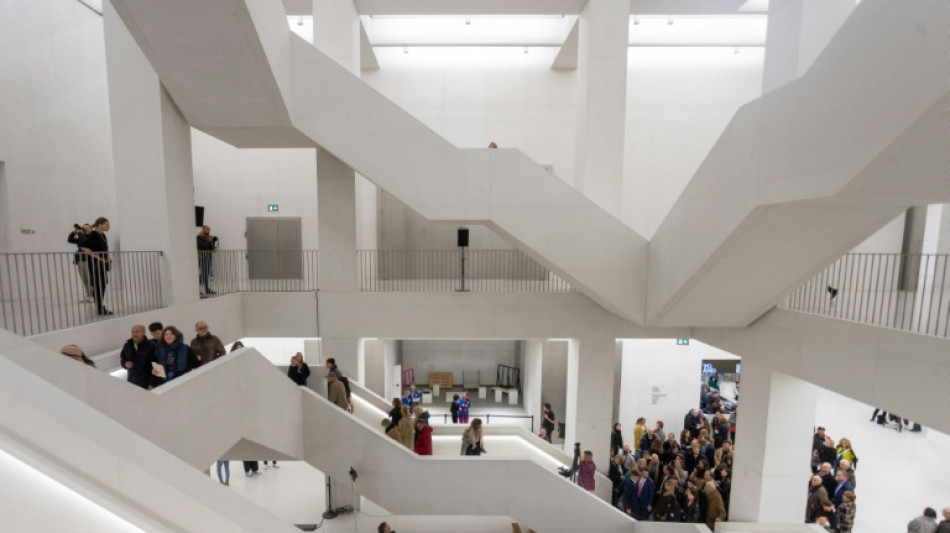
Modern art museum breathes new life into downtown Warsaw / Photo: Wojtek RADWANSKI - AFP

 Leaders visit Pacific atoll at frontline of climate change

 Yemen's Houthis claim striking Riyadh airport, other Saudi sites

 Best-selling British author Jeffrey Archer dies aged 86

 Military plane crash kills 32 in Nigeria

 Olise powers France to win over Belgium in Nations League
 High-flying Blazy turns to birdlife at Chanel
 Riyadh's allies pledge troops as Yemen, Saudi Arabia attack Houthis
 Clashes erupt outside Kosovo parliament over war crimes court
 Milan's Saelemaekers suffers ankle setback, faces lengthy spell out

 Rubio arrives in Iceland to push for greater US presence in Arctic
 Putin allows Italy's UniCredit to sell part of Russian business
 Djokovic into China Open final as Medvedev out for hitting fan with ball

 ICC unseals arrest warrants for Taliban education ministers
 Modric hopes fans back Croatia against Spain after England shame
 Bolsonaro rides right-wing surge into Brazil's election runoff

 Turkey blocks X account of British reporter
 Ukraine says using AI robot guns to shoot down new Russian drones
 At Oct 7 memorial, Netanyahu says will be no Hamas rule in Gaza
 Ukraine blames Russia for deadly sinking of Turkish ship in Black Sea
 UN rights council slams Taliban's 'oppression' of women

 Norway eyes partial ban of smart glasses
 Two dead after ship catches fire, sinks in Black Sea

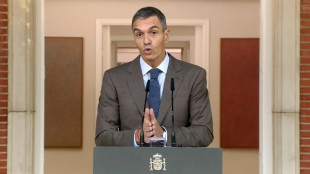 Spain's PM calls snap election after housing bill defeat

 STARCARES Equips Seven Foster Homes for Children and Young People in Tanzania

 Alleged Indian leader of neo-Nazi child abuse ring goes on trial in Paris
Warsaw's new modern art museum building opened on Friday, a minimalist white concrete structure meant to revitalise an abandoned area of the Polish capital long-defined by an imposing Stalin-era palace.
Warsaw, a city of 1.8 million people, did not until now have a proper site for its modern art museum. Instead, the cultural institution showcased its collections at various temporary locations.
Compared by some to a shoebox, shipping container or bunker, the new museum building designed by US architect Thomas Phifer has been hailed by others as a pearl of minimalism.
Mayor Rafal Trzaskowski called the opening "a historical event" for both Polish art and the city.
"Warsaw has been changing very dynamically, but the city's centre had kept its look from a few decades ago," he told reporters on Thursday.
- Stalin's legacy -
Nazi Germany destroyed 90 percent of the Polish capital during World War II, leaving its downtown a ruin upon liberation.
The communists that came to power in the war's aftermath decided not to reconstruct the area and instead built the Palace of Culture and Science, a building of Soviet-sanctioned socialist realist architecture.
More than 230 metres (750 feet) tall, it was a gift from USSR leader Joseph Stalin that for many years dominated the Polish capital.
During the communist era, the palace served as the site of mass political gatherings.
After the fall of the Soviet Union, the large empty square in front of the building became a street market, then a large rundown parking lot -- all cut off from urban life by a wide avenue.
The square was until now "anything and everything", a ramshackle spot with no clear purpose, according to architectural historian Anna Cymer.
She said "Warsaw still hasn't been able to shed its heavy historical legacy" and "break the spell cast by Stalin".
"We are finally on track to bring life back to this part of the city for everyone's benefit," Cymer added.
"The museum marks a big step towards the creation of a real downtown area and a revitalisation of the neighbourhood."
- 'Light of Warsaw' -
For the architect of the nearly 20,000-square-metre museum, the choice of location was significant and "courageous".
"They could have picked any other site in Warsaw" yet they decided to make it "the first thing built that is next to the palace, with all of its history," Phifer told reporters.
"This will be the new voice and the new home, the new town square, the new forum, the new place to meet, to encounter art and to encounter each other."
The museum, which cost 700 million zloty ($170 million) to build, has floor-to-ceiling glass on its ground floor as an invitation to all to enter.
Inside, a double staircase leads visitors to the exhibition rooms -- for now, mostly empty, with only a dozen works shown before the permanent exhibition opens in February.
Over the next two weeks, the museum will celebrate its opening with various events, concerts, dance shows and workshops.
The building's whole interior is bathed in natural light, which Phifer said was intentional.
"The light of Warsaw, this light that defines this place, is beginning to weave into the experience of the art," he said.
R.J.Fidalgo--PC