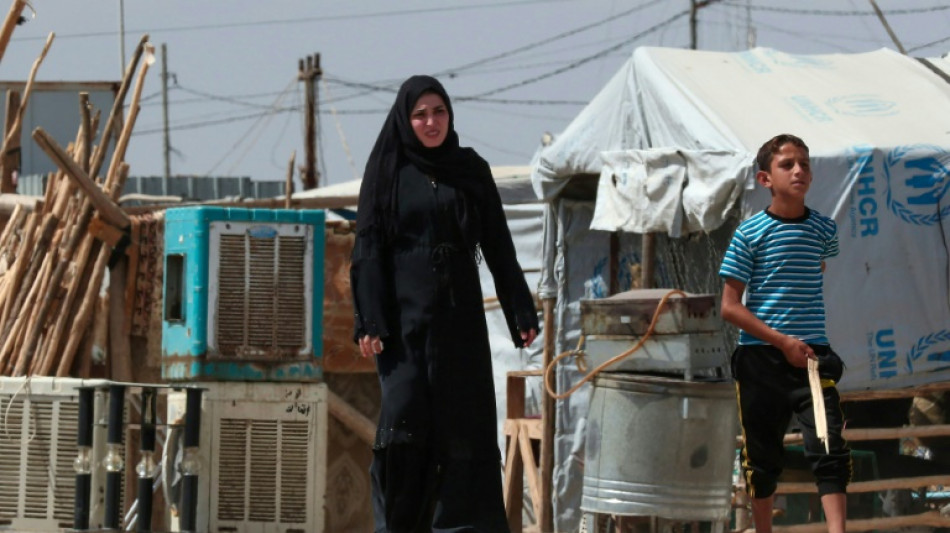
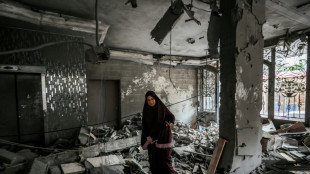
Iraqis face tough homecoming a decade after IS rampage / Photo: Safin HAMID - AFP

 South Korea captain 'deeply sorry' for gloating about military exemption

 Alcaraz through to Japan Open semis after Shapovalov injury

 Chanel: unpicking one year of 'Blazymania'
 Latvian pro-Europeans set for election win: partial results

 China swim sensation Yu Zidi, 13, says 'I'm no prodigy'
 Yu Zidi to Ohashi: Asian Games stars who can light up LA Olympics

 'Act before it's too late': Tokyo residents fight for more trees

 'Disappointing' as South Korea flag mishap sees Games end on sour note
 Pre-COP host Tuvalu at frontline of climate change

 Hungary's dwindling paprika producers battle to save signature spice
 Cornell president vows review in wake of alleged student gang rape
 Latvian partial election results suggest pro-European choice
 In Egypt's Sinai, Gazan builds school for children displaced by war

 Trump tariffs a mixed bag for US auto industry

 Yemen government forces say struck Houthi targets

 Music links past, present for Pedro Pascal's cellist in 'Behemoth!'

 ALEX BODI ȘI AMBASADORUL REPUBLICII SUDANUL DE SUD, GUM DOMINIC MATIOK, DISCUTĂ LA BERLIN DESPRE POSIBILITATEA ÎNFIINȚĂRII UNUI CONSULAT ONORIFIC LA BUCUREȘTI

 Dodgers step up World Series three-peat bid with 5-3 win over Braves

 Spain break down Czechs as England outclass Croatia in Nations League

 Yamal on target as Spain hold off Czech Republic

 Latvian exit polls suggest pro-European choice
 Lula, Bolsonaro wrap up campaigns ahead of knife-edge election
 Tuchel hails 'complete' England after Croatia demolition

 Fury to invite Trump to lead ring walk before Joshua showdown

 Fashion industry in 'precarious moment', says Vivienne Westwood supremo

A decade after Islamic State group extremists rampaged through northern Iraq, Moaz Fadhil and his eight children finally returned to their village after languishing for years in a displacement camp.
Their home, Hassan Shami, is just a stone's throw from the tent city where they had been living, and it still bears the scars of the fight against IS.
The jihadists seized a third of Iraq, ruling their self-declared "caliphate" with an iron fist, before an international coalition wrestled control from them in 2017.
Seven years on, many of the village's homes are still in ruins and lacking essential services, but Fadhil said he felt an "indescribable joy" upon moving back in August.
Iraq -- marred by decades of war and turmoil even before the rise of IS -- is home to more than a million internally displaced people.
Baghdad has been pushing for the closure of the displacement camps, with the country having attained a degree of comparative stability in recent years.
Most of the camps in federal Iraq have now been closed, but around 20 remain in the northern autonomous Kurdistan region, which according to the United Nations house more than 115,000 displaced people.
But for many, actually returning home can be a difficult task.
After getting the green light from Kurdish security forces to leave the camp, Fadhil moved his family into a friend's damaged house because his own is a complete ruin.
- 'Beautiful memories' -
"Water arrives by tanker trucks and there is no electricity," said the 53-year-old.
Although the rubble has been cleared from the structure he now lives in, the cinder block walls and rough concrete floors remain bare.
Across Hassan Shami, half-collapsed houses sit next to concrete buildings under construction by those residents who can afford to rebuild.
Some have installed solar panels to power their new lives.
A small new mosque stands, starkly white, beside an asphalt road.
"I was born here, and before me my father and mother," said Fadhil, an unemployed farmer.
"I have beautiful memories with my children, my parents."
The family survives mainly on the modest income brought in by his eldest son, who works as a day labourer on building sites.
"Every four or five days he works a day" for about $8, said Fadhil.
In an effort to close the camps and facilitate returns, Iraqi authorities are offering families around $3,000 to go back to their places of origin.
To do so, displaced people must also get security clearance -- to ensure they are not wanted for jihadist crimes -- and have their identity papers or property rights in order.
But of the 11,000 displaced people still living in six displacement camps near Hassan Shami, 600 are former prisoners, according to the UN.
They were released after serving up to five years for crimes related to membership of IS.
- Not that simple -
For them, going home can mean further complications.
There's the risk of ostracism by neighbours or tribes for their perceived affiliation with IS atrocities, potential arrest at a checkpoint by federal forces or even a second trial.
Among them is 32-year-old Rashid, who asked that we use a pseudonym because of his previous imprisonment in Kurdistan for belonging to the jihadist group.
He said he hopes the camp next to Hassan Shami does not close.
"I have a certificate of release (from prison), everything is in order... But I can't go back there", he said of federal Iraq.
"If I go back it's 20 years" in jail, he added, worried that he would be tried again in an Iraqi court.
Ali Abbas, spokesperson for Iraq's migration ministry, said that those who committed crimes may indeed face trial after they leave the camps.
"No one can prevent justice from doing its job", he said, claiming that their families would not face repercussions.
The government is working to ensure that families who return have access to basic services, Abbas added.
In recent months, Baghdad has repeatedly tried to set deadlines for Kurdistan to close the camps, even suing leaders of the autonomous region before finally opting for cooperation over coercion.
Imrul Islam of the Norwegian Refugee Council said displacement camps by definition are supposed to be temporary, but warned against their hasty closure.
When people return, "you need schools. You need hospitals. You need roads. And you need working markets that provide opportunities for livelihoods," he said.
Without these, he said, many families who try to resettle in their home towns would end up returning to the camps.
F.Santana--PC