
Canada AI project hopes to help reverse mass insect extinction / Photo: Sebastien ST-JEAN - AFP

 Asian Games set to close after records, rancour and rain

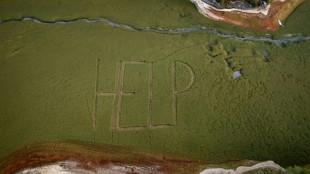 Cry for help as French-Swiss lake dries up

 Sabalenka swept out of China Open in third round

 US urges 'restraint' as Ethiopia's Tigray crisis rocks region

 Teens on target again as USA down Mexico 3-0

 World records prove Asian Games were a hit, says top official

 US prison chief who oversaw botched execution resigns

 'Chaotic' Asian Games threaten Japan hopes of hosting Olympics again

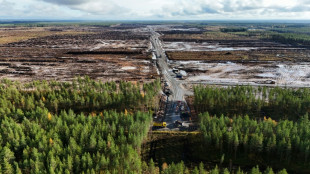 Finnish town braces for change from Google data centres

 What is fuelling French school protests?

 Without lawyers, migrant children face deportation from the US

 Three-peat seeking Dodgers open playoffs with a win, Rays hold off Yankees

 Brazil votes in nail-biter polls closely watched by Trump

 'Just be you': Kim reveals Tiger text that inspired him to gold

 Myanmar migrants returned to war-torn nation from Malaysia

 ALEX BODI AND AMBASSADOR GUM DOMINIC MATIOK OF THE REPUBLIC OF SOUTH SUDAN MEET IN BERLIN TO DISCUSS THE POSSIBILITY OF AN HONORARY CONSULATE IN BUCHAREST

 Lula, Bolsonaro wrap up campaigns ahead of Brazil's knife-edge vote

 Toulouse edge Castres in Top 14 derby

 Murakami homer propels White Sox to MLB playoff win over Guardians

 Israel targets top Hamas leader in deadly Gaza strike on anniversary

 Houthis say struck oil facility near Riyadh, as Saudis hit Sanaa

 AI needs safety layers like nuclear plants: ex-OpenAI engineer

 MVP Judge will miss Yankees' MLB playoff series against Rays

 New lizard species discovered in Peru

 Fernandes hails Portugal's 'greatest symbol' Ronaldo, calls for unity

Researchers in Canada are using artificial intelligence to monitor the ongoing mass extinction of insects, hoping to collect data that can help reverse species collapse and avert catastrophe for the planet.
"Of all the mass extinctions we have experienced in the past, the one affecting insects is happening a thousand times faster," said Maxim Larrivee, director of the Montreal Insectarium.
The decline is occurring so quickly it can't be properly monitored, making it impossible "to put in place the necessary actions to slow it down," he told AFP.
For the Montreal-based project, called Antenna, some of the data collection is happening inside the insectarium under a large transparent dome, where thousands of butterflies, ants and praying mantises are being studied.
Solar-powered camera traps have also been installed in several regions, from the Canadian far north to Panamanian rainforests, snapping photos every 10 seconds of insects attracted to UV lights.
Larrivee said innovations like high-resolution cameras, low-cost sensors and AI models to process data could double the amount of biodiversity information collected over the last 150 years in two to five years.
"Even for us, it sounds like science fiction," he said, a grin stretched across his face.
- 'Tip of iceberg' -
Scientists have warned the world is facing its biggest mass extinction event since the dinosaur age.
The drivers of insect species collapse are well understood -- including climate change, habitat loss and pesticides -- but the extent and nature of insect losses have been hard to quantify.
Better data should make it possible to create "decision-making tools for governments and environmentalists" to develop conservation policies that help restore biodiversity, Larrivee said.
There are an estimated 10 million species of insects, representing half the world's biodiversity, but only a million of those have been documented and studied by scientists.
David Rolnick, a biodiversity specialist at the Quebec AI Institute working on the Antenna project, noted that artificial intelligence could help document some of the 90 percent of insect species that remain undiscovered.
"We found that when we went to Panama and tested our sensor systems in the rainforest, within a week, we found 300 new species. And that is just the tip of the iceberg," Rolnick told AFP.
- Public education -
At Antenna, testing to advance AI tools is currently focused on moths.
With more than 160,000 different species, moths represent a diverse group of insects that are "easy to identify visually" and are low in the food chain, Rolnick explained.
"This is the next frontier for biodiversity monitoring," he said.
The Montreal project is using an open source model, aiming to allow anyone to contribute to enriching the platform.
Researchers eventually hope to apply their modeling to identify new species in the deep sea and others harmful to agriculture.
Meanwhile, the Montreal Insectarium is using its technology for educational purposes. Visitors can snap pictures of butterflies in a vivarium and use an app to identify the exact species
French tourist Camille Clement sounded a note of caution, saying she supported using AI to protect ecology provided "we use it meticulously."
For Julie Jodoin, director of Espace Pour La Vie, an umbrella organization for five Montreal museums including the Insectarium: "If we don't know nature, we can't ask citizens to change their behaviour."
P.Serra--PC