
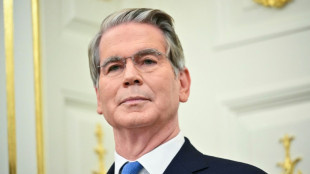
Hungary's neutral war stance puts off Ukraine refugees / Photo: PETER KOHALMI - AFP

 West Bank settlers attack AFP journalists
 MEXC Kicks Off MOVE Carnival With 0-Fee Trading and 1M USDT in Rewards
 Human rights in Myanmar hitting a 'new low': UN

 Son of Luxottica founder quits after succession row

 One million Afghan children suffering 'life-threatening' malnutrition: UN

 Real Madrid's Mourinho happy with squad despite losing out on Rodri
 Sri Lanka slump to 216-7 at tea in second India Test

 US delays Lockerbie bombing trial over new evidence

 Rohingya refugees protest dire conditions in Bangladesh camps

 Lego net profit up 32% in first half, 'stronger than expected': CEO to AFP

 German GDP growth revised upwards, defying Iran war turmoil

 STARTRADER Adds 30 U.S. Stock and ETF CFDs as 2026 Product Expansion Accelerates

 Trees 'giving up': climnate change hammers historic English gardens
 Namibia paves way for phosphate mining in the Atlantic Ocean
 Six months into Iran war, Hormuz traffic way down, sailors stranded

 Netanyahu got his Iran war, but maybe not his desired result

 Hyundai reaches tentative deal with workers after strikes

 Once its saviour, US puts Kuwait in Iran's crosshairs
 Australia's top music charts ban AI songs
 Polaris Renewable Energy Announces Renewal of Normal Course Issuer Bid

 LiberNovo Support Week Goes Live: Up to 44% Off on Maxis, Omni SE and Omni Pro Ergonomic Chair Series
 Despair and anger erupt after deadly Guinea landfill collapse

 Tornado tears through French village, dozens injured

 Federer looks forward to brief return to Arthur Ashe stadium

 US removes Syria from state sponsor of terrorism list
Like Kristina Novytska, most Ukrainian refugees in Hungary are keen to leave the country, whose nationalist leader's neutral stance on the war is an exception in the EU.
"I like Hungary so much... but I also saw how the Hungarian government thinks about us," Novytska told AFP at The Workshop, a shelter for refugees run by a Budapest resident.
The 39-year-old fashion designer fled Kyiv with her two-year-old daughter soon after Russia invaded Ukraine and now wants to look for work in an English-speaking country.
Despite Hungarian government claims of providing for hundreds of thousands of refugees, only an estimated 10 to 20 percent of Ukrainians stay more than a few days, according to relief organisations.
Personal networks abroad, language and job prospects are key in refugees' decisions where to go, aid organisations say.
But nationalist Prime Minister Viktor Orban's neutral stance on the war, as well as his moves to dismantle the system supporting asylum seekers and refugees are additional push factors.
- 'Uncomfortable' -
"It's as if the government would like refugees in general to avoid Hungary," said Viktoria Horvath of Migration Aid, which runs a help desk in the government-run BOK aid centre in Budapest.
In the vast centres, dozens of volunteer staff outnumber refugees by far.
United Nations data estimates that more than 620,000 Ukrainian refugees have crossed into Hungary since the invasion on February 24.
But according to official Hungarian data, only around 20,000 have applied for "temporary protection" that grants them access to the local health and social insurance systems.
In the days after the invasion, Orban described Hungary as "a good friend of Ukraine" and said his government would help Ukrainians -- contrary to its usual anti-refugee stance that has seen the country push back on asylum seekers, mostly from the Middle East and Africa.
At the same time, Orban, who has sought close ties with Vladimir Putin in recent years, has avoided naming the Russian leader as being responsible for the war.
Orban has sent aid to Ukraine, but he has refused to send weapons, saying it could draw Hungary into the conflict.
This "stay out" approach is seen as having propelled him to a fourth straight term in office in another landslide win last month.
His stance has not won him praise among the leadership in Kyiv.
Ukrainian President Volodymyr Zelensky told Orban in a video message in March that "once and for all, you should decide who you are with".
Hitting back during an election day victory speech on April 3, Orban described Zelensky as an opponent, a remark met by cheers from his supporters.
Most recently, Orban has said he would not be able to support an EU oil embargo, citing Hungary's dependence on Russian imports.
"Ukrainians do tend to feel uncomfortable here," said Anya Yelina, a university dance and choreography teacher from Kyiv, who came to Hungary in early March.
"The problem is that Orban is pro-Russian, and everyone among the refugees is talking about it constantly," added the 25-year-old, whose brother has worked in Hungary for three years but now also wants to leave.
- 'Demolished' asylum system -
Some of the animosity is rooted in the two countries' recent history.
Budapest has in recent years complained about what it sees as discrimination of a large Hungarian minority in western Ukraine, discouraging them to speak their language.
Since the invasion, pro-Russian narratives relativising Moscow's aggression have also been prominent on Hungary's heavily pro-Orban public media.
"There are millions of people (in Hungary) watching TV channels or reading news that are actually following the Kremlin line," Patrik Szicherle, an analyst, told AFP.
In a poll last month, market researcher Ipsos found that 67 percent of Hungarians agree that "the problems of Ukraine are none of our business, and we should not interfere".
It was among the highest of the 27 countries polled, and well above the average of 39 percent.
Unlike in nearby Poland or the Czech Republic, there have also been no large solidarity rallies against Russia's invasion.
The problem for Ukrainian refugees is also institutional.
Hungary "demolished" its asylum system in recent years, which makes it harder for Ukrainians to integrate, according to Aniko Bakonyi of the Hungarian Helsinki Committee, a refugee rights group.
Since 2015, fences were built on Hungary's southern borders, and refugee camps shuttered.
Police are also obliged by law to physically "push back" migrants across the borders, while asylum seekers since 2020 can only submit applications at embassies abroad.
"The open border with Ukraine and humanitarian aid is the right way, but refugees need to see a perspective, and a holistic system of services to integrate in a new home," Bakonyi said.
J.V.Jacinto--PC