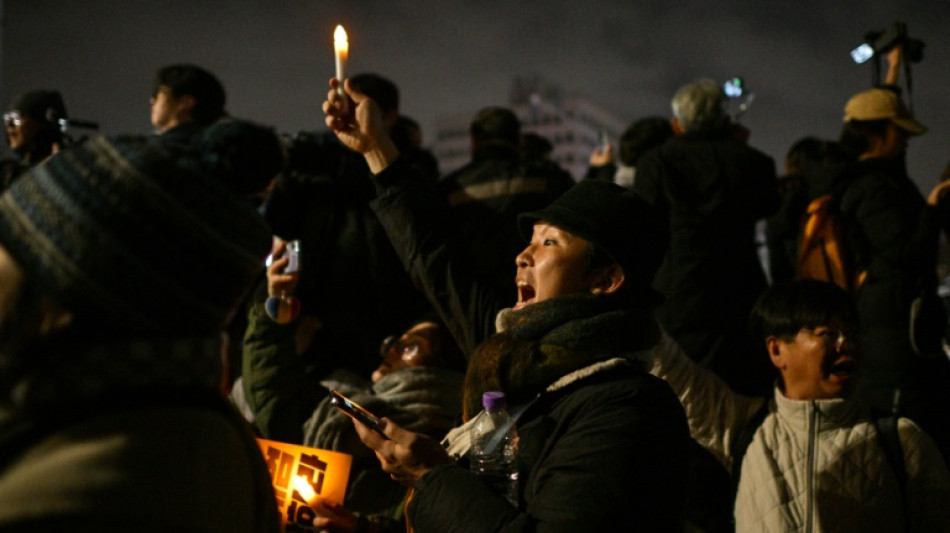
S.Korea political upheaval shows global democracy's fragility - and resilience / Photo: Anthony WALLACE - AFP/File

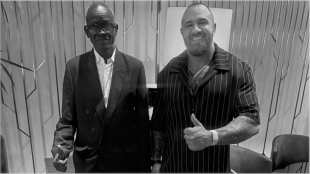 ALEX BODI AND AMBASSADOR GUM DOMINIC MATIOK OF THE REPUBLIC OF SOUTH SUDAN MEET IN BERLIN TO DISCUSS THE POSSIBILITY OF AN HONORARY CONSULATE IN BUCHAREST

 Lula, Bolsonaro wrap up campaigns ahead of Brazil's knife-edge vote

 Toulouse edge Castres in Top 14 derby

 Murakami homer propels White Sox to MLB playoff win over Guardians
 Israel targets top Hamas leader in deadly Gaza strike on anniversary

 Houthis say struck oil facility near Riyadh, as Saudis hit Sanaa

 AI needs safety layers like nuclear plants: ex-OpenAI engineer

 MVP Judge will miss Yankees' MLB playoff series against Rays

 New lizard species discovered in Peru

 Fernandes hails Portugal's 'greatest symbol' Ronaldo, calls for unity

 Grandidier-Nkanang double takes Pau to Top 14 summit despite Vannes fightback
 Trainer Scott gets perfect Arc boost with top notch double

 Ex-PM says Putin cannot admit 'mistake' over Ukraine

 Houthis say Saudi Arabia launches dozens of strikes on Yemen capital

 Qatar and Abu Dhabi F1 Grand Prix to go ahead - F1 boss
 South Korea lift gloom with smash-and-grab Games football gold

 Ireland news conference before Israel game cut short amid tensions

 Protests over housing flare in Spain after relief measures rejected

 Zverev thrashes Shang to set up Djokovic quarter-final at China Open

 Turkey football ref chief jailed pending trial for graft
 North Korea says test of intermediate-range strategic missile included use of AI
 Rampant Sayers leads Hong Kong to third men's rugby gold in a row

 Ethiopia's Tigray rebels abandon regional capital as govt advances
 Bulgaria's Tsar Samuel returns 'home' after 1,000 years

 'Glad it's over': Kim powers to Games gold and military exemption

South Korean President Yoon Suk Yeol's brief imposition of martial law marks a new warning for the worldwide fragility of democracy, even in a country hailed as a model of political transformation.
Yoon's overnight attempt to shut down political activity, censor media and lock out opposition lawmakers stunned South Korea's longtime ally, the United States, which said it had no advance warning and issued a statement of concern.
South Korea's transition to elected rule since a mass uprising in 1987 had been seen as so thorough that the United States increasingly spoke of its ally as a global partner. Meanwhile, Seoul billed itself as a new, ideal hub for international media as China clamped down on Hong Kong.
President Joe Biden had even chosen Yoon as the host in March of his final Summit for Democracy -- a signature initiative of the outgoing US leader, who sought to champion liberal values globally, in an unstated repudiation of Donald Trump, who returns to the White House next month.
But observers, while stunned by Yoon, said there were warning signs.
Danny Russel, a top US diplomat for Asia under former president Barack Obama and who earlier served in South Korea, pointed to the deadlock in parliament where the opposition repeatedly sought impeachments against Yoon's administration.
Yoon's move "was a complete surprise to me (but) yes, there were very obvious structural forces at work," he said.
"There is a radically polarized political scene in Korea. The opposition has been pursuing scorched-earth political obstruction tactics," he said.
But he pointed to the quick, large-scale protests that erupted after Yoon's declaration as a sign of a vibrant civil society ready to defend democracy.
"One certainly would hope that this would serve as a wake-up call to both the ruling conservative party and the progressive opposition that both sides have gone too far and that there needs to be some process of reconciliation, of dealing with legitimate differences and grievances."
- Authoritarian tendencies -
Yoon himself had earlier shown signs of authoritarianism.
In a national address last year, Yoon raged against supposed communists who have "disguised themselves as democracy activists, human rights advocates or progressive activists."
A prosecutor, Yoon narrowly won the 2022 election on a platform of economic reform and advocated close ties with the United States as well as historic rival Japan. But his popularity swiftly slid and the opposition won the National Assembly.
Celeste Arrington, a Korea expert at George Washington University, noted that Yoon had never held elected office before and had become increasingly frustrated.
"This is really an extreme move that may signal, I think, the president's lack of political experience," she said.
She said that martial law showed "some cracks in democracy" but that the quick reversal "gives me hope in the health and strength and vibrancy of democracy in South Korea."
Bruce Klingner, a senior research fellow at the conservative Heritage Foundation, expected Yoon's career to be over after attempting martial law, which constitutionally can only be imposed for wars or other emergencies.
"Yoon's action is a damning reversal to decades of South Korean efforts to put its authoritarian past behind it," he said.
- Democracy stronger? -
The number of democracies worldwide soared starting in the late 1980s as the Soviet Union collapsed and student-led uprisings brought reforms elsewhere.
But globally, democracy has been in retreat for the last 18 straight years, according to the Washington-based group Freedom House, which promotes political liberty.
Democratically elected leaders have taken increasingly authoritarian steps in countries as diverse as India, Turkey and Hungary.
V-Dem, another closely watched democracy index, had most recently ranked South Korea third in Asia after Taiwan and Japan.
In the United States, Trump has rejected long-held norms, refusing to accept he lost to Biden four years ago -- culminating in his supporters violently rampaging through the US Capitol.
Trump's rejection of democracy ultimately worked out for him: campaigning on the rage of 2020, he won last month's election.
But experts said Yoon's power play -- and its reversal -- could in fact show a victory for democratic values.
"Yoon is a deeply unpopular and ineffectual leader, but there was nothing I saw of people being dissatisfied with the way government runs," Alan Yu, a senior vice president at the left-leaning Center for American Progress, said after a recent trip to Seoul.
Darcie Draudt-Vejares of the Carnegie Endowment for International Peace, said that with the swift response to Yoon, "this crisis may ultimately strengthen Korean democracy by reaffirming civilian control and demonstrating institutional resilience."
P.Cavaco--PC