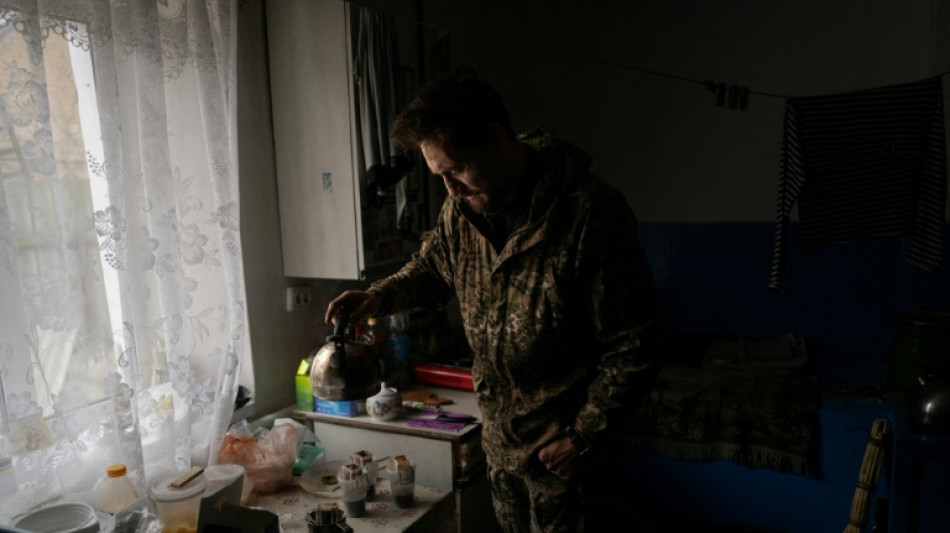
Ukraine struggles against Russian 'meat grinder' tactics / Photo: Florent VERGNES - AFP/File

 Former soldier stopped with blank round at Incheon Airport

 Korea Post breach exposes data of at least 113,855 customers

 Many AAPI Candidates Win Seats in Orange County Local Elections

 Holly Ramsay and Adam Peaty Welcome Daughter Daphne June at Portland Hospital

 Honda and Toyota Recall 1.6 Million Vehicles Over Takata Airbag Risks

 Court Dismisses Fenech’s Bid to Revoke Theuma’s Pardon

 Fundraiser launched for Daniel Buttigieg after boat accident

Lighting his pipe, the commander barely reacted to explosions in the distance as he explained how his men were dying, overwhelmed by Russian soldiers storming eastern Ukraine despite heavy losses.
The Ukrainian officer, who uses the callsign "Goth", was speaking to AFP in the eastern Donetsk region, where Russia made in November its largest gains in a month since March 2022.
But those advances have come at the heavy human cost of 53 Russian casualties per square kilometre seized, according to the US-based Institute for the Study of War (ISW).
"We're losing ground to cannon fodder," Goth said bitterly, with a puff of blueish smoke.
He said Russian forces were sending waves of small groups of men one after another, eventually overpowering outnumbered and exhausted Ukrainian troops.
The tactic, first seen on a large scale in the battle for the city of Bakhmut in 2023, is widely referred to as "meat grinder".
- 'Four times more people' -
Russia is poking holes in Ukrainian defence lines, which Ukrainian troops are trying to fill using drones.
Kurt and his drone unit with the 28th brigade were working precisely on that task near Toretsk, which is also facing a push from Russian forces.
"We're up against an army with four times more people," Kurt said.
"Fifty percent is just cannon fodder, former prisoners, people from lower classes that Russia deems disposable," he said.
Russia has not communicated on its war losses since the early months of the invasion.
But a Russian official in November accidentally revealed that the government had received 48,000 appeals from relatives regarding DNA identification of missing soldiers.
This slip-up could provide an insight into the extent of Russian casualties, which are fuelled by the "meat grinder" tactic.
The expression became widespread during the battle for Bakhmut in which Russia deployed tens of thousands -- including convicts recruited from prisons by Yevgeny Prigozhin's Wagner Group -- to storm and overrun Ukrainian positions.
In a rare admission of numbers, Ukrainian President Volodymyr Zelensky said last week that 43,000 Ukrainian troops had been killed fighting Russia's invasion, and around 370,000 were wounded.
The number of Russian losses is believed to be much higher.
- 'Costs nothing' -
Prigozhin ended up revolting against Russia's military command over a range of issues, including unnecessary losses among his group, but his uprising was squashed.
Russia has still pushed on with the tactic.
AFP spoke to two Russian prisoners of war who said they chose to enlist for financial reasons.
One said he joined up to pay for repairs on his car, while the second said he joined to be a cook after leaving prison, but found himself fighting after three days of training.
It was hard to evaluate how freely they were speaking since they spoke from captivity.
In any case, Kurt said he was convinced the only way to win the war was to recruit more men.
But Kyiv has been struggling to fill the ranks.
"It costs nothing to Moscow to kill 150 people to take a patch of trees, but we count every soldier," Kurt said.
"We're grateful for international aid, but it's not enough to win," he said.
Goth agreed, though he thought that Moscow would soon face similar manpower issues given the number of Russian casualties.
In the meantime, he is hoping a harsh winter will hamper the progress of Russian troops against exhausted Ukrainians.
But he fears the accumulated fatigue would take its toll at the end of the war.
"I'll probably have some kind of a breakdown. But my wife will be there to help me," he said as he poured himself a cup of coffee.
E.Raimundo--PC