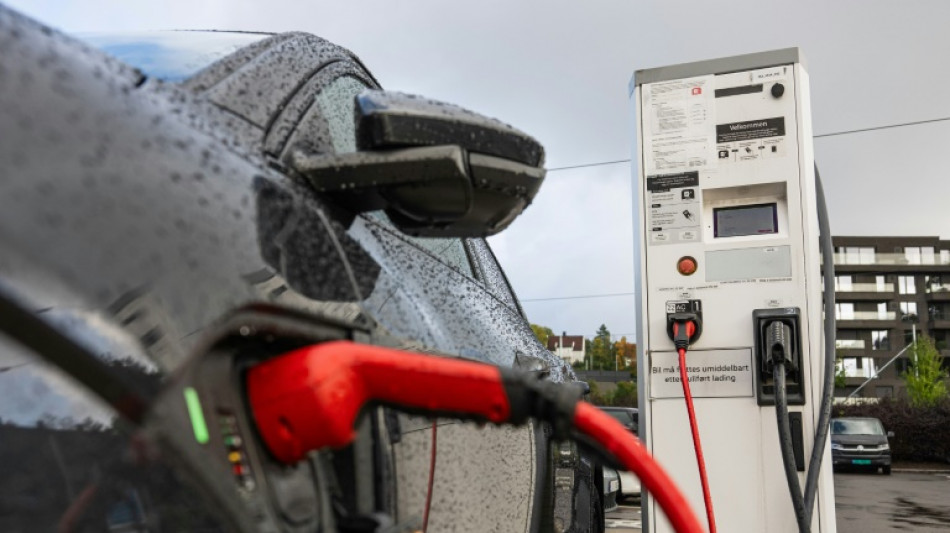
Germany's Scholz calls for Europe EV subsidy plan / Photo: Jonathan NACKSTRAND - AFP/File

 Former soldier stopped with blank round at Incheon Airport

 Korea Post breach exposes data of at least 113,855 customers

 Many AAPI Candidates Win Seats in Orange County Local Elections

 Holly Ramsay and Adam Peaty Welcome Daughter Daphne June at Portland Hospital

 Honda and Toyota Recall 1.6 Million Vehicles Over Takata Airbag Risks

 Court Dismisses Fenech’s Bid to Revoke Theuma’s Pardon
 Fundraiser launched for Daniel Buttigieg after boat accident

Germany's Chancellor Olaf Scholz called Tuesday for a European subsidy programme for electric vehicles, as the country's flagship auto industry struggles with the transition to battery-powered cars.
"We need incentives to buy electric cars -- as a European bonus or as direct support for electric cars made in Germany," Scholz said on social media after a visit to US automaker Ford's factory in Cologne.
Scholz made the call as campaigning got underway ahead of an expected snap poll in February, brough on by the collapse of the government last month.
The election has not officially been called yet but Scholz has already set out his stall, pledging to protect jobs and support working people if returned to office.
But the context for the campaign is inauspicious for the chancellor. Germany's economy has registered barely any growth over the past two years and the stagnation is widely predicted to continue into next year.
The outlook is particularly gloomy for Germany's automakers, who have struggled with high costs, weak demand and rising competition from China.
New help to buy for electric cars has been a key ask for manufacturers, who saw sales suffer after the government ended a subsidy programme at the end of last year.
The financial support programme for EVs was the victim of a budget crunch that would eventually drive a wedge between Scholz's coalition partners and topple the government.
The crisis in the auto industry meanwhile has led to a series of job cut announcements in the key sector.
Volkswagen, Europe's largest carmaker, recently said it was considering closing sites in Germany for the first time in its history.
And at Ford, where Scholz spoke Tuesday, the group has said it plans to cut 2,900 jobs in Germany by 2027.
After companies had invested billions in the switch to electric cars, the government needed to do "what we believe is necessary in terms of support" to drive progress, Scholz told workers at the plant.
This meant keeping energy prices low and keeping tax advantages for electric company cars, Scholz said.
"We also want the whole of Europe to make an effort," Scholz said.
"We need sales support that works across Europe or approval from Europe to encourage production to promote sales in Germany."
P.L.Madureira--PC