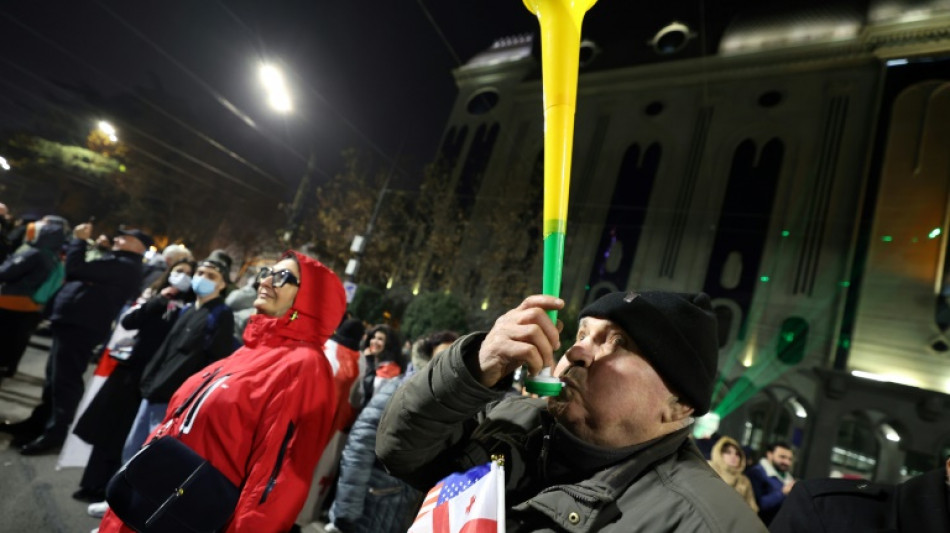
Georgia protests enter 13th night as EU threatens 'measures' / Photo: Giorgi ARJEVANIDZE - AFP

 Former soldier stopped with blank round at Incheon Airport
 Korea Post breach exposes data of at least 113,855 customers
 Many AAPI Candidates Win Seats in Orange County Local Elections

 Holly Ramsay and Adam Peaty Welcome Daughter Daphne June at Portland Hospital

 Honda and Toyota Recall 1.6 Million Vehicles Over Takata Airbag Risks

 Court Dismisses Fenech’s Bid to Revoke Theuma’s Pardon

 Fundraiser launched for Daniel Buttigieg after boat accident

Pro-Europe protests showed no sign of abating Tuesday, with thousands taking to the streets as the European Union warned it could punish Tbilisi for its crackdown on demonstrators.
Waving EU and Georgian flags and loudly blowing horns and whistles, demonstrators rallied outside parliament for the 13th consecutive day against the government's decision to shelve its push to join the EU after disputed elections.
"Every day after work we are coming here," said Sofia Japaridze, 40, an air industry worker.
"All of Georgia, every city, every village, everybody wants (to join) the EU, we don't want to go back to USSR," she said.
The Caucasus nation has been mired in turmoil since the ruling Georgian Dream party -- accused of moving the country towards Russia -- claimed victory in the October 26 parliamentary polls.
The pro-Western opposition has dismissed the vote as rigged, while tens of thousands have protested against alleged electoral fraud.
Prime Minister Irakli Kobakhidze's shock decision on November 28 to suspend Georgia's talks to join the EU triggered a fresh wave of demonstrations, which were met with a tough police response.
The crackdown has triggered outrage at home and mounting international condemnation.
On Tuesday, the EU said the bloc's foreign ministers will discuss "additional measures" against Georgia's authorities next week after what Brussels called "credible concerns" of torture against demonstrators.
"The persistent democratic backslide and the recent repressive means used by Georgian authorities have consequences for our bilateral relations," a statement said.
- 'Planned escalation' -
The United States, Britain, France and Germany have also voiced indignation at the handling of the protests.
Critics accuse Georgian Dream of creeping authoritarianism.
Security forces have fired tear gas and water cannons to disperse previous demonstrations and arrested more than 400 people since the second wave of unrest began.
Police have raided opposition party offices, and on Saturday dozens of unidentified masked men brutally assaulted opposition figures and journalists near the protest venue.
The State Security Service said Tuesday it expected more trouble ahead of December 14, when Georgian Dream lawmakers are to elect a loyalist to succeed pro-Western President Salome Zurabishvili.
Without providing any evidence, it said violent groups aiming to stop the vote were planning to "escalate" their actions, cause "the deaths of two or three people" and blame the government in a bid at fuelling further protests.
Zurabishvili -- who has vowed not to step down until the parliamentary polls are re-run -- denounced the agency's statement as an attempt to "psychologically terrorise people", according to the Interpress news agency.
- 'Burning passion' -
Authorities have been at pains to project an air of normality.
Kobakhidze has repeatedly said police averted an attempted revolution by what he has described as "liberal fascist" opposition groups -- in language similar to how the Kremlin refers to dissenters in Russia.
He has shrugged off the demonstrations as insubstantial.
A giant Christmas tree has been set up outside parliament -- the main protest venue.
On Monday the city deployed dozens of cleaners and street sweepers to tidy up the area as soon as the demonstrations ended.
But protesters, young and old, have continued to demand a fresh vote and a return to European integration.
On Tuesday, Roland Kalandadze, 25, said he did not think the protests would peter out as they approached a third week.
"There is still fuel and burning passion to it, because there are already a lot of people who suffered, who were put in jail. That motivates us more," he said.
He expressed the hope the government will be gone "before the new year".
The previous night demonstrators set alight a coffin containing an effigy of billionaire former premier Bidzina Ivanishvili, widely believed to be pulling the strings of power.
Critics of Georgian Dream are enraged by what they call its betrayal of the country's bid for EU membership, enshrined in the constitution and supported by some four-fifths of the population.
The party, in power for more than a decade, has advanced controversial legislation in recent years, targeting civil society and independent media and curbing LGBTQ rights.
Brussels has warned that such policies are incompatible with EU membership, while domestic detractors accuse the government of copying Russia's playbook.
C.Cassis--PC