Hopes for 'reunification' a fact of life on China's window to Taiwan / Photo: ADEK BERRY - AFP

 Former soldier stopped with blank round at Incheon Airport
 Korea Post breach exposes data of at least 113,855 customers
 Many AAPI Candidates Win Seats in Orange County Local Elections

 Holly Ramsay and Adam Peaty Welcome Daughter Daphne June at Portland Hospital

 Honda and Toyota Recall 1.6 Million Vehicles Over Takata Airbag Risks

 Court Dismisses Fenech’s Bid to Revoke Theuma’s Pardon

 Fundraiser launched for Daniel Buttigieg after boat accident

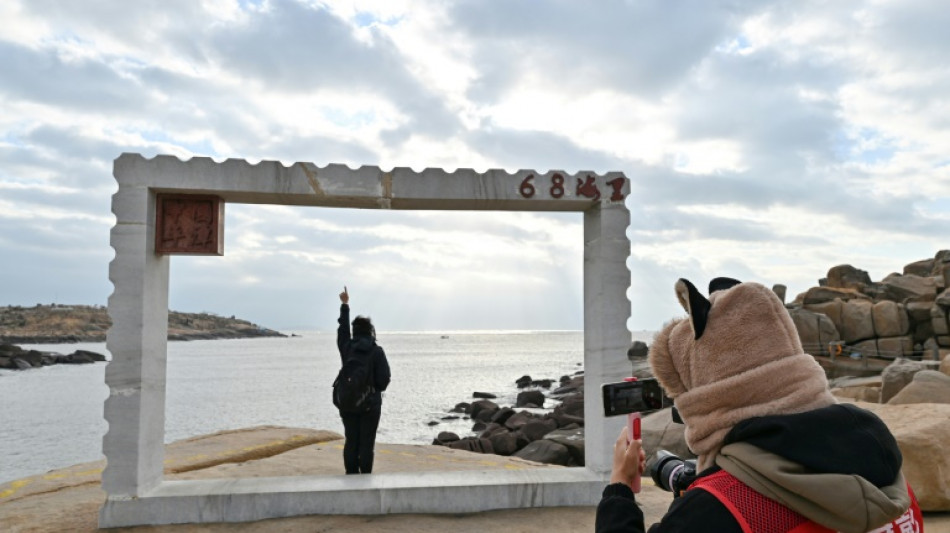
Atop rock formations overlooking a vast coastline, groups of Chinese tourists snap pictures and gaze out to sea with binoculars in the direction of Taiwan's main island, just over a hundred kilometres away.
Taipei has this week accused China of launching its biggest maritime drills in years, with about 60 warships and 30 coastguard vessels deployed, spanning from near the southern islands of Japan to the South China Sea.
Beijing has not confirmed the exercises are taking place.
At a scenic park on Pingtan -- a Chinese island that is the closest point to Taiwan's main island -- visitors were more concerned with snapping selfies than military manoeuvres.
Posing for photos, tourists shouted "reunification soon!" in unison.
"We hope for reunification soon, but this hope depends on the will of the people from both Taiwan and the Chinese mainland," a tourist surnamed Hu from the eastern province of Jiangsu told AFP.
"We have only one China," he said.
Communist China has never ruled out the use of force to take democratic Taiwan, which regards itself as a sovereign nation.
The dispute goes back to 1949 when Chiang Kai-shek's nationalist forces were defeated by Mao Zedong's communist fighters and fled to Taiwan.
- 'Why fight?' -
Another tourist in Pingtan, 70-year-old Zhang, said that unification by force could take place quickly -- but said the damage to people on both sides "would be too great".
"We're all Chinese, so why fight each other?" Zhang, visiting from eastern Zhejiang province, added.
"It would be best if everyone could unite peacefully," he said.
"We're not afraid of fighting, but we hope not to."
Nearby, a military compound's propaganda signs on its walls urged passersby to "follow the Party's command" and be "capable of winning battles".
But the fighting rhetoric belied the sleepy island vibes -- in a nearby coastal village, stray dogs roamed freely through empty streets as a labourer tended to roadside bushes.
Laundry lines of clothes stretched across quiet alleyways, the air occasionally punctuated by scooters whizzing by.
Retiree Nian Mei Sheng, 74, said he often saw military planes during drills, including after the inauguration this year of Taiwan's President Lai Ching-te, who Beijing has branded a "separatist".
"When we were farming in the mountains, we often saw planes flying over our heads," Nian told AFP in front of his home.
"This year, it has happened several times... after Lai Ching-te came to power," he added.
The Pingtan native said he had noticed fewer Taiwanese tourists visiting the island.
"Since Lai came to power, both travel from Taiwan to here and from here to Taiwan has decreased," he said.
"We hope for Taiwan to reunify with the mainland... we have this aspiration."
S.Pimentel--PC