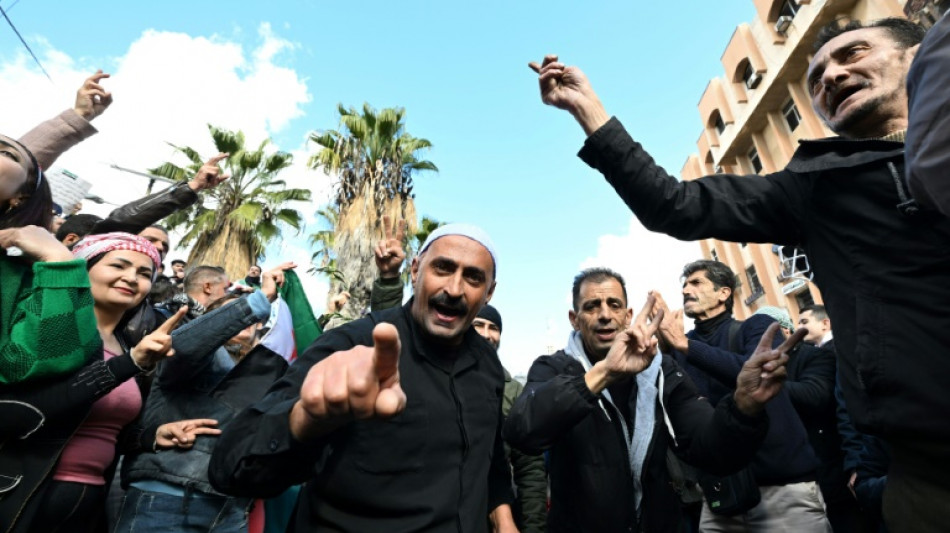
Syria's Druze hope for better future without Assad / Photo: LOUAI BESHARA - AFP

 Many AAPI Candidates Win Seats in Orange County Local Elections

 Holly Ramsay and Adam Peaty Welcome Daughter Daphne June at Portland Hospital

 Honda and Toyota Recall 1.6 Million Vehicles Over Takata Airbag Risks

 Court Dismisses Fenech’s Bid to Revoke Theuma’s Pardon

 Fundraiser launched for Daniel Buttigieg after boat accident

 Egypt and Qatar Call for Gaza Ceasefire Implementation and Regional De-escalation

 INGLOT Malta offers Black Friday discounts of up to 60%

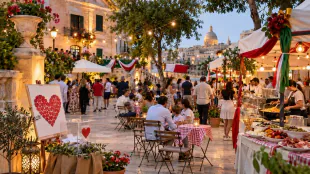 Italian Village event in Malta raises funds for Puttinu Cares

 Malta launches second national AI strategy with 86 measures
Bayan al-Hinnawi, who spent years behind bars in Bashar al-Assad's Syria, joined crowds in the heartland of the Druze minority on Friday to celebrate the president's fall, "a dream" come true for the former prisoner.
Hundreds of people descended on Sweida's main square, singing and clapping in jubilation, just days after Islamist-led rebels took the capital Damascus, sending Assad fleeing.
The Druze-majority city in Syria's south has been a focal point of renewed anti-government demonstrations over the past year and a half.
On Friday, residents waved Syria's pre-Assad flag of white, green and black with three stars, and raised olive branches in a sign of peace.
Some of them have lost family members during the anti-government uprising that began in 2011 and spiralled into civil war. Others, like Hinnawi, had languished in prison under the Assad family's five-decade rule.
"It was a dream," said 77-year-old Hinnawi of Assad's ouster.
Decades ago, a few years after Hafez al-Assad seized power -- which he later handed over to his son Bashar -- a 23-year-old Hinnawi was jailed.
He was released 17 years later.
The grey-haired man said he had "dreamed that one day the regime would fall", but did not believe that he would live to see the day.
"It's a wonderful sight. Nobody could have imagined that this could happen", he said.
- 'Dignity' -
But his joy was incomplete, remembering the many who have died in jail.
"I wish that those who died when I was imprisoned in Mazzeh or Saydnaya could see this scene," said Hinnawi.
Since Assad's fall, rebel forces and residents have broken into both detention centres, freeing political prisoners and searching for long-missing loved ones.
Activists and rights groups say the Assad government tortured and abused inmates at both facilities.
"I got out when I was 40, I missed out of my whole life," said Hinnawi, who served in the Syrian army before being jailed.
Recalling torture behind bars, he said that "no oppressor in history has done what they did to us."
Since Sunday, the ousted government's security forces were nowhere to be seen in Sweida, and the office of Assad's Baath party has been abandoned, as have army checkpoints on the road to Damascus.
Local armed men are present, but not the Islamist group Hayat Tahrir al-Sham which spearheaded the rebel offensive against Assad.
Siham Zein al-Din, who lost her son in 2014 after he defected from the national army to join rebel fighters, said he had "sacrificed his life... for freedom, for dignity".
The family was still searching for Khaldun's remains, said his 60-year-old mother.
Like her son, some members of the Druze community took up arms against Assad's forces during the war.
- A brother's congratulations -
Beyond defending themselves from attacks in the areas where they live, Syria's Druze largely stayed on the sidelines of the civil war.
Many managed to avoid compulsory conscription since 2011.
Residents of Sweida have long complained of discrimination and the lack of basic services.
Many buildings in the city are constructed from black volcanic stone that can be found in the area, and its roads have fallen into disrepair.
Sheikh Marwan Hussein Rizk, a religious leader, said that "Sweida province has been marginalised" for decades, with most of its residents living in poverty.
But, surrounded by the joyful protesters, Rizk said better days may be coming.
"Today, we look to the future and ask for a helping hand... Our hand is extended to all Syrians."
Next to him, resident Hussein Bondok held up a poster of his brother Nasser, a journalist and opposition activist who was last heard from in 2014 when he was arrested.
Bondok, 54, said he believes his brother was likely killed under torture in one of Damascus's prisons.
Nasser struggled for freedom, Bondok said.
"I want to congratulate him now, because the seeds he had planted with his brothers-in-arms has become a tree."
A.F.Rosado--PC