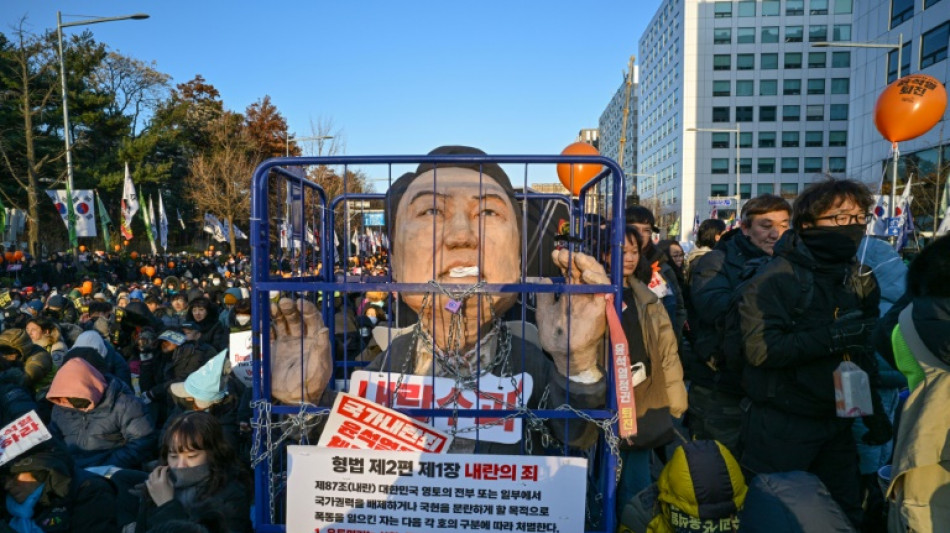
South Korea's Yoon impeached: what happens next? / Photo: ANTHONY WALLACE - AFP

 Many AAPI Candidates Win Seats in Orange County Local Elections

 Holly Ramsay and Adam Peaty Welcome Daughter Daphne June at Portland Hospital

 Honda and Toyota Recall 1.6 Million Vehicles Over Takata Airbag Risks

 Court Dismisses Fenech’s Bid to Revoke Theuma’s Pardon

 Fundraiser launched for Daniel Buttigieg after boat accident

 Egypt and Qatar Call for Gaza Ceasefire Implementation and Regional De-escalation

 INGLOT Malta offers Black Friday discounts of up to 60%

 Italian Village event in Malta raises funds for Puttinu Cares
 Malta launches second national AI strategy with 86 measures
South Korean lawmakers have voted to impeach President Yoon Suk Yeol over his shock decision to declare martial law last week, which plunged the country into some of its worst political turmoil in decades.
AFP takes a look at what lies ahead for the vibrant East Asian democracy.
- Who is running the country? -
Technocratic Prime Minister Han Duck-soo has stepped in as interim leader and will govern the country for a maximum of eight months, depending on how long the court deliberates on the impeachment motion and what it decides to do.
In his first address to the nation as acting president, Han vowed to "ensure stable governance."
"I will devote all my strength and efforts to ensure stable governance," the 75-year-old career bureaucrat said.
- How will impeachment proceed? -
In its last such deliberation involving former president Park Geun-hye -- impeached by parliament over corruption and incompetence allegations -- the Constitutional Court took 92 days to review the motion and remove her from office.
The court requires six votes in favour of impeachment from its nine-member bench.
But with three seats vacant due to disagreements between the ruling and opposition parties, the court must vote unanimously to support the impeachment motion -- unless it fills the empty positions in the coming weeks.
Legal experts say it is very likely the judges will remove him given the clear constitutional violations involved in his martial law declaration.
It is clear Yoon "aimed to paralyse the state's functions," Kim Hyun-jung, a researcher at the Korea University Institute of Law, told AFP.
"Even the most conservative scholars acknowledge this has caused a crisis in constitutional order," Kim said.
If the court confirms Yoon's removal, a snap election will be held within 60 days.
And unlike in typical elections, there will be no 60-day transition period for the president-elect: the victor will be inaugurated the day after the vote.
- Will protests continue? -
The vast protests both for and against Yoon that have rocked the South Korean capital are likely to continue in a push to pressure the Constitutional Court.
"Those in favour of Yoon's removal are likely to rally at Gwanghwamun Square near the Constitutional Court," Bae Kang-hoon, a co-founder of the political think tank Valid, said.
Protesters on both sides have told AFP they would keep coming to the streets until the court delivers its ruling.
"I will certainly protest at the court to demand it reject the impeachment," Cho Hee-sun, a Yoon supporter, told AFP at a rally on Saturday before the parliamentary vote.
Kim Cho-rong, who marched on Saturday urging MPs to impeach Yoon, said she would "keep coming out for the next few weeks to make my voice heard by the judges."
- Who might be the next president? -
Lee Jae-myung, leader of the main opposition Democratic Party, is the clear frontrunner for the presidency, analysts say.
"Lee has demonstrated strong leadership during the turbulent days since the martial law declaration and played a key role in passing the impeachment motion," said attorney and political columnist Yoo Jung-hoon.
Lee, who rose from humble beginnings as a "factory boy" and a teenage school dropout supporting his family, has leveraged his rags-to-riches story to build political stardom.
In the 2022 election, Lee lost to Yoon by the narrowest vote margin in South Korea's electoral history, with a gap of around 0.7 percent.
But his bid for the presidency has been overshadowed by a series of scandals, including a court ruling in November finding him guilty of election law violations, resulting in a suspended sentence.
If the verdict is upheld, it would strip him of eligibility to run for office.
From Yoon's conservative People Power Party, party leader Han Dong-hoon and Seoul Mayor Oh Se-hoon are seen as potential contenders.
Despite his legal challenges, Lee "stands far ahead" in the potential race, Yoo said.
"While uncertainty lingers over his ongoing trial, it remains to be seen whether an appellate court will uphold the suspended sentence and deliver its ruling before an election," he said.
"Legal proceedings against Lee will come to a halt if he wins the election, granting him immunity as president."
A poll last week showed more than 52 percent of eligible voters favour Lee as the next president, with all other potential contenders trailing in single digits.
F.Moura--PC