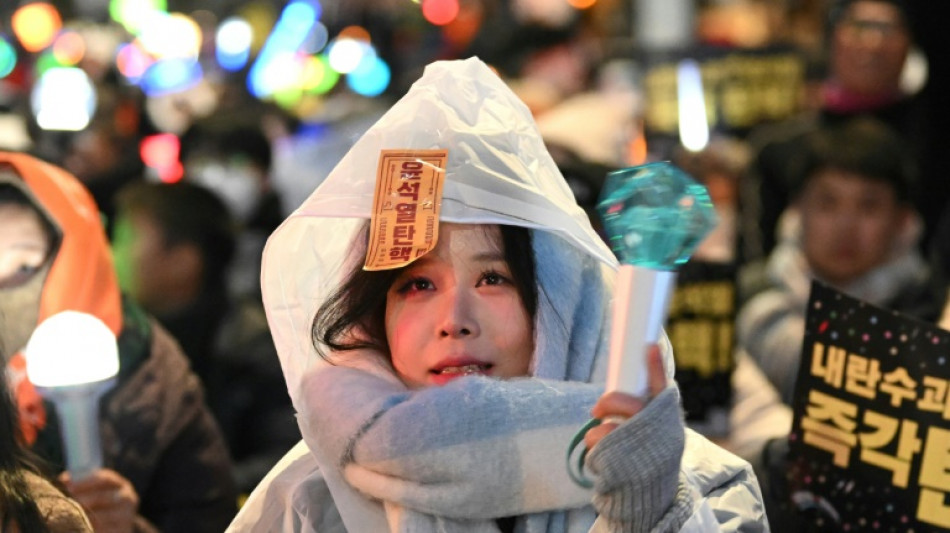
South Korean democracy holds firm against Yoon's martial law bid / Photo: Jung Yeon-je - AFP

 Lula, Bolsonaro in final push for votes ahead of knife-edge election

 Boisterous fashion week barnstorms 'sleepy' Nigerian capital

 UAE investigators say flydubai co-pilot was planning 'terrorist act'

 Rahul smacks century in India v Windies ODI

 Daryz seeks to join exclusive club of dual Arc winners

 Russia warns diplomats to leave Kyiv over new strikes threat

 Olympic champ Zheng rebukes rowdy home crowd at China Open

 World No.1 Sinner pulls out of Shanghai Masters to delay return

 Red Bull's Verstappen grabs pole position for Bahrain GP

 India beat Pakistan in blockbuster as golfer Kim wins 'crazy' gold

 India beat arch-rivals Pakistan to win Asian Games cricket gold

 Ethiopia's Tigray rebels abandon regional capital as govt advances: journalist

 Tom Kim powers to Games gold and exemption from military service
 Split loyalties for Indian football fans at Brazil friendly

 India-Pakistan blockbuster brings cricket fever to Japan baseball field

 Wong waiting on Rafa after winning Asian Games tennis gold

 With Russia next door and rising costs, Latvia goes to the polls

 Penalty hero rues empty seats as Games hosts Japan win football gold

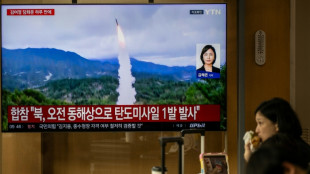 North Korea fires ballistic missile after Seoul's apology demand

 US regulator finds Boeing 737 MAX software bug 'not a safety concern'

 Ohtani 'managing' injuries as Dodgers launch MLB post-season

 Botched US execution leaves murderer unconscious on ventilator: lawyers

 Cornell rape case exposes sexual violence at US colleges

 France held by Italy in Zidane's homecoming after Olise stunner

 Ethiopian pro-government militia claims Tigray airport as regional tensions spike

South Korea's swift rebuke of martial law and removal of President Yoon Suk Yeol from office have been hailed in the country as evidence of the strength of its young democratic institutions.
Yoon's bid to suspend civilian rule and claims of a communist conspiracy harkened back to the dark days of dictatorship in South Korea four decades ago, when human rights abuses by military and security forces were widespread.
But the fallout from the failed attempt was immediate and South Korea's institutions kicked in -- Yoon's inner circle were swiftly placed under police investigation and hauled before a parliament demanding answers.
Lawmakers rapidly launched impeachment proceedings against Yoon for his alleged "insurrection" and attempt to override the country's democratic constitution.
And on Saturday he was removed by a secret ballot in a tense vote in the ornate parliamentary chamber.
The vote sparked wild jubilation on the streets of Seoul -- opinion polls suggested more than 75 percent of the public supported impeachment.
"This situation has provided the Korean people with an invaluable lesson on what democracy truly entails and how our democratic republic can be protected," lawyer Yun Bok-nam, president of Lawyers for a Democratic Society, told AFP.
"For the people this has been a transforming experience in building a more powerful democratic consciousness among them."
- Red line drawn -
Bordering isolated, totalitarian North Korea and separated by a strip of sea from vast and authoritarian China, South Korea has for years been a posterchild for boisterous, democratic rule in East Asia.
Forged in the chaos and bloodshed of the 1980s anti-dictatorship movement -- from which many of the country's current crop of politicians emerged -- South Koreans have long sought to challenge their leaders in raucous street protests and vibrant displays of dissent.
And its strong rebuke of authoritarian rule this week again saw it buck a global trend towards autocratic politics, from the re-election this year of Donald Trump in the United States to a surge in right-wing populism in Europe.
That trend has seen UN Secretary-General Antonio Guterres warn that democratic values are "under assault" globally -- pointing to rising attacks and restrictions on media and human rights defenders.
But for many South Koreans, there was never any doubt that the country would turn back the clock.
"What we have witnessed over the past two weeks is a testament to the fact that it is now impossible to regress the country to its authoritarian past," said Bae Kang-hoon, co-founder of political think tank Valid.
"There is a red line drawn in the minds of the Korean people: that the country should never regress back to military rule," Bae told AFP.
"Yoon's martial law proclamation clearly crossed that line for many."
- Reform needed -
Should the Constitutional Court remove him from power, Yoon will gain the ignominious distinction of being only the second South Korean president to have been impeached.
Fellow conservative Park Geun-hye -- who Yoon, as chief prosecutor, played a key role in removing -- was also impeached under very similar circumstances.
But in the wake of that impeachment, South Korea "failed" to ensure the popular momentum that brought down Park translated into real change, Kim Jeong-min of analysis service Korea Pro told AFP.
"For this popular will to translate into better government will require a wholesale review of the constitution and the system," she said.
And Lim Ji-bong, constitutional law professor at Sogang University, stressed that "too much power" has been concentrated in the presidency.
Reforms could see the country "weaken the so-called 'imperial presidency' by getting rid of many of the president's powers and investing them in the legislature", he suggested.
Yoon has remained defiant throughout the turmoil that followed his martial law declaration.
He doubled down Thursday on allegations that "anti-state" forces were seeking to undermine South Korea's national security and electoral system.
"Yoon's speech was basically him sending out the impeachment invitation letter... like: 'Please impeach me'," Kang Won-taek, political science professor at Seoul National University, said.
"When the president said those things, it convinced lawmakers that he needed to be impeached."
M.Gameiro--PC


