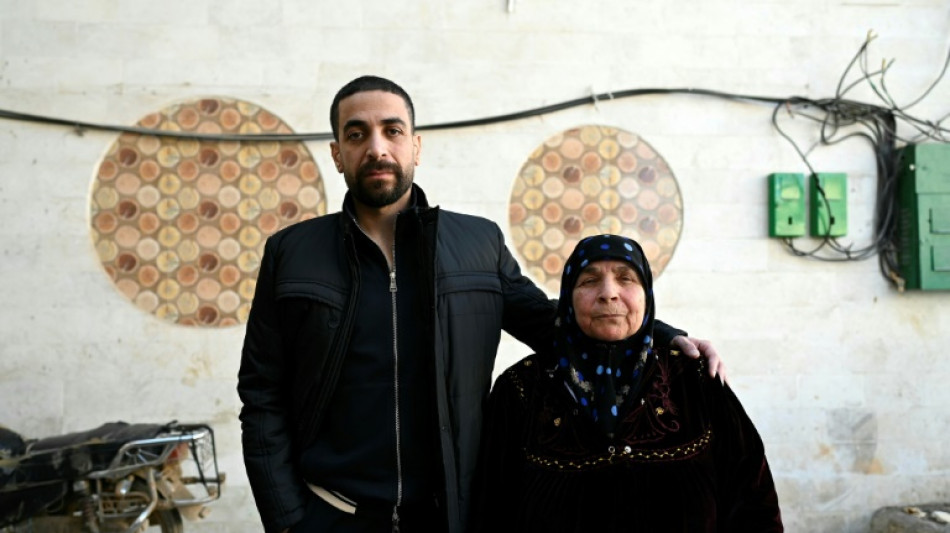
Assad's prisoner No 3006 tells his story / Photo: OZAN KOSE - AFP

 Lula, Bolsonaro in final push for votes ahead of knife-edge election

 Boisterous fashion week barnstorms 'sleepy' Nigerian capital

 UAE investigators say flydubai co-pilot was planning 'terrorist act'

 Rahul smacks century in India v Windies ODI

 Daryz seeks to join exclusive club of dual Arc winners

 Russia warns diplomats to leave Kyiv over new strikes threat

 Olympic champ Zheng rebukes rowdy home crowd at China Open

 World No.1 Sinner pulls out of Shanghai Masters to delay return

 Red Bull's Verstappen grabs pole position for Bahrain GP

 India beat Pakistan in blockbuster as golfer Kim wins 'crazy' gold

 India beat arch-rivals Pakistan to win Asian Games cricket gold

 Ethiopia's Tigray rebels abandon regional capital as govt advances: journalist

 Tom Kim powers to Games gold and exemption from military service

 Split loyalties for Indian football fans at Brazil friendly

 India-Pakistan blockbuster brings cricket fever to Japan baseball field

 Wong waiting on Rafa after winning Asian Games tennis gold
 With Russia next door and rising costs, Latvia goes to the polls

 Penalty hero rues empty seats as Games hosts Japan win football gold

 North Korea fires ballistic missile after Seoul's apology demand

 US regulator finds Boeing 737 MAX software bug 'not a safety concern'

 Ohtani 'managing' injuries as Dodgers launch MLB post-season

 Botched US execution leaves murderer unconscious on ventilator: lawyers
 Cornell rape case exposes sexual violence at US colleges

 France held by Italy in Zidane's homecoming after Olise stunner

 Ethiopian pro-government militia claims Tigray airport as regional tensions spike

The Syrian military intelligence officers who detained Ghazi Mohammed al-Mohammed told him to forget his name and who he was.
They took away his papers, he said, and told him: "Now you're number 3006."
For five and a half months Mohammed languished in one of president Bashar al-Assad's jails, losing 40 kilograms (88 pounds), all the while under the threat of imminent execution.
Since Islamist-led rebels toppled Assad's paranoid and brutal government one week ago, numerous ex-prisoners like Mohammed are shedding light on the depths of the despair visited upon Syria's people over the past decades.
Mohammed, an emaciated man propped up on cushions in front of the stove in Sarmada, near Aleppo in northwestern Syria, is a shadow of his former self.
The 39-year-old swears he was never involved in politics in Syria, that he is a simple merchant trying to make a living along with his brothers.
He was seized on a brief business trip to Damascus, and plunged into a living hell.
"The moment comes when you lose all hope," said Mohammed, his beard and dark hair closely cropped.
"Towards the end I just wanted to die, waiting for when they would execute us. I was almost happy, as it would mean my suffering was over."
It was the mukhabarat, the omnipotent intelligence henchmen and enforcers of Assad rule, who seized him when he visited the capital.
They took him away, hands clamped behind his back, along with one of his friends, a doctor.
"That was five and a half months ago," Mohammed told AFP.
He doesn't know why he was arrested, but thinks it may have been because he comes from the northwestern province of Idlib, heartland of the rebels whose lightning push south forced Assad to flee on December 8.
Manacled and blindfolded, Mohammed was taken to a detention centre in the upscale Mazzeh district of Damascus, home to embassies, United Nations offices and security headquarters.
They took him deep into a building, and it was there that the blows began.
- Hung by his wrists -
For the first few days, he was hung by his wrists from a bar high up in a cell, his feet unable to touch the floor. Then he was lowered so at least he could touch the ground.
Mohammed was beaten and fed practically nothing. His only contact was with the jailers.
"They told me to confess that my brother had joined the rebels," he said.
"To be honest, I told them what they wanted to hear, even though my brother's a businessman who runs an aid organisation here in Sarmada."
He said he could hear the cries of women and children being tortured in front of loved ones to make them confess.
After a month or so, Mohammed was handed over to military intelligence, the ones who told him that, from then on, he would only be a number.
He was thrown into a narrow cell about two metres (six feet) long, roughly the length of a man, and 1.2 metres wide. An overhead skylight provided the only source of light.
The cell had no electricity, no water, and when he needed the toilet, he said the guards forced him to go there naked, bent over and with his eyes fixed on the floor.
They taunted him, saying he would be executed.
"You'll have your throat slit like a sheep. Unless you prefer hanging by the legs? Or being impaled?"
Towards the end, Mohammed was of course unaware of what was happening on the outside, of the rapid 11-day rebel advance from the north as Assad's forces abandoned their tanks and other equipment.
- 'He has changed' -
"One night they brought us out of the cells and lined us all up in the corridor, tied to each other. Two rows of 14 prisoners. We could see each other for the first time, and assumed we were going to die," he said.
They were kept standing there for about an hour, before being shoved back into random cells.
"I called out that I was sick and need the toilet, but nobody came," Mohammed said.
"Then we heard the sound of helicopters landing and taking off again, I suppose to take away the officers."
A few hours later the cell doors were broken open and rebels freed them.
"I saw the fighters appear. I thought I was dreaming."
As Mohammed told his story, his 75-year-old mother sat beside him and nuzzled his anorak. Not once did she take her eyes off her son.
Nobody ever told her he had been arrested. He simply disappeared.
The International Committee of the Red Cross says it has documented more than 35,000 cases of disappearances in Syria.
Unlike many, Mohammed was lucky. He came back.
"But he has changed," his mother Fatima Abd al-Ghany said. "When I look at him, it's like he's not my son."
He has nightmares, she said, despite his denials.
"I hope they're brought to justice," Mohammed said of his captors. He's sure he can identify three of them.
L.Torres--PC


