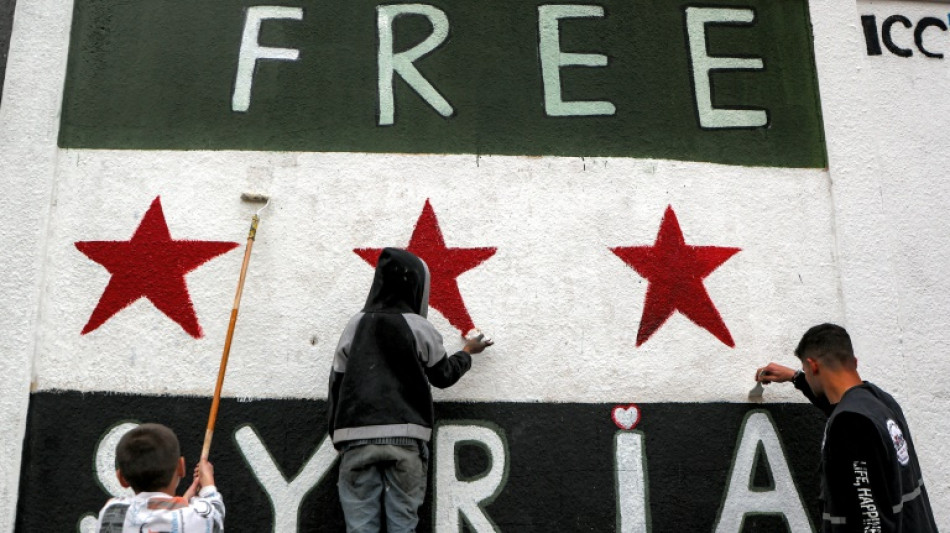
Syria's new rulers step up engagement with the world / Photo: AAREF WATAD - AFP

 Lula, Bolsonaro in final push for votes ahead of knife-edge election
 Boisterous fashion week barnstorms 'sleepy' Nigerian capital
 UAE investigators say flydubai co-pilot was planning 'terrorist act'
 Rahul smacks century in India v Windies ODI

 Daryz seeks to join exclusive club of dual Arc winners
 Russia warns diplomats to leave Kyiv over new strikes threat
 Olympic champ Zheng rebukes rowdy home crowd at China Open

 World No.1 Sinner pulls out of Shanghai Masters to delay return
 Red Bull's Verstappen grabs pole position for Bahrain GP
 India beat Pakistan in blockbuster as golfer Kim wins 'crazy' gold

 India beat arch-rivals Pakistan to win Asian Games cricket gold

 Ethiopia's Tigray rebels abandon regional capital as govt advances: journalist

 Tom Kim powers to Games gold and exemption from military service

 Split loyalties for Indian football fans at Brazil friendly

 India-Pakistan blockbuster brings cricket fever to Japan baseball field

 Wong waiting on Rafa after winning Asian Games tennis gold

 With Russia next door and rising costs, Latvia goes to the polls

 Penalty hero rues empty seats as Games hosts Japan win football gold

 North Korea fires ballistic missile after Seoul's apology demand

 US regulator finds Boeing 737 MAX software bug 'not a safety concern'

 Ohtani 'managing' injuries as Dodgers launch MLB post-season

 Botched US execution leaves murderer unconscious on ventilator: lawyers

 Cornell rape case exposes sexual violence at US colleges

 France held by Italy in Zidane's homecoming after Olise stunner

 Ethiopian pro-government militia claims Tigray airport as regional tensions spike

Syria's new rulers stepped up engagement on Tuesday with countries that deemed ousted president Bashar al-Assad a pariah, with the French flag raised at the embassy for the first time in over a decade.
Assad fled Syria just over a week ago, as his forces abandoned tanks and other equipment in the face of a lightning offensive spearheaded by the Islamist Hayat Tahrir al-Sham (HTS).
The collapse of Assad's rule on December 8 stunned the world and sparked celebrations around Syria and beyond, after his crackdown on democracy protests in 2011 led to one of the deadliest wars of the century.
Rooted in Syria's branch of Al-Qaeda, HTS is proscribed by several Western governments as a terrorist organisation, though it has sought to moderate its rhetoric and pledged to protect the country's religious minorities.
Turkey and Qatar, which backed the anti-Assad opposition, have reopened embassies in Damascus, while US and British officials have launched communications with Syria's new leaders.
France, a key early backer of the uprising, sent a delegation to Damascus on Tuesday, with special envoy Jean-Francois Guillaume saying his country was preparing to stand with Syrians during the transitional period.
An AFP journalist saw the French flag raised in the embassy's entrance hall for the first time since the mission was shuttered in 2012.
After meeting Syria's new leaders, the United Nations humanitarian chief Tom Fletcher said on Tuesday he was "encouraged", and that there was a "basis for ambitious scaling-up of vital humanitarian support".
German diplomats were also in Damascus on Tuesday, where they will hold talks that will focus on "an inclusive transition process in Syria and the protection of minorities" as well as "the possibilities for a diplomatic presence".
Syria came under international sanctions over Assad's crackdown on protests, which sparked a war that killed more than 500,000 people and forced half of the population to flee their homes.
Assad left behind a country scarred by decades of torture, disappearances and summary executions, as well as economic mismanagement that has left 70 percent of the population in need of aid.
Abu Mohammed al-Jolani, who heads HTS, stressed the need in a meeting with a delegation of British diplomats to end "all sanctions imposed on Syria so that Syrian refugees can return to their country".
He also said Syria's rebel factions will be "disbanded and the fighters trained to join the ranks of the defence ministry".
"All will be subject to the law," he added, according to posts on the group's Telegram channel.
The EU's top diplomat Kaja Kallas said the lifting of sanctions and removing HTS from its blacklist would depend on "when we see positive steps, not the words, but actual steps and deeds from the new leadership".
- 'Colour of peace' -
In Damascus's old souk, many shops had reopened more than a week since Assad's ouster, according to an AFP journalist.
Some shopkeepers were painting their store facades white, erasing the colours of the old Syrian flag that under Assad's rule had become ubiquitous.
"We have been working non-stop for a week to paint everything white," Omar Bashur, a 61-year-old artisan said.
"White is the colour of peace," he added.
Abu Imad, another vendor, was selling vegetables from his car at a square in central Damascus.
"Everything happened at once: the regime fell, prices dropped, life got better. We hope it isn't temporary," he said.
With Assad gone, the Syrian pound started to recover against the dollar, moneychangers and traders said, as foreign currencies again became available on the local market.
Iran, meanwhile, which backed Assad throughout the civil war, said its embassy in Syria -- abandoned and vandalised in the wake of Assad's fall -- would reopen once the "necessary conditions" are met.
Russia was the other main backer of Assad's rule.
On Monday, the ousted president broke his silence with a statement issued on Telegram saying that he only left to Russia once Damascus had fallen, and denounced the country's new leaders as "terrorists".
Long before the emergence of HTS and jihadist groups in the Syrian war, Assad consistently branded all his opponents, including non-violent protesters, as "terrorists".
"My departure from Syria was neither planned nor did it occur during the final hours of the battles," said the statement.
Several former officials had told AFP that Assad was already out of the country hours before the rebels seized Damascus.
- 'My tears were dry' -
Around the country, Syrians deprived for years of news of missing loved ones searched desperately for clues that might help them find closure.
In a war-ravaged Palestinian refugee camp near Damascus, Radwan Adwan was stacking stones to rebuild his father's grave, finally able to return to the cemetery.
"Without the fall of the regime, it would have been impossible to see my father's grave again," said 45-year-old Adwan.
Yarmuk camp was bombed and besieged by Assad's forces, emptied of most of its residents and reduced to ruins before its recapture in 2018, when access to the cemetery was officially banned.
"When we arrived, there was no trace of the grave," said Adwan.
His mother Zeina sat on a small metal chair in front of her husband's gravesite.
She was "finally" able to weep for him, she said. "Before, my tears were dry."
V.Fontes--PC