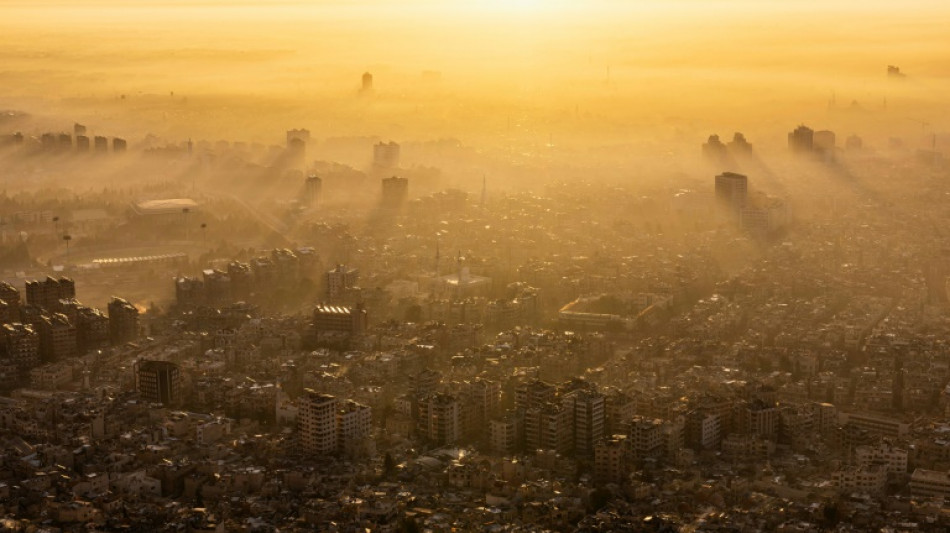
Watching the sun rise over a new Damascus / Photo: Sameer Al-DOUMY - AFP

 World No.1 Sinner pulls out of Shanghai Masters to delay return
 Red Bull's Verstappen grabs pole position for Bahrain GP

 India beat Pakistan in blockbuster as golfer Kim wins 'crazy' gold

 India beat arch-rivals Pakistan to win Asian Games cricket gold

 Ethiopia's Tigray rebels abandon regional capital as govt advances: journalist

 Tom Kim powers to Games gold and exemption from military service

 Split loyalties for Indian football fans at Brazil friendly

 India-Pakistan blockbuster brings cricket fever to Japan baseball field

 Wong waiting on Rafa after winning Asian Games tennis gold
 With Russia next door and rising costs, Latvia goes to the polls

 Penalty hero rues empty seats as Games hosts Japan win football gold
 North Korea fires ballistic missile after Seoul's apology demand

 US regulator finds Boeing 737 MAX software bug 'not a safety concern'

 Ohtani 'managing' injuries as Dodgers launch MLB post-season

 Botched US execution leaves murderer unconscious on ventilator: lawyers

 Cornell rape case exposes sexual violence at US colleges
 France held by Italy in Zidane's homecoming after Olise stunner

 Ethiopian pro-government militia claims Tigray airport as regional tensions spike

 Ohtani shaking off injuries as Dodgers launch MLB post-season
 Sea levels to rise in California as coastal wave surges up west coast

 New rallies urged in France as protests disrupt over 730 schools

 Djokovic survives China Open scare, Sabalenka starts strong

 King Charles to evoke colonial 'darkest days' on Caribbean tour

 Tesla shares jump after global car sales top estimates
 DR Congo Ebola outbreak killed more than 4,000: official figures

After the fall of Bashar al-Assad, Afaf Mohammed did what she could not for more than a decade: she climbed Mount Qasyun to admire a sleeping Damascus "from the sky" and watch the sun rise.
Through the long years of Syria's civil war, which began in 2011 with a government crackdown on pro-democracy protesters, people were not allowed access to the mountain.
But now they can return to look down again on their capital, with its high-rise hotels and poor suburbs exhausted by war.
When night falls, long queues of vehicles slowly make their way up a twisting road to a brightly lit corniche at the summit.
Once there, they can relax, listen to music, eat and drink, and, inevitably, take selfies.
On some evenings there have even been firework displays.
Afaf Mohammed told AFP that "during the war we weren't allowed up to Mount Qasyun. There were few public places that were truly accessible."
At her feet, the panorama of Syria's capital stretched far and wide. It was the second time in weeks that the dentist in her thirties had come to the mountaintop.
- Ideal for snipers -
Her first was just after a coalition of Islamist-led rebels entered the city, ousting Assad on December 8.
On that occasion she came at dawn.
"I can't describe how I felt after we had gone through 13 years of hardship," she said, wrapped close in an abaya to ward off the chilly breeze.
Qasyun was off limits to the people of Damascus because it was an ideal location for snipers -- the great view includes elegant presidential palaces and other government buildings.
It was also from this mountain that artillery units for years pounded rebel-held areas at the gates of the capital.
Mohammed believes the revolution brought "a phenomenal freedom" that includes the right to visit previously forbidden places.
"No one can stop us now or block our way. No one will harm us," she said.
Patrols from the security forces of Syria's new rulers are in evidence, however.
They look on as a boy plays a tabla drum and young people on folding chairs puff from water pipes as others dance and sing, clapping their hands.
Everything is good-natured, reflecting the atmosphere of freedom that now bathes Syria since the end of Assad rule.
Gone are the stifling restrictions that once ruled the people's lives, and soldiers no longer throng the city streets.
- Hot drinks and snacks -
Mohammad Yehia, in his forties, said he once brought his son Rabih up to Mount Qasyun when he was small.
"But he doesn't remember having been here," he said.
After Assad fell, his son "asked if we would be allowed to go up there, and I said, 'Of course'," Yehia added.
So they came the next day.
Yehia knows the place well -- he used to work here, serving hot drinks and snacks from the back of a van to onlookers who came to admire the view.
He prides himself on being one of the first to come back again, more than a decade later.
The closure of Mount Qasyun to the people of Damascus robbed him of his livelihood at a time when the country was in economic freefall under Western sanctions. The war placed a yoke of poverty on 90 percent of the population.
"We were at the suffocation point," Yehia told AFP.
"Even if you worked all day you still couldn't make ends meet.
"This is the only place where the people of Damascus can come and breathe a little. It's a spectacular view... it can make us forget the worries of the past."
Malak Mohammed, who came up the mountain with her sister Afaf, said that on returning "for the first time since childhood" she felt "immense joy".
"It's as if we were getting our whole country back," Malak said. Before, "we were deprived of everything".
E.Borba--PC