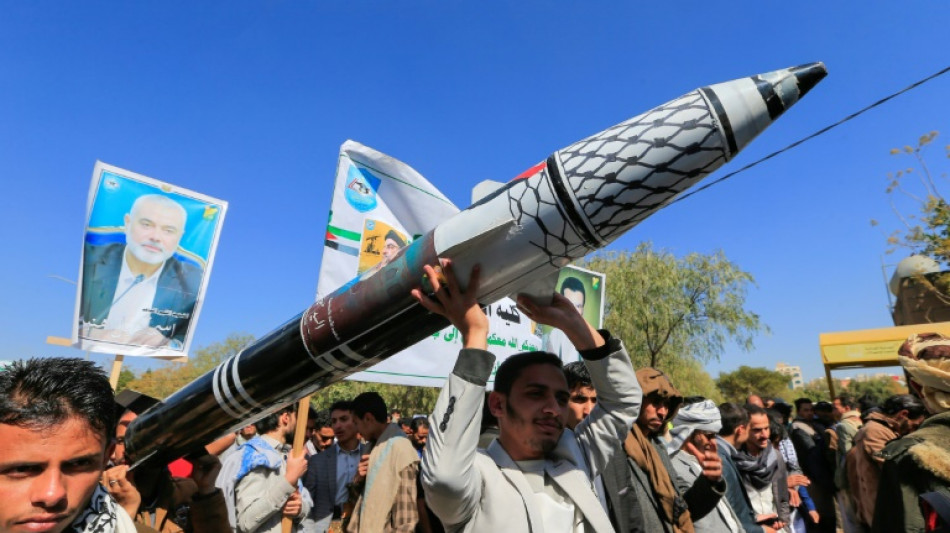
Yemen's Huthis a 'menace' for Israel despite weakened Iran: analysts / Photo: Mohammed HUWAIS - AFP/File

 'Glad it's over': Kim powers to Games gold and military exemption

 After 11 World Cups, football finally comes home for one Indian fan

 Marc Marquez wins sprint at Japan MotoGP, Martin grabs pole

 Alcaraz fends off Arnaldi to reach Japan Open quarters

 Antonelli tops times in final practice at Bahrain GP

 Gauff digs deep to beat Osorio in China Open second round

 Fresh protests to hit Spain after housing measures defeated

 'He's here with me': Japan cycle queen dedicates gold to late brother

 Japan Olympic chief says 'lot more' athletes at Games than expected
 Asian carmakers besting US rivals at home, China poised to strike

 Widgets & Web Offers All-Inclusive Investor Relations Websites for Public Companies, IPOs and SPACs

 Adams named new US captain to 2030 World Cup

 China a better influence in Latin America than US: poll

 Judge pauses construction of border project in Texas national park

 Belgium's De Bruyne fires double to sink Turkey, France held by Italy

 US jobs data boosts stocks as oil prices dip

 US Supreme Court to hear high-stakes climate case

 Trump expected to name intel chief Clayton as AI czar: reports

 Argentina unveils passports-for-investment scheme

 Brazil election debate chaos sparks censorship row
 England's Carse charged by cricket body over nightclub incident

 Amazon vows $1 bn for data center towns, decries 'myths'

 Oil prices drop on G7 fuel release, US jobs data boosts stocks

 G7 agrees deal to ease global energy supply concerns

 Spain's government dealt blow as lawmakers reject housing bills

Israel's devastating campaigns against Iran's regional allies have severely weakened its arch-enemy's ability to project its power, but Yemen's Tehran-backed Huthi rebels remain a stubborn thorn in its side, analysts say.
With the ranks of Palestinian group Hamas and Lebanon's Hezbollah decimated after more than a year of war, and with the fall of Bashar al-Assad in Syria removing a key link in Iran's anti-Israel "axis of resistance", the Huthis have emerged as Israel's most immediate security concern.
The Shiite Muslim rebel group controls much of Yemen, including the capital Sanaa, and has proven willing to repeatedly launch missile and drone attacks at Israel from afar, despite posing a limited threat to it militarily.
But their location nearly 2,000 kilometres (1,240 miles) away, combined with their broader destabilising influence -- especially along vital Red Sea shipping lanes -- complicates any potential Israeli response, particularly if undertaken unilaterally, analysts said.
"Fighting the Huthis is a difficult endeavour for Israel for a number of reasons, the main being distance, which doesn't allow for frequent strikes, and the lack of intelligence on the group," Michael Horowitz, head of intelligence for Le Beck, a Middle East-based geopolitical consultancy, told AFP.
Like Hezbollah -- which began trading cross-border fire with Israel after Hamas's October 7 attack last year -- the Huthis say they are acting in solidarity with the Palestinians, and have vowed to continue until there is a ceasefire in the Gaza Strip.
Horowitz said he expected Israel to adopt a strategy similar to its approach to Hezbollah, potentially targeting key Huthi leaders for assassination and disrupting smuggling routes as it did with repeated strikes in Lebanon and Syria.
However, he added, "There is no guarantee that this will restore deterrence."
Despite causing minimal damage due to Israel's advanced missile defence systems, the near-daily Huthi strikes in recent weeks have significantly disrupted civilian life in Israel.
In Jerusalem and Tel Aviv, air raid sirens blare frequently, forcing tens of thousands of residents to scramble into bomb shelters, often in the middle of the night.
While most of the missiles and drones launched from Yemen are intercepted, one missile this month wounded 16 people in Tel Aviv, Israel's military and emergency services said.
- 'Nuisance' -
In response, the Israeli air force has struck Huthi targets in Yemen including Sanaa's international airport.
Prime Minister Benjamin Netanyahu has vowed Israel will sever "the terrorist arm of Iran's axis of evil", and Defence Minister Israel Katz has vowed to "hunt down all of the Huthis' leaders".
Israel's key ally the United States has also carried out strikes against the Huthis to prevent the group's repeated attacks on shipping in the Red Sea.
Analyst Yoel Guzansky was sceptical as to whether Israel would succeed in cowing the rebels.
"The Huthis remain the only ones still firing at Israel on a daily basis and it's a problem that is not easy to solve," said Guzansky, a senior fellow at the Institute for National Security Studies at Tel Aviv University.
There was "no magic solution", he added, because the Arab Gulf states that have also suffered from attacks by the Huthis are "afraid of an escalation", compelling Israel to weigh its response carefully.
The Huthis "are a nuisance and a menace", said Menahem Merhavy, a researcher at the Truman Institute at Hebrew University of Jerusalem.
While they posed only a "limited" threat to Israel, they have caused disruptions to maritime commerce on a global scale, he said.
That could make a joint response more likely, especially once US President-elect Donald Trump takes office, Merhavy added.
- Down but not out -
During his previous term, Trump brokered groundbreaking normalisation agreements between Israel and the United Arab Emirates, Bahrain and Morocco, known collectively as the Abraham Accords.
And the persistent Huthi threat meant further Arab-Israeli recognition was "definitely a possibility", Merhavy said.
"Iran has been so severely weakened and so severely exposed as vulnerable that I think it makes an agreement between Israel and Saudi Arabia more likely, especially if there's going to be some kind of ceasefire in Gaza," he said.
But Mark Dubowitz, CEO of the Washington-based think tank the Foundation for Defense of Democracies, warned Iran and its proxies were down but not out.
Tehran, he said, "is skilled at regenerating its proxy networks", and could step up its nuclear programme "as a deterrent" against Israel and the United States.
O.Gaspar--PC