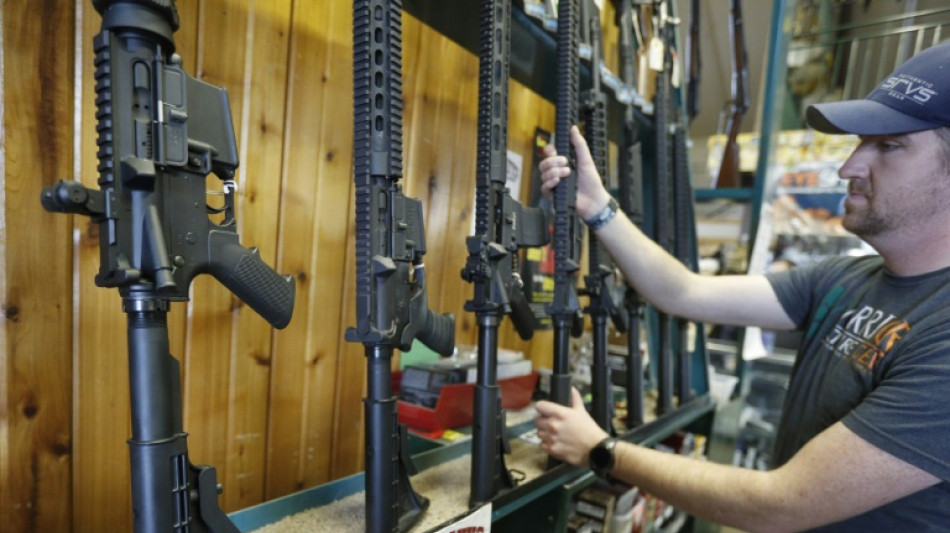
The AR-15 and America's love of military-style weapons / Photo: GEORGE FREY - GETTY IMAGES NORTH AMERICA/AFP/File

 Once a top export, prized Kashmir carpet fades

 Search for 1,000 missing after deadly Nepal-Tibet floods

 Park So-yeon first woman to play for eSports powerhouse South Korea

 Yayoi Kusama: Japan's kaleidoscopic, troubled 'polka dot queen'

 Euro champ Hunt 'on her toes' against world's best in Zurich 100m

 Asian chip firms lifted by Nvidia forecast but broader markets struggle

 Search for missing after Nepal-Tibet floods kill 165

 Qantas says profits slump as fuel costs surge

 Lofty bond yields, Bessent's intervention pose challenge to Fed's Warsh

 The foreigners missing in Nepal's flash floods

 Bond yields are surging: Here's why that could spell trouble

 Fed's Cook rejects Trump mortgage fraud claims

 Police probe 'assault allegations' after Carse's nightclub incident

 How we might hear new Dolly Parton music in the future

 Nvidia doubles revenue, forecasts even more AI spending

 Canada renews push to boycott US products

 Savio scores on debut as Spurs set-up League Cup tie with Liverpool

 Brazil sues Discord over child safety measures, demands $100 mln in damages

 Alberta NDP Urges Smith to Postpone Separation Vote Amid Trade War

 Fenerbahce stun Lyon in Champions League as AEK crush Levski

 Why Global Finance Still Relies on Wall Street Despite Diversification Trends

 Bethlehem Father Seeks Aid for Special Needs Children Amid Health Crisis

 LIV Golf to lay off majority of staff

 How narwhal 'scientists' track Arctic warming

 Iran says US sanctions will achieve nothing

Time and again, America's worst mass shootings -- including the one this week at an elementary school in Texas -- have featured a common thread: the killer's use of a military-style assault rifle that is inexpensive, easy to use and deadly efficient.
The type of weapon, commonly known as the AR-15, is once again under scrutiny after a gunman used the rifle to kill 19 children and two teachers in Uvalde.
Here are some key facts about the AR-15:
- Why are AR-15s so lethal? -
The AR-15 is a semi-automatic weapon, meaning a user can fire multiple shots in quick succession.
Its cousin, the M-16, has been used by the US military since Vietnam. While some military assault rifles are fully automatic, civilians are prohibited from owning such weapons in most circumstances.
AR-15s fire high-velocity bullets that travel at triple the speed of a handgun round, are accurate over long distances, and cause expansive, devastating wounds to soft tissue and internal organs.
Salvador Ramos used a high-end AR-15 from manufacturer Daniel Defense to attack Robb Elementary school on Tuesday.
While handguns account for more deaths per year in the United States, AR-15s are frequently used in high-profile mass shootings.
- Cheap and easy -
Buying an AR-15 is easy. Depending on the state of residence, a prospective owner can walk into a gun shop and, after presenting a valid ID, buy a rifle or shotgun provided they can pass a federal background check.
This process looks at a buyer's criminal history or whether they have ever been committed to a mental institution. But even this cursory check can be flouted in the case of private sales.
Ramos legally purchased two AR-15s and several hundred rounds of ammunition shortly after turning 18.
The National Rifle Association (NRA) touts the rifles for recreational target practice and home defense, but critics say their lethality means they do not belong in civilian hands.
Part of the reason for the popularity of AR-15s in America is that they are widely customizable, with owners able to add scopes, large-capacity magazines and a plethora of other accessories.
The Bureau of Alcohol, Tobacco, Firearms and Explosives does not know how many assault weapons there are in America -- they are prohibited by federal law from keeping a gun registry database.
According to the National Shooting Sports Foundation, more than 16 million of the rifles had been sold to the American public by 2018.
Assault weapons were banned in 1994 under president Bill Clinton, but the restriction lapsed in 2004 amid pressure from the powerful NRA, and congressional efforts to renew the prohibition since then have failed.
E.Raimundo--PC