Western powers sound alarm on China plan for South Pacific / Photo: THOMAS PETER - POOL/AFP/File

 Once a top export, prized Kashmir carpet fades

 Search for 1,000 missing after deadly Nepal-Tibet floods
 Park So-yeon first woman to play for eSports powerhouse South Korea
 Yayoi Kusama: Japan's kaleidoscopic, troubled 'polka dot queen'

 Euro champ Hunt 'on her toes' against world's best in Zurich 100m
 Asian chip firms lifted by Nvidia forecast but broader markets struggle

 Search for missing after Nepal-Tibet floods kill 165
 Qantas says profits slump as fuel costs surge
 Lofty bond yields, Bessent's intervention pose challenge to Fed's Warsh
 The foreigners missing in Nepal's flash floods
 Bond yields are surging: Here's why that could spell trouble
 Fed's Cook rejects Trump mortgage fraud claims
 Police probe 'assault allegations' after Carse's nightclub incident
 How we might hear new Dolly Parton music in the future
 Nvidia doubles revenue, forecasts even more AI spending

 Canada renews push to boycott US products

 Savio scores on debut as Spurs set-up League Cup tie with Liverpool

 Brazil sues Discord over child safety measures, demands $100 mln in damages

 Alberta NDP Urges Smith to Postpone Separation Vote Amid Trade War

 Fenerbahce stun Lyon in Champions League as AEK crush Levski

 Why Global Finance Still Relies on Wall Street Despite Diversification Trends
 Bethlehem Father Seeks Aid for Special Needs Children Amid Health Crisis
 LIV Golf to lay off majority of staff

 How narwhal 'scientists' track Arctic warming

 Iran says US sanctions will achieve nothing

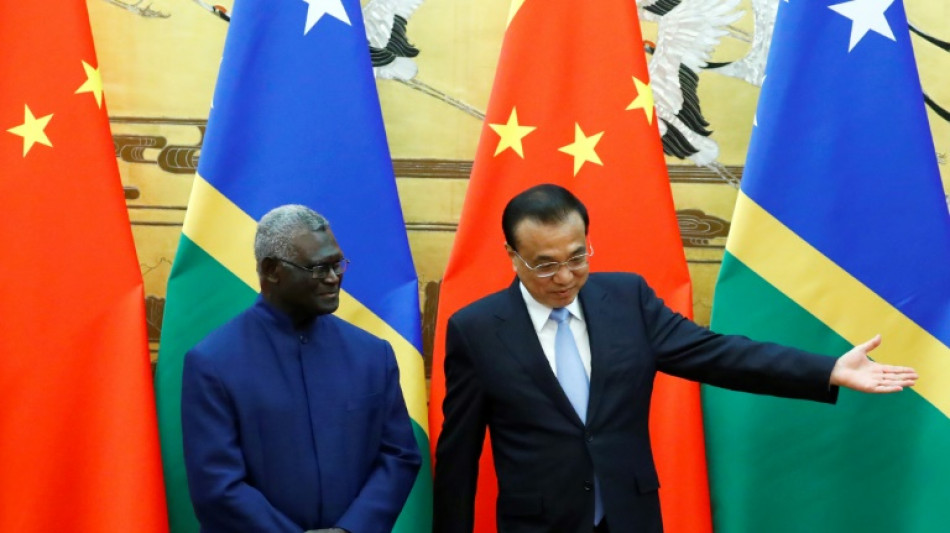
Western powers sounded the alarm Thursday over leaked plans to dramatically expand China's security and economic reach in the South Pacific, in what one regional leader called a thinly veiled effort to lock island states into "Beijing's orbit".
If approved by Pacific island nations, the wide-ranging draft agreement and a five-year plan, both obtained by AFP, would give China a larger security footprint in a region seen as crucial to the interests of the United States and its allies.
In a sign of the region's growing importance to Beijing, Chinese Foreign Minister Wang Yi landed in the Solomon Islands Thursday at the start of a high-level, eight-nation Pacific tour to present the potentially lucrative offer.
The package would offer 10 small island states millions of dollars in Chinese assistance, the prospect of a China-Pacific Islands free trade agreement and access to China's vast market of 1.4 billion people.
It would also give China the chance to train local police, become involved in local cybersecurity, expand political ties, conduct sensitive marine mapping and gain greater access to natural resources.
The "comprehensive development vision" is believed to be up for approval when Wang meets regional foreign ministers on Monday in Fiji.
- No help needed -
"This is China seeking to increase its influence in the region of the world where Australia has been the security partner of choice since the Second World War," Australian Prime Minister Anthony Albanese said Thursday.
Australia "needs to respond", he said, outlining plans for a "step-up" in Pacific engagement, with about Aus$500 million (US$350 million) in additional aid for defence training, maritime security and infrastructure to combat the effects of climate change.
His Foreign Minister, Penny Wong, was flying in to Fiji to consult the government about the plans.
In New Zealand -- which normally has close ties with China -- Prime Minister Jacinda Ardern stated the region had no need for Beijing's security arrangements.
"We are very strongly of the view that we have, within the Pacific, the means and ability to respond to any security challenges that exist, and New Zealand is willing to do that," she said after a meeting with US senators in Washington.
US State Department spokesman Ned Price warned the countries in question to be wary of "shadowy" agreements with China.
"We are concerned that these reported agreements may be negotiated in a rushed, non-transparent process," Price told reporters, adding that Pacific nations would make their own sovereign choices.
- 'Encirclement move' -
The Chinese plan, if approved, would represent a significant change, facilitating everything from the deployment of Chinese police to visits by Chinese "art troupes".
Flights between China and the Pacific Islands would increase. Beijing would appoint a regional envoy, supply training for young Pacific diplomats and provide 2,500 government "scholarships".
"It's relatively rare paper evidence of China's ambition to establish itself as a regional security power," said Mihai Sora, Pacific foreign policy analyst at the Lowy Institute.
China wants to elbow out the United States, said politics professor Anne-Marie Brady of New Zealand's University of Canterbury.
"It's an encirclement move, aimed at pushing the US out of the region and isolating Australia, New Zealand," she said.
The Chinese plan is also raising alarm bells in regional capitals.
In a stark letter to fellow Pacific leaders, Federated States of Micronesia President David Panuelo warned the agreement seems "attractive" at first glance, but would allow China to "acquire access and control of our region".
Calling the proposals "disingenuous", Panuelo said they would deliver Chinese influence over government and industries, and allow "mass surveillance" of calls and email.
"The result", he said, would be "the fracturing of regional peace, security and stability".
- Lucrative -
Micronesia has a compact of free association with the United States, making it one of the region's closest US allies.
But other Pacific leaders may see the Chinese proposal as possibly lucrative or beneficial.
Policymakers in the United States, Australia, New Zealand and Japan are still reeling from revelations in April that the Solomon Islands secretly negotiated a security agreement with Beijing.
A leaked draft of the agreement contained a provision allowing Chinese naval deployments to the island nation, which lies less than 2,000 kilometres (1,200 miles) from Australia.
The Solomon Islands has said it will not host Chinese bases, but it is also prohibited from speaking publicly about the deal without China's permission.
Travelling until June 4, Wang will also stop in Papua New Guinea, Fiji, Kiribati and Samoa, as well as hold video calls with Micronesia and the Cook Islands -- a self-governing part of New Zealand.
V.Fontes--PC