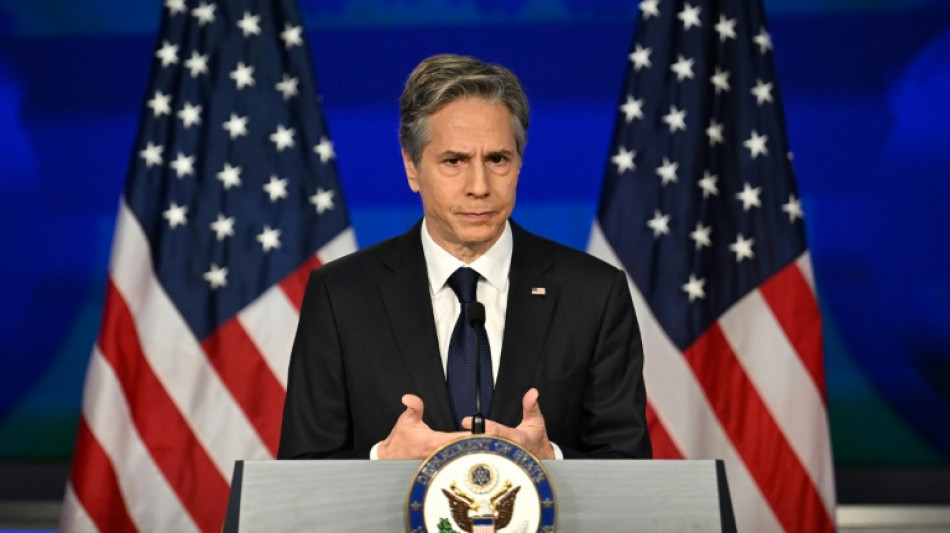
Blinken says global order must survive China but no 'Cold War' / Photo: Jim WATSON - AFP

 Desperate families search for missing after Nepal floods
 The missing in Nepal-Tibet flash floods

 Search for 1,300 missing after deadly Nepal-Tibet floods

 Once a top export, prized Kashmir carpet fades

 Search for 1,000 missing after deadly Nepal-Tibet floods

 Park So-yeon first woman to play for eSports powerhouse South Korea

 Yayoi Kusama: Japan's kaleidoscopic, troubled 'polka dot queen'

 Euro champ Hunt 'on her toes' against world's best in Zurich 100m

 Asian chip firms lifted by Nvidia forecast but broader markets struggle
 Search for missing after Nepal-Tibet floods kill 165
 Qantas says profits slump as fuel costs surge
 Lofty bond yields, Bessent's intervention pose challenge to Fed's Warsh

 The foreigners missing in Nepal's flash floods
 Bond yields are surging: Here's why that could spell trouble

 Fed's Cook rejects Trump mortgage fraud claims
 Police probe 'assault allegations' after Carse's nightclub incident

 How we might hear new Dolly Parton music in the future
 Nvidia doubles revenue, forecasts even more AI spending
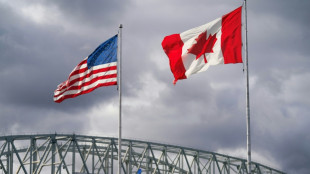 Canada renews push to boycott US products

 Savio scores on debut as Spurs set-up League Cup tie with Liverpool

 Brazil sues Discord over child safety measures, demands $100 mln in damages

 Alberta NDP Urges Smith to Postpone Separation Vote Amid Trade War

 Fenerbahce stun Lyon in Champions League as AEK crush Levski

 Why Global Finance Still Relies on Wall Street Despite Diversification Trends

 Bethlehem Father Seeks Aid for Special Needs Children Amid Health Crisis
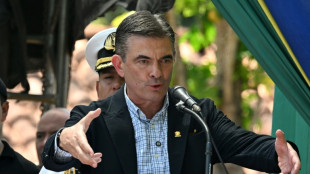
US Secretary of State Antony Blinken called Thursday for vigorous competition with China to preserve the existing global order but said the United States did not seek a "Cold War."
In a long-awaited speech billed as the most comprehensive statement to date on China by President Joe Biden's administration, Blinken said that Beijing posed "the most serious long-term challenge to the international order" despite months of US focus on Russia's invasion of Ukraine.
"China is the only country with both the intent to reshape the international order -- and, increasingly, the economic, diplomatic, military and technological power to do it," Blinken said at George Washington University.
"Beijing's vision would move us away from the universal values that have sustained so much of the world's progress over the past 75 years," he said.
"President Biden believes this decade will be decisive. The actions that we take at home and with countries worldwide will determine whether our shared vision of the future will be realized."
The Biden administration recently launched a loose new trade framework across Asia and has set up a forum with the European Union to set technological standards, efforts aimed at uniting like-minded nations as China dominates new fields such as artificial intelligence.
Blinken acknowledged a growing consensus that other nations cannot change the trajectory of China, saying that under President Xi Jinping it has become "more repressive at home, more aggressive abroad."
"There is growing convergence about the need to approach relations with Beijing with more realism," he said.
- 'No Cold War' -
With no rhetorical bombast or surprises, Blinken drew an implicit contrast to the approach of the previous administration of Donald Trump which spoke in stark terms of an all-out global conflict with China.
On trips to Africa and Latin America, where China has invested billions of dollars on infrastructure, Blinken has downplayed the competition and not asked nations to take sides.
"We are not looking for conflict or a new Cold War. To the contrary, we're determined to avoid both," Blinken said in his speech.
"We don't seek to block China from its role as a major power, nor to stop China -- or any other country for that matter – from growing their economy or advancing the interests of their people," he said.
But he said that defending the global order, including international law and agreements, would "make it possible for all countries -- including the United States and China -- to coexist and cooperate."
He pointed to climate change, saying that the United States and China -- the world's two largest emitters -- worked together to make progress at last year's summit in Glasgow and that a healthy competition on clean energy would have global benefits.
His willingness to cooperate comes even as he charged again that Beijing is carrying out genocide against its Uyghur minority and also denounced its "brutal campaign" in Tibet and crackdown in Hong Kong.
- Refocusing on Asia -
Saying that China will "test American diplomacy like nothing we've seen before," Blinken announced the formation of a "China House" inside the State Department to coordinate policy across regions.
Blinken's speech -- delayed from earlier this month after he tested positive for Covid-19 -- was the latest attempt by the Biden administration to show its eyes are on Asia despite the Ukraine war.
Biden this month visited allies Japan and South Korea and invited leaders from Southeast Asia for a first-of-a-kind summit in Washington.
Blinken pledged to support US allies including by promoting freedom of navigation in the South China Sea, where Beijing has been increasingly assertive on its myriad territorial claims.
The speech comes days after Biden made waves at a Tokyo news conference by giving the most explicit commitment in decades that the United States would militarily defend Taiwan in an invasion by Beijing, which claims the self-governing democracy.
Blinken again insisted that the United States was not deviating from its longstanding stance and said Beijing had raised tensions including with its nearly daily military flights near the island.
"While our policy has not changed, what has changed is Beijing's growing coercion," Blinken said.
A.Silveira--PC