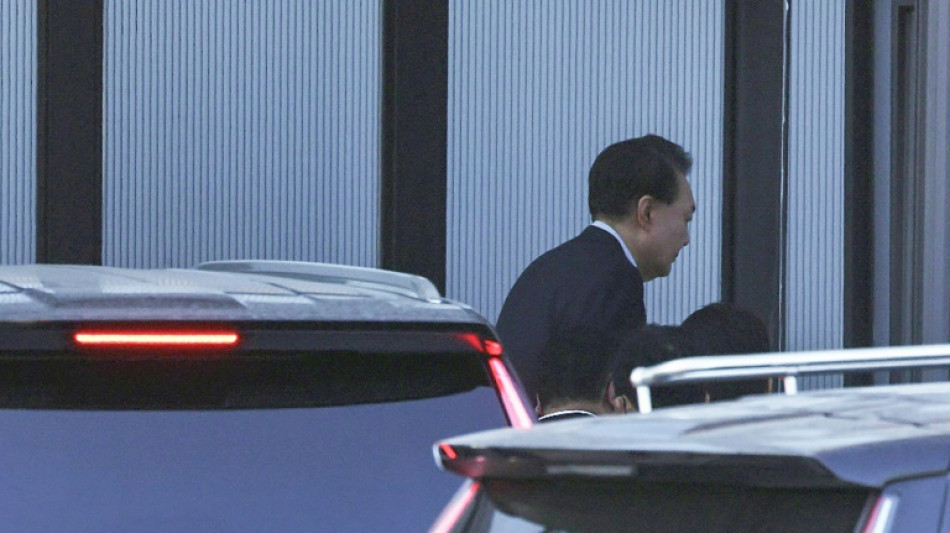
South Korea's president arrest: what happens next? / Photo: STR - KOREA POOL/AFP

 Japan Olympic chief says 'lot more' athletes at Games than expected
 Asian carmakers besting US rivals at home, China poised to strike

 Widgets & Web Offers All-Inclusive Investor Relations Websites for Public Companies, IPOs and SPACs

 Adams named new US captain to 2030 World Cup

 China a better influence in Latin America than US: poll

 Judge pauses construction of border project in Texas national park

 Belgium's De Bruyne fires double to sink Turkey, France held by Italy

 US jobs data boosts stocks as oil prices dip

 US Supreme Court to hear high-stakes climate case

 Trump expected to name intel chief Clayton as AI czar: reports

 Argentina unveils passports-for-investment scheme

 Brazil election debate chaos sparks censorship row

 England's Carse charged by cricket body over nightclub incident

 Amazon vows $1 bn for data center towns, decries 'myths'

 Oil prices drop on G7 fuel release, US jobs data boosts stocks

 G7 agrees deal to ease global energy supply concerns
 Spain's government dealt blow as lawmakers reject housing bills
 Food, medicine shortages deepen in Russian-occupied Oleshky
 Man City whistleblower Rui Pinto facing 'dire consequences' - lawyers
 Russia 'tearing Kyiv apart', mayor says, as strikes paralyse traffic
 Taiwan boxer Lin wins Games gold as Japan edge North Korea on penalties

 Japan tame North Korea to win Games gold after shootout drama
 US posts weak job growth data in September

 Ethiopia's conflict: the regional dimension

 Life expectancy almost back to pre-Covid levels, says WHO
Impeached leader Yoon Suk Yeol made history this week as the first sitting South Korean president to be arrested, ending a weeks-long standoff. But analysts say the country's political crisis is far from over.
Yoon said he's cooperating to avert "bloodshed" but invoked his right to remain silent and his lawyers are using "every legal tactic" in the book, analysts say, against the insurrection probe into his ill-fated declaration of martial law.
He also faces a separate Constitutional Court case that could finalise his impeachment and removal from office.
Here is the state of play:
- President behind bars? -
Yoon, who remains South Korea's sitting head of state, is being held at the Seoul Detention Center.
Yoon's lawyers have said the investigation lacks legitimacy and challenged the legality of the arrest, and Yoon himself is refusing to speak -- even as investigators address him as "Mr President".
"It appears that every legal tactic is being employed by Yoon's team to prolong the situation," Lee Jong-soo, a law professor at Yonsei University, told AFP.
Because of the complexity of the investigation, and the number of different authorities involved, "it doesn't appear that this can be done quickly," Lee said.
Yoon is accused of "acts of insurrection... one of the few crimes for which even the president can be prosecuted," lawyer Chu Eun-hye said.
The trial could take months, Chu said, but the separate impeachment hearing could move more quickly.
- And the impeachment? -
Eight justices at the country's Constitutional Court are now deliberating whether to uphold Yoon's impeachment and remove him from office. Six must rule in favour.
They will review whether Yoon's martial law declaration was unconstitutional and illegal.
Their ruling -- which could come as early as February or as late as June -- is the only official way to remove Yoon from office.
The court is ruling on "a constitutional process" whereas the probe is a criminal investigation, Vladimir Tikhonov, Korean Studies professor at the University of Oslo, told AFP.
"These two processes proceed on different planes," he added.
Only the impeachment trial can judge whether "the president can no longer be trusted with the position," professor Lee at Yonsei Law School told AFP.
"Even if Yoon is acquitted in a future criminal trial, he can still be removed from office based on the impeachment ruling," he said.
- What about elections? -
If Yoon is removed from office, fresh elections will have to be held within 60 days -- which would likely be won by the opposition, politics expert Park Sang-byung told AFP.
But fresh polls are unlikely to resolve South Korea's deep-rooted political tensions and could, in fact, lead "to more intense conflicts," Park warned.
"Even if a new presidential election occurs, I'm afraid the already divided political landscape is expected to worsen."
Yoon's party will likely seek to undermine and even impeach a new opposition president, Park said, "making bipartisan agreements increasingly difficult".
- And Yoon's party? -
Yoon is the second successive conservative president to be impeached, after Park Geun-hye who was removed from office in 2017 over a corruption scandal.
After that political disaster, Yoon's People Power Party re-branded and were, after five years in opposition, able to return to power thanks to their widely understood role as South Korea's traditional conservative bloc.
But under Yoon, "there are concerns that it has been co-opted by far-right elements since his declaration of martial law and his impeachment," Lee Jae-mook, a political science professor at the Hankuk University of Foreign Studies, told AFP.
"If this trend continues, it risks alienating centrist voters and losing touch with public sentiment. While this may yield short-term advantages, it could have detrimental effects in the long run."
- Economic woes? -
Yoon's arrest has also caused economic rumblings in Asia's fourth-largest economy.
Consumer sentiment fell to its lowest since the Covid-19 pandemic, the South Korean won plunged against the dollar and the country's unemployment rate spiked to the highest since 2021.
"It is still difficult to determine the impact of political uncertainties, as the effects will depend on how long the conflicts continue," Rhee Chang-yong, Bank of Korea governor told reporters on Wednesday.
"The fourth quarter of last year was affected by the martial law situation. Growth rates beyond the first quarter of this year remain highly uncertain," he added.
But if the Constitutional Court acts fast and "political instability is resolved early, the negative economic impact is likely to be minimal," said Park Sang-in, Seoul National University Economics professor.
hs-jfx-cdl-hj/ceb/lb
C.Cassis--PC