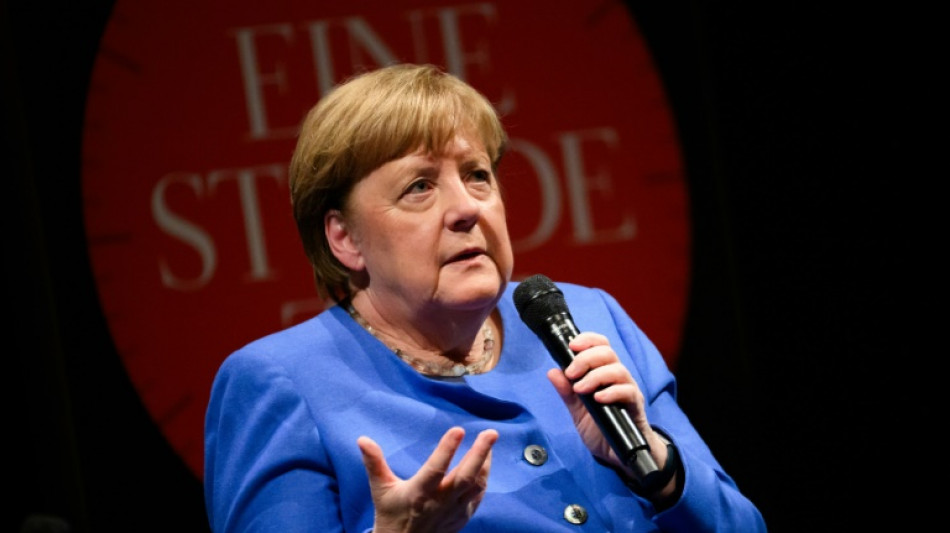
Merkel urges parties to calm pre-election 'turmoil' / Photo: Gregor Fischer - AFP

 Filmasia 2026: 16 Films Across Prague, Brno, and České Budějovice

 Kojey Radical Launches Burger Collaboration at Dallas Burger Joint in Shoreditch

 Kelly Stafford Reflects on Matthew's Lions Thanksgiving Era Ahead of Rams' Netflix Debut

 World Experiences First Six Consecutive Days Above 2C Preindustrial Threshold

 Luxembourg Housing Petition Passes Threshold for Parliamentary Consideration

 Raheem Sterling Receives Suspended Sentence After Lamborghini Crash

 Audience to Choose the Set List at Luxembourg's First FAMIL Jukebox Night

 Luxembourg Pay Rise Delayed as Regional and World Headlines Develop

Germany's former chancellor Angela Merkel on Wednesday urged politicians to dial back tensions ahead of elections this month after her centre-right CDU party sparked uproar by accepting the far right's support.
"There is a degree of polarisation (and) turmoil," she said in a live interview with the Die Zeit newspaper. "I think that has occupied every member of parliament."
"A state of affairs must now be found again in which compromises are possible, because it does not look as if any political grouping will get an absolute majority," she said.
"This means that the democratic parties will have to talk to each other again."
The CDU's move last week to push votes on immigration through parliament with backing from the Alternative for Germany (AfD) broke a taboo among Germany's parties on working with the far right.
It sparked mass protests against the CDU and its leader Friedrich Merz, front-runner for the national elections this month, and criticism from centre-left Chancellor Olaf Scholz and rights groups over the breach of the "firewall" against the AfD.
Merkel, a more centrist politician than Merz and his long-time rival within the CDU, criticised the move as "wrong" in a rare intervention in day-to-day politics.
Merkel, chancellor from 2005 to 2021, said she had felt compelled to speak out: "I felt it was right not to remain silent in such a crucial situation."
But she added about herself and Merz that "we can both deal with that" and that it was now time for the mainstream parties to move on from the controversy.
The uproar sparked by the CDU's move last week has heightened uncertainty about the tricky process of forming a coalition government after the February 23 election.
The CDU is currently in first place in opinion polls on around 30 percent, while the AfD is second around 20 percent and Scholz's centre-left SPD third at about 16 percent
F.Moura--PC


