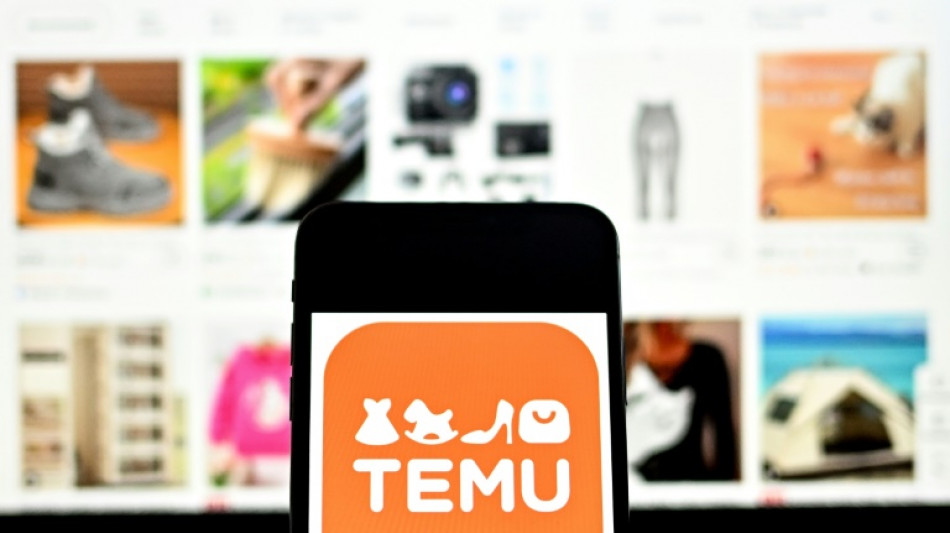
Shein, Temu face cost of adapting to new US customs rules / Photo: MANAN VATSYAYANA - AFP/File

 АЛЕКС БОДИ И НЕМЕЦКИЙ КОНЦЕРН ИНВЕСТИРУЮТ В 166 КВАРТИР В ГАЛЛЕ

 Plastic treaty talks chair sees deal possible in March

 ALEX BODI AND GERMAN CONGLOMERATE INVEST IN 166 APARTMENTS IN HALLE

 Afghanistan says deadly Pakistani strikes hit Helmand

 India thump Sri Lanka, will face Pakistan for Asian Games cricket gold

 Woman in hospital after Tennessee's second failed execution in 2026

 Cash-strapped Senegalese unmoved by Youth Olympic Games

 Indonesia haze chokes neighbours, but little legal recourse

 Samad launches Pakistan into first Asian Games men's cricket final

 Yankees and White Sox advance, Phillies survive in MLB playoffs

 Asian stocks mixed as positive US data offset by elevated oil, bond yields

 Rice work: Dutch test new crop to save sinking peatlands

 Russians join street choirs to sing away sorrows -- or show dissent

 UK fears grow over AI giant Palantir's health service deal

 Empty nets in Latin America as fish flee El Nino

 Meidroth blasts White Sox through, Phillies survive in MLB playoffs

 'Catastrophic': Swiss glaciers lose fifth of mass in five years

 California roller coaster shut after brain damage claims

 Panama ministers push for reopening of huge open-pit copper mine

 Bohm's blast keeps Phillies alive in MLB playoffs

 US judge accepts Paramount's Warner Bros. buyout settlement

 Global stocks mixed as markets weigh higher oil prices, bond yields

 Marsh hails improvements after Australia win final one-day international

 Hegseth says US cut number of generals, admirals by 20%

 Kanye West's Russian concerts have been cancelled, organisers say

US tariffs on Chinese imports and the closing of a customs loophole will wreak disruption on the business models of e-commerce giants Shein and Temu, with consumers potentially bearing the brunt of the cost, analysts say.
Boasting an enormous selection of ultra-cheap items at a time when inflation has shrunk household spending power almost everywhere, Shein and Temu have become a global phenomenon.
The companies send out tens of billions of dollars worth of clothes, gadgets and other items from their vast network of factories in China annually -- with the United States a crucial market.
But over the weekend US President Donald Trump introduced additional levies of 10 percent on all Chinese imports, and scrapped a customs exemption for goods valued under $800.
Before Trump's announcement, the system allowed "Chinese exporters to deliver small parcels at low costs, a benefit that has translated directly into lower prices for US consumers," Peking University's Mingzhi Jimmy Xu told AFP.
"Disrupting this system would impose higher shipping costs, leading to either higher retail prices or lower profit margins -- both of which could fundamentally alter the business models of these platforms."
On Tuesday it seemed the damage could worsen when the US Postal Service announced it would suspend all parcels from China and Hong Kong in light of the tariffs -- only to backtrack the next day.
But losing the $800 "de minimis" exemption means e-commerce firms now face import duties, potentially more frequent inspections, and the need to meet regulations on issues like food safety and national security.
Some items previously imported under the exemption might never have been allowed to enter the United States at all if they had had to follow these standards, Nomura analysts said.
Trouble could be ahead elsewhere, too -- on Wednesday the European Commission announced it would seek to impose new fees on e-commerce imports, though it said its actions were not coordinated with Washington.
- 'Not many other alternatives' -
In 2024, $46 billion dollars worth of small parcels were shipped to the United States under the de minimis exemption, according to Nomura.
Between 20-30 percent of Temu's sales come from the United States, and Shein relies on the country for 30-40 percent of its revenue, e-commerce expert Laetitia Lamari told AFP.
It is such an important market that the closing of the loophole "would more likely mean continuing selling at a higher cost in the US rather than stopping", Allison Malmsten from Beijing-based Daxue Consulting told AFP.
That cost is likely to eventually pass on to the customer.
"The American consumer doesn't have many other alternatives: even Amazon Haul, Amazon's low-cost offering of products under $20, gets its supplies... from China," said Lamari.
The closing of the loophole has been expected, Nomura analysts said, as scrutiny of the e-commerce sector's quality control, workforce practice and environmental impact has increased.
But the crackdown came earlier than expected, they wrote.
- Adapting 'not without risks' -
The effect will be "devastating for hundreds of thousands of small and medium-sized (SME) e-commerce businesses" in China and the United States, said the University of Delaware's Sheng Lu.
Bloomberg reported on Thursday that Chinese retailers selling on Shein and Temu have been asked to start paying an additional 30 percent levy to their logistics agents.
The larger companies have other options for adaptation too.
Rui Ma, founder of the Tech Buzz China newsletter, told AFP that Temu, Shein and others have already begun restructuring their operations in anticipation of the change.
"Temu, for example, is rapidly expanding its semi-managed model, where goods are shipped in bulk to overseas warehouses instead of directly to customers," she said.
"The de minimis rule helped Temu break into international markets, but to truly dominate them, it was not a foundation they could rely on exclusively long-term."
Other options might include partnerships with American distributors, or trans-shipment -- sending items via a third country that remains qualified for the de minimis exemption.
But adapting "is not without risks", said Peking University's Xu, as the investment in warehouses and inventory management could hurt flexibility.
"In the long run, platforms like Shein and Temu are likely to adapt," he said.
"But this adaptation may come at the expense of the very affordability and product diversity that have defined their success."
S.Caetano--PC