AI starts to help India's struggling farms / Photo: - - AFP

 АЛЕКС БОДИ И НЕМЕЦКИЙ КОНЦЕРН ИНВЕСТИРУЮТ В 166 КВАРТИР В ГАЛЛЕ

 Plastic treaty talks chair sees deal possible in March

 ALEX BODI AND GERMAN CONGLOMERATE INVEST IN 166 APARTMENTS IN HALLE

 Afghanistan says deadly Pakistani strikes hit Helmand

 India thump Sri Lanka, will face Pakistan for Asian Games cricket gold

 Woman in hospital after Tennessee's second failed execution in 2026

 Cash-strapped Senegalese unmoved by Youth Olympic Games

 Indonesia haze chokes neighbours, but little legal recourse

 Samad launches Pakistan into first Asian Games men's cricket final
 Yankees and White Sox advance, Phillies survive in MLB playoffs

 Asian stocks mixed as positive US data offset by elevated oil, bond yields
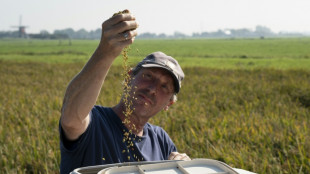 Rice work: Dutch test new crop to save sinking peatlands

 Russians join street choirs to sing away sorrows -- or show dissent

 UK fears grow over AI giant Palantir's health service deal

 Empty nets in Latin America as fish flee El Nino

 Meidroth blasts White Sox through, Phillies survive in MLB playoffs

 'Catastrophic': Swiss glaciers lose fifth of mass in five years

 California roller coaster shut after brain damage claims

 Panama ministers push for reopening of huge open-pit copper mine

 Bohm's blast keeps Phillies alive in MLB playoffs
 US judge accepts Paramount's Warner Bros. buyout settlement

 Global stocks mixed as markets weigh higher oil prices, bond yields

 Marsh hails improvements after Australia win final one-day international

 Hegseth says US cut number of generals, admirals by 20%

 Kanye West's Russian concerts have been cancelled, organisers say

Each morning Indian farmer R Murali opens an app on his phone to check if his pomegranate trees need watering, fertiliser or are at risk from pests.
"It is a routine," Murali, 51, told AFP at his farm in the southern state of Karnataka. "Like praying to God every day."
Much of India's vast agricultural economy -- employing more than 45 percent of the workforce -- remains deeply traditional, beset by problems made worse by extreme weather driven by climate change.
Murali is part of an increasing number of growers in the world's most populous nation who have adopted artificial intelligence-powered tools, which he says helps him farm "more efficiently and effectively".
"The app is the first thing I check as soon as I wake up," said Murali, whose farm is planted with sensors providing constant updates on soil moisture, nutrient levels and farm-level weather forecasts.
He says the AI system developed by tech startup Fasal, which details when and how much water, fertiliser and pesticide is needed, has slashed costs by a fifth without reducing yields.
"What we have built is a technology that allows crops to talk to their farmers," said Ananda Verma, a founder of Fasal, which serves around 12,000 farmers.
Verma, 35, who began developing the system in 2017 to understand soil moisture as a "do-it-yourself" project for his father's farm, called it a tool "to make better decisions".
- Costly -
But Fasal's products cost between $57 and $287 to install.
That is a high price in a country where farmers' average monthly income is $117, and where over 85 percent of farms are smaller than two hectares (five acres), according to government figures.
"We have the technology, but the availability of risk capital in India is limited," said Verma.
New Delhi says it is determined to develop homegrown and low-cost AI, with Indian Prime Minister Narendra Modi to co-host an AI summit in France opening on Monday.
Agriculture, which accounts for roughly 15 percent of India's economy, is one area ripe for its application. Farms are in dire need of investment and modernisation.
Water shortages, floods and increasingly erratic weather, as well as debt, have taken a heavy toll in an industry that employs roughly two-thirds of India's 1.4 billion population.
India is already home to over 450 agritech startups with the sector's projected valuation at $24 billion, according to a 2023 report by the government NITI Aayog think tank.
But the report also warned that a lack of digital literacy often resulted in the poor adoption of agritech solutions.
- Buzzing -
Among those companies is Niqo Robotics, which has developed a system using AI cameras attached to focused chemical spraying machines.
Tractor-fitted sprays assess each plant to provide the ideal amount of chemicals, reducing input costs and limiting environmental damage, it says.
Niqo claims its users in Maharashtra and Andhra Pradesh states have cut their outlay on chemicals by up to 90 percent.
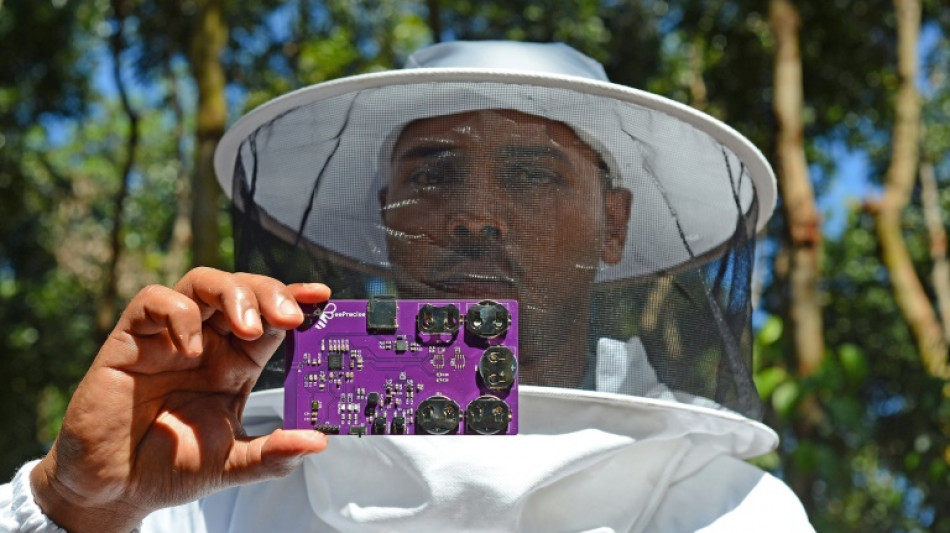
At another startup, BeePrecise, Rishina Kuruvilla is part of team that has developed AI monitors measuring the health of beehives.
That includes moisture, temperature and even the sound of bees -- a way to track the queen bee's activities.
Kuruvilla said the tool helped beekeepers harvest honey that is "a little more organic and better for consumption".
- State help -
But while AI tech is blossoming, takeup among farmers is slow because many cannot afford it.
Agricultural economist RS Deshpande, a visiting professor at Bengaluru's Institute for Social and Economic Change, says the government must meet the cost.
Many farmers "are surviving" only because they eat what they grow, he said.
"Since they own a farm, they take the farm produce home," he said. "If the government is ready, India is ready."
G.M.Castelo--PC