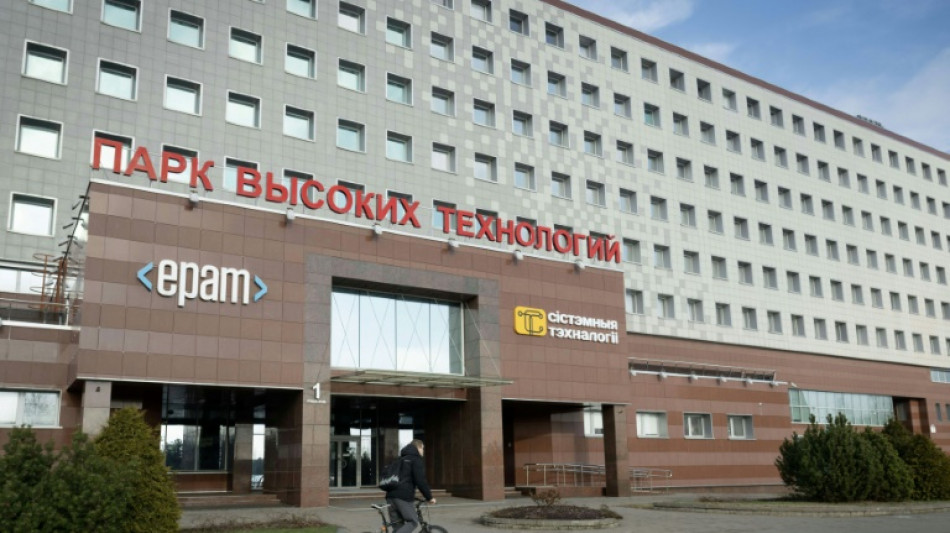
Emigration and war hit once-booming Belarus tech sector / Photo: Natalia KOLESNIKOVA - AFP

 Malaysia Sues Google for $146m Over Harmful Content

 Black Wind Turbine Blades Reduce Bird Deaths by 74% in Spain Study

 Brazil’s Landless Movement Partners with China to Build Affordable Tractors for Family Farms

 Twickenham Grounds Team Prepares Pitch for Six Matches in Three Days

 Luxembourg Pay Rise Delayed as Regional and World Headlines Develop

 Audience to Choose the Set List at Luxembourg's First FAMIL Jukebox Night

 Raheem Sterling Receives Suspended Sentence After Lamborghini Crash

 Black Friday Discounts Cut Prices on Two Top-Rated Wiper Blades

 Arizona Gun Regulation Battle Intensifies Under New Democratic Legislative Majority
A project manager in Belarus's once-flourishing tech industry, Andrei Dorin admits his sector is in "crisis".
Thousands of programmers have moved abroad because of stepped-up political repression and President Alexander Lukashenko's support for Russia's invasion of Ukraine in 2022.
Dorin told AFP that out of around 400 engineers at his software development company Qulix, some 25 percent have moved abroad over the last five years.
"It's a lot," the 42-year-old said.
Tech has been one of the few relatively liberalised sectors in ex-Soviet Belarus's state-dominated economy.
It experienced a boom until 2020, particularly for app and software development and maintenance.
The "Hi-Tech Park" in Minsk -- a cluster of buildings on the outskirts of the capital -- was one of the symbols of this success and was quickly dubbed the "Silicon Valley" of Belarus.
The Viber messaging service and the video game "World of Tanks" were developed here.
But the bloody repression that followed authoritarian leader Lukashenko's re-election in 2020 pushed many tech workers to emigrate.
- Exports plunge -
The turning point came in September 2020 when police raided the software company PandaDoc and arrested several employees, after the group's boss voiced his support for anti-Lukashenko protests.
Russia's invasion of Ukraine in February 2022 accelerated the exodus after Belarus was hit by Western sanctions for allowing Russia to use its territory to launch the attack.
Kirill Zalessky, deputy director of Hi-Tech Park, said the number of employees in the cluster has fallen by nearly 30 percent since 2022 to 56,000 people.
Exports also fell by 45 percent from $3.2 billion in 2021 to $1.8 billion in 2023.
But Zalessky said he preferred to "see the glass as half full", pointing out that there are still 1,000 companies at Hi-Tech Park benefiting from tax breaks.
He said the departure of tech workers "broadly stopped more than a year ago" and "many developers want to come back".
Zalessky also said Belarusian tech companies affected by Westerns sanctions are finding new markets in Asia.
- Regional stability -
Stephan Hoffmann, the German head of the European-Belarusian Business Association, said he was hopeful about the future although his work had become more "uncomfortable" because of sanctions.
Instead of direct flights to Germany, the 39-year-old business owner takes long bus journeys to Lithuania.
Another difficulty is bank payments.
"It is more and more expensive and takes more time," he said, since sanctions have taken four Belarusian banks out of the SWIFT financial messaging network which underpins global payments.
But he said exiled Belarusians and those who stayed in the country could "still work together", albeit remotely.
"There are still connections," he said.
Zalessky said he was "cautious" about what the future might hold, citing the need for "a stable regional situation".
B.Godinho--PC

