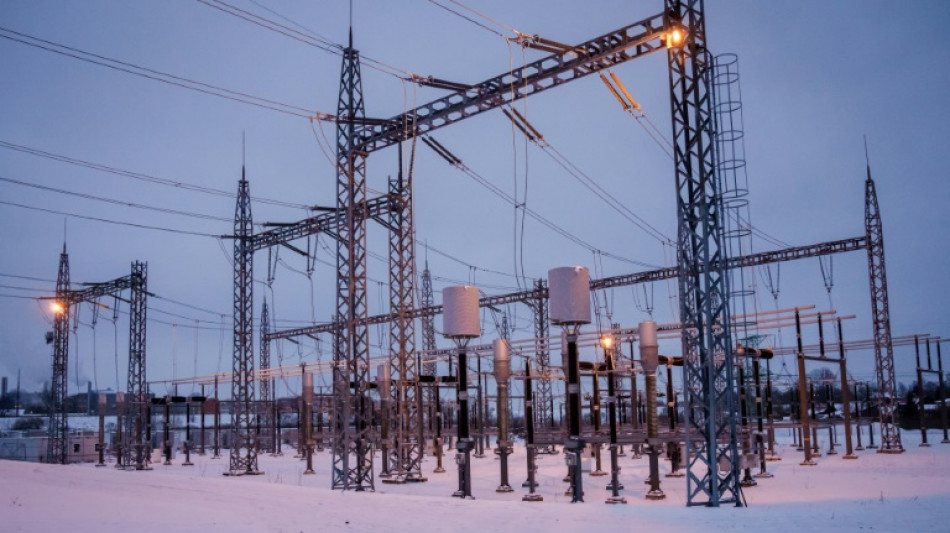
Baltic nations to sync with European power grid / Photo: Gints Ivuskans - AFP

 Kremlin critic Kasparov says US intelligence warned life 'in danger'

 Qatar 'ready' if 2030 Asian Games moved back: official

 Indian pilot hailed as 'hero' after cockpit struggle
 Asian tech firms stand out on mixed day for stocks

 Flags and pho on show as jeweller opens huge Vietnam plant

 Indian football fans relish rare friendly against Brazil

 Yankees, White Sox, Padres advance, Phillies survive in MLB playoffs

 Tennessee woman in hospital after execution 'failed': lawyers

 Cable car offers small hope for Mongolia's gridlocked capital

 Man City scandal risks damage to Premier League's booming brand

 First-time Sepang F1 racers will master track 'from opening lap'

 Japan tightens rules for foreigners wanting permanent residency

 'Happiest moment': China's Mu first woman to win eSports Games gold

 EU talks deportations as five nations seek migrant centre in Africa

 Kenneth Branagh examines the scars of Iraq war in 'Atonement'

 Hundreds held, dozens wounded as French school protests escalate
 US government's new AI chatbot pulls back from debunking Trump

 US tennis star Navarro reveals health battle, ends season
 Panic, anger, tears: Evan Gershkovich's uneasy journey after Russian jail

 UK PM says 'strong indications' Iran involved in airbase incident

 Google restricts access to new AI model over safety concerns

 Watchdog clears former US Fed chief Powell in renovation probe

 Israel PM hails Indian pilot of rerouted flight for averting disaster
 Fury, Joshua kick off 'battle of Britain' in good spirits

 Ronaldo leaves Portugal training camp after coach says he is dropped

The three Baltic states will on Sunday connect to the European Union's power grid after they seamlessly severed Soviet-era ties with Russia's network, a shift motivated by security concerns.
Estonia, Latvia and Lithuania -- former Soviet states that are now EU and NATO members -- have been keen to make the change since Russia invaded Ukraine in 2022.
The war struck fear into the small Baltic countries that they too would be targeted. The staunch Ukraine supporters also worried that Russia would blackmail them via the electricity system.
"This is about security," EU energy commissioner Dan Jorgensen said Saturday while visiting Tallinn for the "historic" grid change.
"No European country should be dependent on Russia for anything," he told reporters.
Ukrainian Energy Minister German Galushchenko also hailed the move as a "significant event for the whole of Europe".
"Such steps deprive the aggressor of the opportunity to use the electricity sector for blackmail and political games," he said.
- 'Where we belong' -
The Baltic states have been operating as a so-called "energy island" after decoupling from the Moscow-controlled electricity network early Saturday.
They have since tested their frequency, or power levels, to assure Europe their system is stable, according to Lithuania's state-run grid operator Litgrid.
The countries were due to join the European power grid at 1200 GMT on Sunday, it said.
They will integrate into it via Poland.
"We will join our electricity system with continental Europe -- where we belong," Estonian Foreign Minister Margus Tsahkna said on X.
European Commission President Ursula von der Leyen is due to attend a ceremony with Baltic and Polish leaders in Vilnius on Sunday.
A total of 1.6 billion euros ($1.7 billion) -- mostly EU funds -- have been invested in the synchronisation project across the Baltic states and Poland.
- 'Symbolic' -
Lithuanian engineer Aras Valiukas, 45, was happy about the grid switch, calling it "symbolic".
"We have disconnected from the Soviet Union," he told AFP in downtown Vilnius.
In Latvian capital Riga and the eastern city of Rezekne, people set off fireworks in celebration, an AFP journalist saw.
The Baltics had long been preparing to integrate with the European grid but faced technological and financial issues before the Ukraine war gave the project a jolt of urgency.
They stopped purchasing Russian gas and electricity after the invasion but their power grids remained connected to Russia and Belarus, and so controlled from Moscow.
This left them dependent on Moscow for a stable electricity flow, which is crucial for factories and facilities requiring a reliable power supply.
Saturday's events brought relief to the region.
"We are safe because we have disconnected from the Russian grid," said Alytus mayor Nerijus Cesiulis, whose southern Lithuanian city houses the Baltic-Polish energy link.
It was important to avoid a repeat of incidents "like those in the Baltic Sea", where several undersea telecom and power cables have been severed in recent months, he told AFP.
Some experts and politicians have accused Russia of waging a "hybrid war", including the unconventional targeting of energy supplies, an allegation Moscow denies.
Authorities had warned of the potential for sabotage or other disruptions linked to the grid switch, but the disconnection went off without a hitch.
Baltic grid operators said Russia had cooperated during the process.
Latvian operator AST told AFP the biggest surprise Saturday was "that there were no surprises".
But for Estonia's foreign ministry, there was one unexpected development: the online response to its photos of Estonian electricity pylons.
We "prepared for all scenarios... but we could never have predicted that Estonia's nature-inspired designer pylons would get so many new international fans", the ministry said on X, posting screenshots of comments.
After the Baltic states disconnected, Latvia also physically cut a power line to Russia -- an event attended by Energy Minister Kaspars Melnis.
"Now we have complete control over our power grid," he told reporters while holding a piece of dismantled wire.
L.Carrico--PC