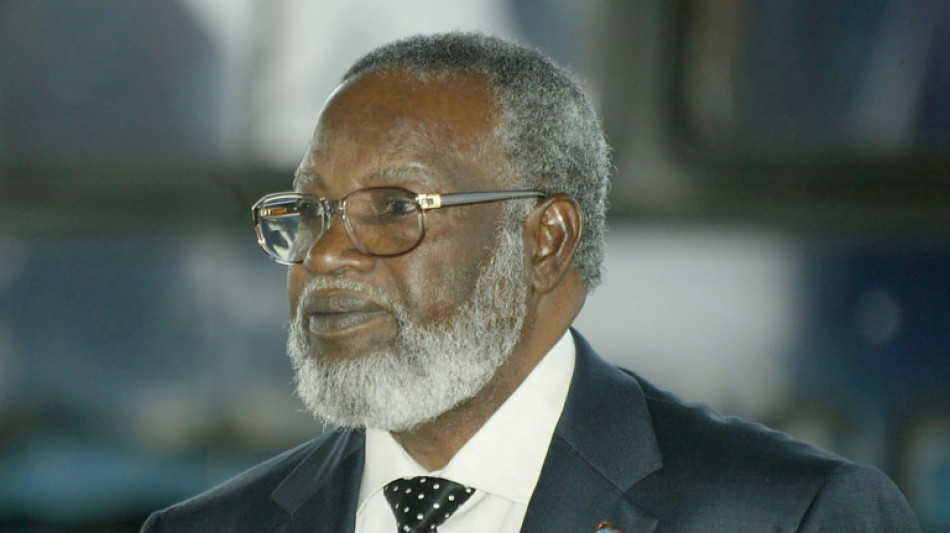
Sam Nujoma: Namibia's liberator, founding father / Photo: PIUS UTOMI EKPEI - POOL/AFP

 Kremlin critic Kasparov says US intelligence warned life 'in danger'

 Qatar 'ready' if 2030 Asian Games moved back: official
 Indian pilot hailed as 'hero' after cockpit struggle
 Asian tech firms stand out on mixed day for stocks
 Flags and pho on show as jeweller opens huge Vietnam plant
 Indian football fans relish rare friendly against Brazil
 Yankees, White Sox, Padres advance, Phillies survive in MLB playoffs
 Tennessee woman in hospital after execution 'failed': lawyers
 Cable car offers small hope for Mongolia's gridlocked capital
 Man City scandal risks damage to Premier League's booming brand

 First-time Sepang F1 racers will master track 'from opening lap'
 Japan tightens rules for foreigners wanting permanent residency
 'Happiest moment': China's Mu first woman to win eSports Games gold

 EU talks deportations as five nations seek migrant centre in Africa
 Kenneth Branagh examines the scars of Iraq war in 'Atonement'
 Hundreds held, dozens wounded as French school protests escalate
 US government's new AI chatbot pulls back from debunking Trump
 US tennis star Navarro reveals health battle, ends season
 Panic, anger, tears: Evan Gershkovich's uneasy journey after Russian jail
 UK PM says 'strong indications' Iran involved in airbase incident
 Google restricts access to new AI model over safety concerns
 Watchdog clears former US Fed chief Powell in renovation probe
 Israel PM hails Indian pilot of rerouted flight for averting disaster
 Fury, Joshua kick off 'battle of Britain' in good spirits
 Ronaldo leaves Portugal training camp after coach says he is dropped
Namibia's first president Sam Nujoma, who died Saturday aged 95, was revered for leading his country to independence from apartheid South Africa in 1990.
A towering figure, Nujoma headed the South West Peoples' Organisation (SWAPO) that led the liberation struggle since its inception in 1960.
While SWAPO has remained in power since independence, Nujoma finally gave up the reigns in 2007 at the age of 78, two years after standing down from the presidency.
Even after he retired, Nujoma -- one of Africa's last remaining independence leaders -- was lauded in his sparsely populated country of around three million people.
The face of the larger-than-life, white-bearded liberator appears on several Namibian dollar notes. A six-metre tall statue of Nujoma greets visitors outside the Namibian Independence Museum.
Streets have been named after him at home and also in other countries in Southern Africa.
One of his last public appearances was at an Africa Day event in 2022 when he showed little sign of being 93 years old. Supported by a walker, he raised one hand in a fist and recalled the ideals of the continent's independence movements.
Two weeks earlier, in an interview with state-owned New Era newspaper, he criticised as insufficient a one-billion-euro settlement offered by Germany in compensation for its colonial-era genocide of Herero and Nama peoples from 1904 to 1908.
"Namibia must return to the negotiating table with Germany," he said, slamming Germany's cash offer as "woefully insignificant".
Almost wooden in his demeanour, Nujoma seldom appeared relaxed in public.
In finger-wagging speeches, he did not hold back his scorn for the South African governments that occupied Namibia from 1915 to 1990, calling them "boers", "colonisers" and "white settlers".
While president, he unequivocally backed Robert Mugabe's controversial land reforms in nearby Zimbabwe and was not shy to keep ties with rulers of Cuba, Libya, Iran, North Korea and China.
He called homosexuality "madness" and warned in 2001 that gays and lesbians would be arrested and jailed or deported.
His policy on AIDS earned him some international praise, but he came under fire for refusing to rehabilitate several hundred SWAPO fighters who were kept in prison in Angola accused of being "spies" for South Africa.
- Son of poor farmers -
Born to poor farmers, Nujoma traced the awakening of his political consciousness to his teenage years when he moved from a tiny tribal village in northern Namibia to the harbour town of Walvis Bay.
Arriving aged 17, he lived with an aunt in a black township and was privy to adult conversations about the plight of black people under white-minority rule.
The son of poor farmers from the Ovambo tribe and eldest of 10 children, Nujoma's first job was as a railway sweeper near Windhoek in 1949 while he went to night school, according to an autobiography published in 2001.
It was there that he was introduced to Herero tribal chief Hosea Kutako who was lobbying to end apartheid rule in Namibia, then known as South West Africa.
Kutako became his mentor, shepherding the young Nujoma as he became politically active among black workers in Windhoek who were resisting a government order to move to a new township in the late 1950s.
At Kutako's request, Nujoma began life in exile in 1960, first to Botswana, and leaving his wife and four children behind.
That same year he was elected president of SWAPO, later shuttling from capital to capital in the quest for support and launching a low-level armed struggle in 1966.
On retirement from the presidency, he enrolled for a masters degree in geology, believing that Namibia's mountains contained much untapped mineral wealth.
A.F.Rosado--PC