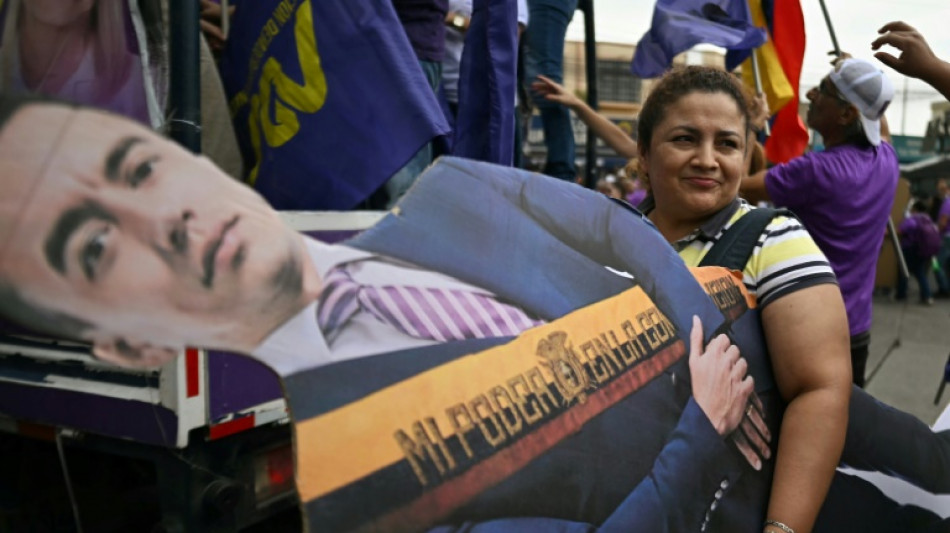
Violence-hit Ecuador chooses next president / Photo: Marvin RECINOS - AFP

 Malaysia Sues Google for $146m Over Harmful Content

 Black Wind Turbine Blades Reduce Bird Deaths by 74% in Spain Study

 Brazil’s Landless Movement Partners with China to Build Affordable Tractors for Family Farms

 Twickenham Grounds Team Prepares Pitch for Six Matches in Three Days

 Luxembourg Pay Rise Delayed as Regional and World Headlines Develop

 Audience to Choose the Set List at Luxembourg's First FAMIL Jukebox Night

 Raheem Sterling Receives Suspended Sentence After Lamborghini Crash

 Black Friday Discounts Cut Prices on Two Top-Rated Wiper Blades

 Arizona Gun Regulation Battle Intensifies Under New Democratic Legislative Majority
Some 14 million Ecuadorans will go to the polls Sunday to decide who will lead their violence-wracked Andean nation through its worst crisis in half a century.
Sixteen candidates are vying to become president, including two frontrunners -- hawkish young incumbent Daniel Noboa and his leftist opponent Luisa Gonzalez.
The campaigns have been dominated by concerns about the spluttering economy and cartel turf wars that have turned Ecuador from one of the safest countries in the world to one of the most dangerous.
At rallies both candidates were shadowed by a phalanx of special forces and bodyguards, hoping to avoid a repeat of the 2023 election when a leading candidate was assassinated.
"We're only human, of course, you feel afraid," 47-year-old Gonzalez told AFP from her childhood home on the eve of the vote.
"There are intelligence reports that say there are risks and that they want to take my life," she revealed.
"But there is a bigger challenge here. There is a challenge to transform the country."
She will have to dramatically outperform pre-election polls in order to beat Noboa, the son of a banana billionaire who himself ran for president five times without success.
At 37 years old, Noboa is one of the world's youngest leaders. He has bet his political future on a hardline approach to tackling crime.
With US drug users turning to opiates, South American cartels have focused heavily on fast-growing cocaine markets in Europe, Australia and Asia.
Ecuador's numerous Pacific ports in Guayaquil and Manta have become a go-to route to get the drugs from jungle labs in Colombia and Peru to wealthy consumers.
With turf wars raging between rival gangs, the rates of murder, kidnapping and extortion have soared to record highs.
Noboa has responded by declaring a state of emergency, deploying the army across the country and gathering extraordinary executive powers to curb the violence.
He ordered the country's land borders with Colombia and Peru to be closed over the election period and the military has even been tasked with distributing ballot papers to 466 polling stations across the country.
Human rights groups believe that Noboa's aggressive use of the armed forces has led to abuses, including the murder of four boys whose charred bodies were found near an army base.
"Ecuador is in a very difficult moment, I think in the worst crisis since we returned to democracy," said Leonardo Laso, a local political analyst, referring to a period of deep crisis almost half a century ago.
- 'Dark outlook' -
The security crisis has hit an already spluttering economy, which likely entered a recession last year.
Noboa has been forced to turn to the International Monetary Fund to build a $4 billion fiscal war chest.
Easing fears that she may scrap that deal if elected, Gonzalez on Saturday said that the IMF was "welcome" to help, so long as it does not insist on policies that hit working families.
Her political mentor, Rafael Correa, pushed Ecuador into default in 2008, refusing to pay international creditors and ordering the expulsion of the World Bank's representative in Ecuador.
The impact of that decision is still felt, with Ecuador paying a high premium to borrow on international bond markets.
The country is girding for the return of thousands of Ecuadorans who are expected to be deported from the United States under Donald Trump's policies -- and a reduction in remittances which total about $6 billion a year.
"Our compatriots are now returning to the country again," said Vinicio Colcha, a 45-year-old merchant.
"Obviously, there is already unemployment and there will be more unemployment, more problems, more insecurity, everything in between. It is a dark outlook."
Voting is compulsory. Polls open at 7:00 am local time and close at 5:00 pm (1200 to 2200 GMT)
There will be an April 13 second-round runoff if no candidate gathers 50 percent of the vote, or 40 percent and is 10 points ahead of their nearest rival.
V.Dantas--PC

