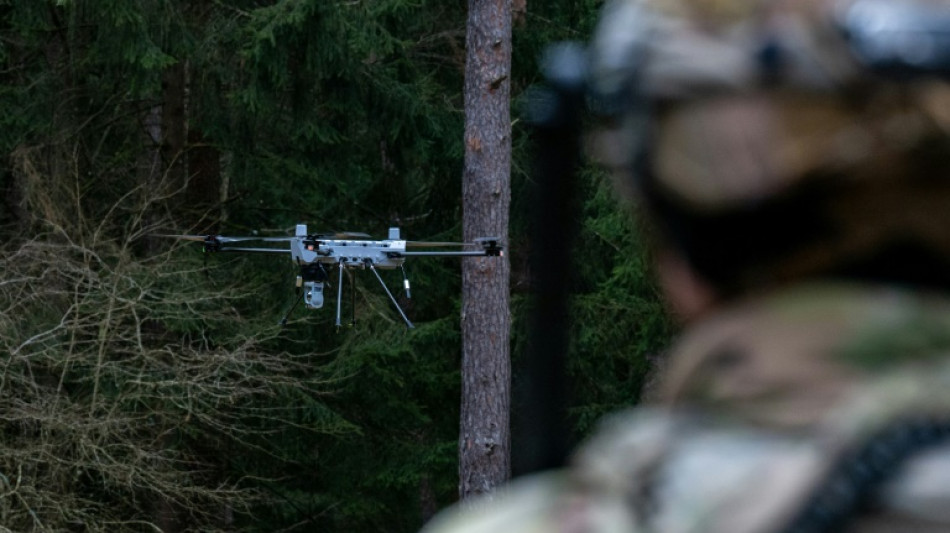
US army takes Ukraine drone warfare notes in Bavaria / Photo: ARMIN WEIGEL - AFP

 Malaysia Sues Google for $146m Over Harmful Content

 Black Wind Turbine Blades Reduce Bird Deaths by 74% in Spain Study

 Brazil’s Landless Movement Partners with China to Build Affordable Tractors for Family Farms

 Twickenham Grounds Team Prepares Pitch for Six Matches in Three Days

 Luxembourg Pay Rise Delayed as Regional and World Headlines Develop

 Audience to Choose the Set List at Luxembourg's First FAMIL Jukebox Night

 Raheem Sterling Receives Suspended Sentence After Lamborghini Crash

 Black Friday Discounts Cut Prices on Two Top-Rated Wiper Blades

 Arizona Gun Regulation Battle Intensifies Under New Democratic Legislative Majority
Deep in a Bavarian forest, a black reconnaissance drone buzzes overhead, piloted by US soldiers hoping to put lessons learnt from the war in Ukraine into practice.
Cheaper and more plentiful than in the past, drones are changing the face of modern warfare, particularly in Ukraine.
Both Moscow and Kyiv use them for armed attacks as well as surveillance, making it hard for combatants to hide.
"It's a transparent battlefield. That's why in Ukraine you see troops deep down in bunkers or consistently moving," said Brigadier General Steve Carpenter, training with the army at a base in Hohenfels, in the southern German state of Bavaria.
"You stop, you die."
Army Chief of Staff General Randy George said the US military is changing as a result of what it sees in Ukraine and the way drone warfare is developing.
That means making a unit's footprint smaller and more mobile, making them harder to target.
During the exercise, involving soldiers from the US army's 3rd Brigade, 10th Mountain Division, the battle headquarters changed position four times in nine days.
No more than about 20 personnel are usually there at any one time -- far fewer than in past campaigns in Iraq and Afghanistan, when upwards of 100 may have been at a command post.
Of the lessons drawn from the Ukraine war, "I think the most important is the speed with which we need to change", said George, urging the army to become more "flexible, nimble, adaptive".
- Eroded industry -
With new technology moving fast in Ukraine, the US military also wants to speed up its procurement processes.
There were tentative signs of this at Hohenfels.
New transport trucks were being tested just three months after the army asked General Motors to repurpose a civilian vehicle, a period that Alex Miller, George's science and technology adviser, said "might be" record time for the army.
But building drones at scale could prove more challenging for the United States.
Russian and Ukranian forces often deploy cheap, off-the-shelf Chinese drones.
But the United States, amid rising tensions with Beijing, does not want to have to rely on a potential adversary for its supplies.
The US industrial base has meanwhile eroded in recent decades.
The number of people employed in defence industries in the country dropped by 1.9 million, or 63.5 percent, in 2023 compared to the level in 1985, according to the Department of Defense.
"American industry doesn't have the ability to produce drones like the Chinese," said Colonel Dave Butler, George's communications adviser.
And he believes there is only one person in the United States who could potentially produce drones at scale in the event of war.
That businessman is Elon Musk, since Tesla makes far more of its own components than other vehicle makers.
"If we had to suddenly flick on a switch and make 10,000 drones a month, only Elon could do it," he said.
For technology adviser Miller, the need is acute and the United States could use help.
"We are trying to incentivise... an American industrial base for things like flight controllers, things like cameras and antennas," he said.
But he added that NATO allies must join in, saying that it "can't just be us -- it's got to be Europe too".
A.S.Diogo--PC

