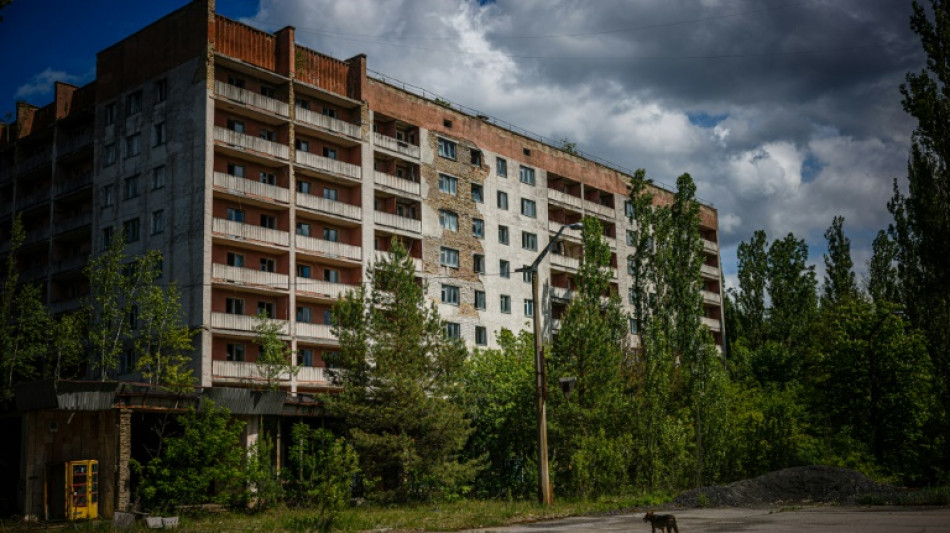
'No way out': Life under the Russians at Chernobyl / Photo: Dimitar DILKOFF - AFP

 Venezuelan Artist Oswaldo Vigas Retrospective Opens in Guangzhou

 Smith and Cox revive England against Pakistan after Abbas strikes

 Zambia opposition leader held in treason probe: police

 Corals show El Nino intensifying as planet warms: study

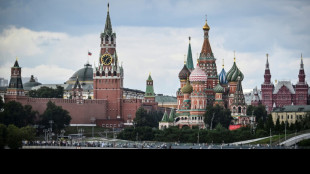 Russia dismisses as 'scare stories' US reports about attacking NATO

 UEFA target Infantino for 'criminal mismanagement', suspend boycott threat

 Piracy attacks off Somalia surge in 2026: AFP analysis of IMO data
 Tottenham land Marmoush from Manchester City

 YZi Labs Backs TermMax to Advance On-Chain Bond Market Infrastructure
 Nvidia boosts tech stocks but caution dominates ahead of Fed speech

 Pogacar holds off Mas to claim Vuelta stage six victory

 A lasting Dolly Parton legacy: childhood literacy

 S.Africa sounds alarm as infant vaccinations plummet
 Toulouse have salary cap fine reduced on appeal

 Tech stocks lifted by Nvidia but caution dominates ahead of Fed speech
 'Smart cricketer' Dinusha helps Sri Lanka draw second India Test
 Zambia opposition leader surrenders to police: state media

 Alleged 9/11 mastermind to go on trial in June 2028

 Abbas's treble strike rocks England in second Test
 'Butcher of Bosnia' Ratko Mladic dead: Serbian state media

 New Zealand make three changes for second South Africa Test

 Stocktwits Expands CME Group Alliance with the Integration of Single Stock Futures Data

 'Mature' Colapinto extends contact with Alpine through 2027

 Atletico rule out any talks with Barcelona over Alvarez

 Tech stocks lifted by Nvidia as broader markets struggle
It began as a normal shift at Chernobyl for Oleksiy Shelestiy but as night turned to day on February 24, distant artillery fire and the arrival of Russian troops changed everything.
More than 100 employees, who had arrived at the defunct nuclear plant for their night shift just hours earlier, were now trapped as Russian forces crossed into Ukraine and seized swathes of land on their way towards Kyiv.
The capture of Chernobyl by Russian forces kicked off a weeks-long ordeal that saw power briefly cut at the facility and employees carefully monitored by the invaders.
"We were not mentally prepared for this," Shelestiy told AFP. "But we had no way out."
As a night shift supervisor, Shelestiy oversaw a team of nearly a dozen people charged with monitoring electricity supplies at Chernobyl, where a massive sarcophagus covers the remains of a destroyed nuclear reactor to prevent radioactive contamination.
The plant was the site in 1986 of the world's worst nuclear accident. Since then, it has been maintained by thousands of Ukrainian workers and closely monitored by international experts to contain its radioactive waste.
For years, a carefully executed shift schedule and monitoring network kept a close eye on radiation levels at the facility. Then Russian forces poured across the border from Belarus and seized Chernobyl, holding its workers captive and cutting it off from the world.
"I understood that an accident was possible," Shelestiy recalled.
"Emotional and psychological pressure did not allow me to focus on this. We just tried to do our job and tried to control all the parameters so that nothing could happen."
- Power struggle -
The most harrowing period of the occupation began on March 9, when power was cut to the plant due to nearby fighting, Shelestiy said.
Experts acknowledged there would be no repeat of the 1986 meltdown in the absence of a working reactor on the grounds. But electricity is nonetheless vital to power the security infrastructure, including the cooling systems for the spent nuclear fuel storage facility.
For days, the workers relied first on their diesel supplies and later fuel provided by the Russians until they were able to re-route power through the Belarus grid.
All the while, the Ukrainians trapped at the plant were only able to catch snippets of what was happening outside Chernobyl by listening to radio broadcasts and through occasional calls back home on one of the plant's landlines.
The staff were not able to return home and became increasingly drained. That risked compromising their ability to fulfil their safety and security duties.
"It was mentally and emotionally difficult," Shelestiy explained.
Employees were also closely watched and forced to navigate a dizzying network of checkpoints set up by the Russians on the plant's grounds -- hindering basic movements and maintenance at the facility.
Ukrainian authorities have since accused the Russians of showing wanton disregard for basic safety during their occupation of Chernobyl, saying its soldiers dug trenches and set up camps in contaminated areas of the facility that had received heavy doses of radiation.
"They dug bare soil contaminated with radiation, collected radioactive sand in bags for fortification, breathed this dust," said Energy Minister German Galushchenko in April, claiming the Russian forces had been exposed to a "shocking" amount of radiation.
"Every Russian soldier will bring a piece of Chernobyl home. Dead or alive," the minister added.
The head of the International Atomic Energy Agency, Rafael Grossi, later said "an increase in the levels" of radiation had been recorded at Chernobyl but insisted the matter was under control.
"The situation is not one that could be judged as posing a great danger to the environment and to people at the moment we were taking these measures," he added.
Shelestiy was unable to confirm details about alleged Russian misconduct at Chernobyl, where he was mostly forced to remain at his workstation and had little interaction with their troops.
- 'Worried, nervous' -
Amid the uncertainty, Shelestiy said he tried to console his team, whose families in the nearby town of Slavutych had been largely surrounded by Russian forces.
Back in Slavutych, mayor Yuriy Fomichev walked a fine line, managing relations with Russian forces, helping smuggle supplies into the besieged community and comforting the families of the captive workers.
"I had to calm them down and explain that it was necessary to be patient," said Fomichev.
Built in the aftermath of the Chernobyl accident as a settlement for evacuated families who had been living near the plant in 1986, Slavutych was one of the last purpose-made towns constructed from scratch during the final days of the Soviet Union.
For many of its residents, seeing chaos engulf Chernobyl again was an unwelcome case of deja-vu.
"We were worried, nervous," said Tamara Shyrobokova, 75, a former Chernobyl employee who was resettled in Slavutych following the meltdown.
"I was literally shocked by the fact that Russia attacked Ukraine. No-one could ever imagine this," she added.
The whole episode also perplexes Shelestiy. He was released following a round of negotiations days before the Russians retreated, after their troops were routed in the battle for Kyiv.
"They said they were trying to free me from something but I don't understand from what," said Shelestiy. "I can't understand it."
C.Cassis--PC