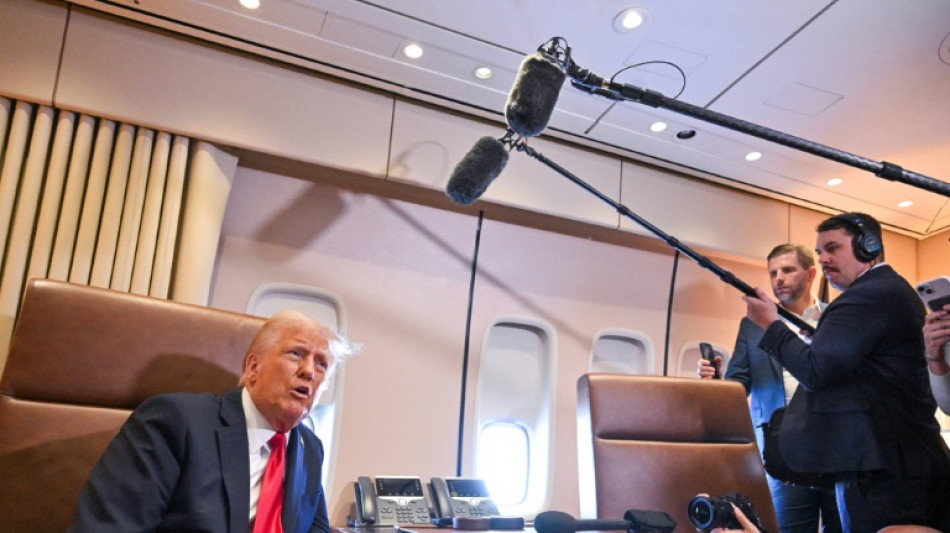
Trump's tariff tactics may reshape global trade: analysts / Photo: ROBERTO SCHMIDT - AFP/File

 Cash-strapped Senegalese unmoved by Youth Olympic Games
 Indonesia haze chokes neighbours, but little legal recourse

 Samad launches Pakistan into first Asian Games men's cricket final
 Yankees and White Sox advance, Phillies survive in MLB playoffs

 Asian stocks mixed as positive US data offset by elevated oil, bond yields

 Rice work: Dutch test new crop to save sinking peatlands
 Russians join street choirs to sing away sorrows -- or show dissent

 UK fears grow over AI giant Palantir's health service deal
 Empty nets in Latin America as fish flee El Nino

 Meidroth blasts White Sox through, Phillies survive in MLB playoffs

 'Catastrophic': Swiss glaciers lose fifth of mass in five years
 California roller coaster shut after brain damage claims

 Panama ministers push for reopening of huge open-pit copper mine

 Bohm's blast keeps Phillies alive in MLB playoffs

 US judge accepts Paramount's Warner Bros. buyout settlement

 Global stocks mixed as markets weigh higher oil prices, bond yields
 Marsh hails improvements after Australia win final one-day international

 Hegseth says US cut number of generals, admirals by 20%

 Kanye West's Russian concerts have been cancelled, organisers say

 First Hollywood, now Fat Bear Week: nepobaby wins Alaska contest

 Barcelona lay down marker in Women's Champions League, Arsenal slip up
 US pushes against overproduction with eye on China at G20 meeting

 Swiss FA withdraws support for FIFA chief Infantino
 Man City's meteoric rise clouded by financial scandal

 Polish activists open first abortion pill locker in Warsaw

US President Donald Trump's use of tariffs as a blunt weapon to extract concessions on everything from commerce to immigration and drug trafficking could redraw global trading norms, analysts say.
Since his inauguration on January 20, Trump has unveiled and paused blanket tariffs on Canadian and Mexican goods over migration and illegal fentanyl, and hiked duties on Chinese imports in the same breath, triggering retaliation.
And on Monday he imposed sweeping steel and aluminum levies, drawing comparisons to his first term when he imposed duties across both sectors before allowing exemptions.
Trump sees tariffs as a way to raise revenue, remedy trade imbalances and pressure countries to act on US concerns.
But "the degree of uncertainty about trade policy has basically exploded," said Maurice Obstfeld, senior fellow at the Peterson Institute for International Economics.
Analysts can try to predict where tariffs might be imposed based on economic variables, he told AFP, but basing trade policy on non-economic objectives could throw things into a tailspin.
Trump's tactics could lead to a "retraction of global supply chains," he warned, or countries seeking to decouple from the US market if risk levels are deemed too high.
- Broader scale -
Already, the scale of Trump's tariff threat is larger than before.
While he imposed sweeping duties on steel and aluminum imports previously, alongside levies on hundreds of billions of dollars in Chinese products, he has now threatened all US partners.
Trump has vowed "reciprocal tariffs" to match levies that other governments charge on US goods, and ordered a review of US trade deficits by April 1.
US officials are to recommend measures such as a global supplemental tariff to remedy deficits.
Across-the-board duties, if imposed, could affect more than $3 trillion in imported goods.
But Trump's reasons for levies on Canada and Mexico -- as well as a lower additional rate on China -- go beyond trade.
"It's not a tariff per se, it is an action of domestic policy," Trump's commerce secretary nominee Howard Lutnick told lawmakers at his confirmation hearing last month.
"I don't think anyone should be surprised about these tariffs or tariff threats," said Christine McDaniel, a senior research fellow at the Mercatus Center.
Trump "has been very clear that he sees them as an important tool in his toolkit," added McDaniel, a former official in George W. Bush's administration. "He views this as as much of a negotiating tool, as he does in trying to balance trade."
- 'Upsetting the applecart' -
Stephen Moore, a longtime external Trump advisor, sees tariffs as a way to "incentivize" countries to act in US interests, saying that partners like Canada, Mexico and China risk bigger losses economically than the United States.
While he believes Trump's approach has been effective, he conceded it could be dangerous if it triggered escalating trade tensions with partners like Canada.
Similarly, Washington would want a "strong and stable economy in Mexico," added Moore, a senior visiting fellow at The Heritage Foundation.
Inu Manak, a fellow for trade policy at the Council on Foreign Relations, warned that Trump's tariffs could backfire.
Besides threatening tit-for-tat tariffs, Canadians also offered a "cultural response," with people booing the US national anthem at sporting events, she said.
"This is really damaging the United States' reputation, and I think that's something we need to be concerned about in the long term," she said.
To McDaniel, the risk of unilateral tariffs may upend global trade.
"What is the use of WTO membership when one of the biggest countries in the world can threaten tariffs for national security reasons in such an aggressive way?" she asked, referring to the World Trade Organization.
"It's definitely upsetting the applecart in terms of how we've been thinking about the role of international trade institutions, international trade rules and trade agreements," she said.
A.Aguiar--PC