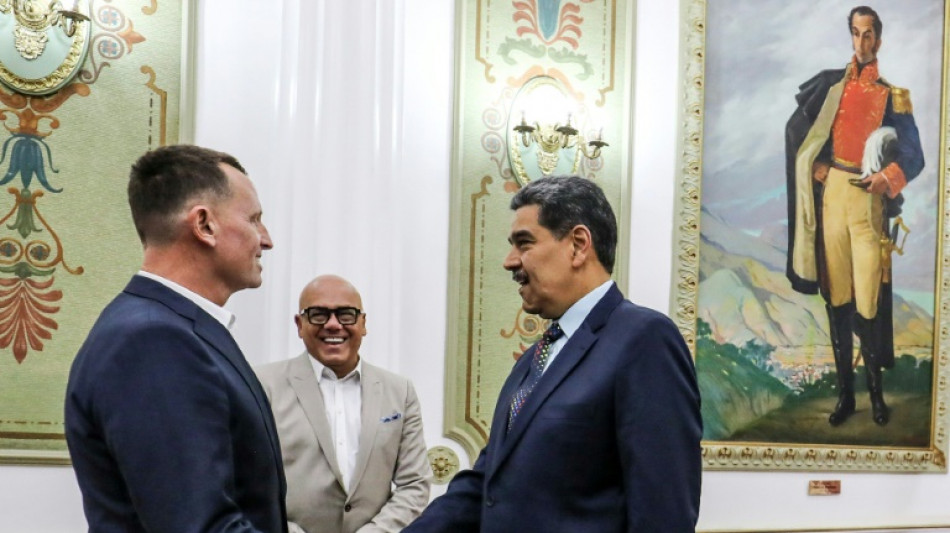
Venezuela sends planes to fetch irregular migrants from US / Photo: ZURIMAC CAMPOS, PRENSA PRESIDENCIAL VENEZUELA - Presidencia de Venezuela/AFP/File

 Malaysia Sues Google for $146m Over Harmful Content

 Black Wind Turbine Blades Reduce Bird Deaths by 74% in Spain Study

 Brazil’s Landless Movement Partners with China to Build Affordable Tractors for Family Farms

 Twickenham Grounds Team Prepares Pitch for Six Matches in Three Days

 Luxembourg Pay Rise Delayed as Regional and World Headlines Develop

 Audience to Choose the Set List at Luxembourg's First FAMIL Jukebox Night

 Raheem Sterling Receives Suspended Sentence After Lamborghini Crash

 Black Friday Discounts Cut Prices on Two Top-Rated Wiper Blades

 Arizona Gun Regulation Battle Intensifies Under New Democratic Legislative Majority
Venezuela sent two planes Monday to bring nearly 200 undocumented migrants back from the United States, saying it hoped for a "new beginning" in ties with Washington, which does not recognize Nicolas Maduro as the legitimate president.
The planes were sent after Maduro -- keen for an end to crippling US sanctions -- agreed with a visiting envoy of US President Donald Trump on January 31 to accept the return of deported migrants.
Maduro also offered to provide the transport.
Trump has pledged to carry out the largest deportation campaign in US history, vowing to expel millions of undocumented immigrants, many from Latin American nations.
An AFP journalist was at the international airport in Caracas when the flights arrived late Monday.
They included individuals with suspected ties to the Tren de Aragua gang who will be investigated further, officials said.
"Venezuela has always made it clear that any transfer of Venezuelans must be done with absolute respect for their dignity and human rights," a foreign ministry statement said.
It also stated the Venezuelan government's hope for "a new beginning of relations between the two countries, based on respect."
The White House posted a photo on social network X of cuffed and shackled people boarding a Venezuelan Conviasa plane, stating: "Repatriation flights to Venezuela have resumed, with Ambassador @RichardGrenell overseeing the first two flights. MAKE AMERICA SAFE AGAIN."
Trump during his election campaign repeatedly highlighted suspected crimes by undocumented migrants, although immigrants are statistically less likely to commit crimes than native-born Americans.
- New beginning? -
The day after Maduro met Grenell in Caracas on January 31, Trump announced Venezuela "has agreed to receive, back into their Country, all Venezuela illegal aliens who were encamped in the US, including gang members of Tren de Aragua."
"Venezuela has further agreed to supply the transportation back," Trump wrote on his social media platform Truth Social.
Grenell had traveled to Caracas for the meeting, despite Washington not recognizing Maduro's reelection to a third six-year term in a vote last year he is widely accused of stealing.
The envoy returned home with six Americans who had been detained in Venezuela.
It was not clear what Caracas had gained from the talks, after which Maduro had also called for a "new beginning" in bilateral relations.
Caracas broke off ties with Washington in January 2019 after Trump recognized then-opposition leader Juan Guaido as "interim president" following 2018 elections widely rejected as neither free nor fair.
Despite the international pressure, Maduro maintained -- and tightened -- his hold on power.
The succeeding administration of former president Joe Biden later relaxed sanctions on Venezuelan oil as part of a deal for American prisoners and a promise to hold free elections.
Venezuela freed 10 Americans in a swap, but Biden reimposed sanctions after Maduro did not follow through on democratic reforms.
Biden made concessions, however, that allowed companies such as Chevron to continue operating in Venezuela, which has the world's largest proven oil reserves.
Maduro in October 2023 allowed US planes with deported migrants to fly into Venezuela, but withdrew permission four months later.
His government has been flying free or subsidized repatriation flights for Venezuelans wishing to return home.
Maduro's claim of victory in elections last July has been rejected by numerous countries, many of whom recognize opposition candidate Edmundo Gonzalez Urrutia as the rightful victor.
Mauricio Claver-Carone, US special envoy for Latin America, has said last month's talks with Grenell did not imply any softening of the US position on Maduro, whose reelection sparked protests in which 2,400 people were arrested, 28 killed and about 200 injured.
On starting his second term last month, Trump quickly stripped roughly 600,000 Venezuelans in the United States of protection from deportation to a country where it is feared they may face retribution.
The Trump administration has also stated: "we don't need Venezuelan oil."
P.L.Madureira--PC

