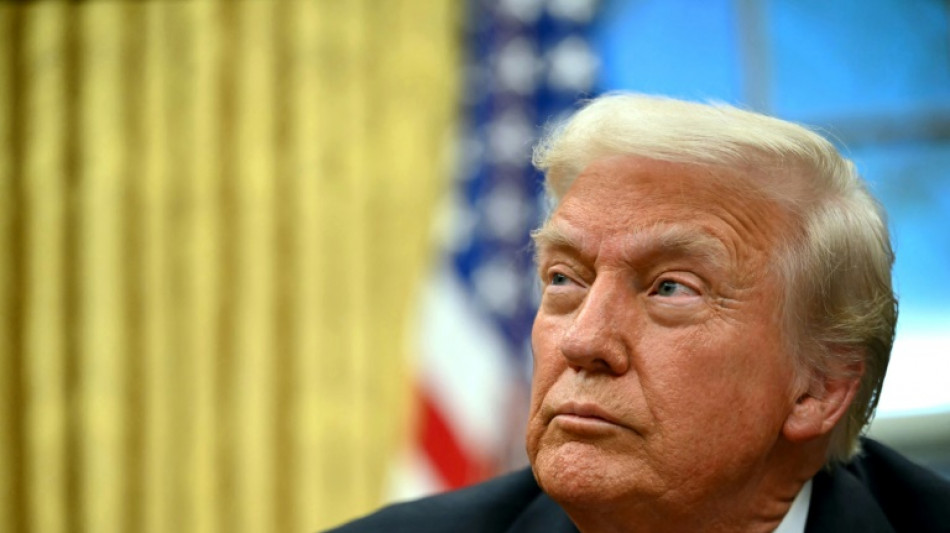
Trump signs executive orders for steel, aluminum tariffs to start March 12 / Photo: ANDREW CABALLERO-REYNOLDS - AFP

 Malaysia Sues Google for $146m Over Harmful Content

 Black Wind Turbine Blades Reduce Bird Deaths by 74% in Spain Study

 Brazil’s Landless Movement Partners with China to Build Affordable Tractors for Family Farms

 Twickenham Grounds Team Prepares Pitch for Six Matches in Three Days

 Luxembourg Pay Rise Delayed as Regional and World Headlines Develop

 Audience to Choose the Set List at Luxembourg's First FAMIL Jukebox Night

 Raheem Sterling Receives Suspended Sentence After Lamborghini Crash

 Black Friday Discounts Cut Prices on Two Top-Rated Wiper Blades

 Arizona Gun Regulation Battle Intensifies Under New Democratic Legislative Majority
US President Donald Trump signed executive orders to impose 25 percent tariffs on steel and aluminum imports from March 12, ramping up a long-promised trade war despite warnings from Europe and China.
"Today I'm simplifying our tariffs on steel and aluminum," Trump said Monday in the Oval Office. "It's 25 percent without exceptions or exemptions."
In an executive order released after, he said: "As of March 12, 2025, all imports of aluminum articles and derivative aluminum articles from Argentina, Australia, Canada, Mexico, EU countries, and the UK shall be subject to the additional ad valorem tariff."
Trump issued a separate order for steel, which said it would apply to all imports from the same countries the aluminum tariffs hit, as well as to Brazil, Japan and South Korea.
Canada and Mexico are the biggest steel importers to the United States, according to US trade data. Brazil and South Korea are also major steel providers.
Trump also signaled he would look at imposing additional tariffs on automobiles, pharmaceuticals and computer chips.
"President Trump has made it clear that an important part of an America First Golden Age is steel production," National Economic Council Director Kevin Hassett told CNBC.
Trump also promised an announcement on Tuesday or Wednesday on broader "reciprocal tariffs" to match the levies other governments charge on US products.
During his 2017-2021 presidency, Trump had imposed sweeping tariffs as he believed US industries faced unfair competition from Asian and European countries.
- 'Devastating blow' -
Canadian steelmakers warned of "massive" disruption, while the European Commission said it would "react to protect the interests of European businesses, workers and consumers from unjustified measures."
French President Emmanuel Macron vowed in an interview aired Sunday to go head-to-head with Trump over his wider tariff threats against the European Union, though he said the United States should focus its efforts on China.
German economy minister Robert Habeck said a tariff conflict "only has losers."
Around 25 percent of European steel exports go to the United States, according to consultancy Roland Berger.
Britain's steel industry body called the tariff plan a "devastating blow."
Trump has already shown his fondness for weaponizing the United States' power as the world's largest economy, ordering tariffs on key trade partners China, Mexico and Canada soon after he took office.
He paused 25 percent levies against Canada and Mexico for a month after both countries vowed to step up measures to counter flows of the drug fentanyl and the crossing of undocumented migrants into the United States.
- 'Tariff fatigue' -
But Trump went ahead with tariffs on China, the world's second-biggest economy, with products entering the United States facing an additional 10 percent levy.
Chinese retaliatory tariffs targeting US coal and liquified natural gas came into play Monday.
Chinese foreign ministry spokesman Guo Jiakun said "there is no winner in a trade war and tariff war."
Trump also focused on steel during a visit by Japanese Prime Minister Shigeru Ishiba last week.
The American leader said he had secured an agreement for Japan's Nippon Steel to make a major investment in US Steel, instead of seeking to take over the troubled firm.
Trump, who has promised a "new golden age" for the United States, insists the impact of any tariffs would be borne by foreign exporters without being passed on to US consumers, despite most experts saying the contrary.
But he did acknowledge this month that Americans might feel economic "pain" from the levies.
Wall Street's main indices finished up Monday despite the tariff threat. London and Frankfurt set fresh records, while Asian markets were mixed Tuesday.
"The fact that global equity indices are higher at the start of the week could be a sign of tariff fatigue," said Kathleen Brooks, research director at trading group XTB.
The dollar also rose against the Canadian dollar, the Mexican peso and South Korean won on Monday.
burs-dk/sst/jgc/sn/dhc
V.Fontes--PC

