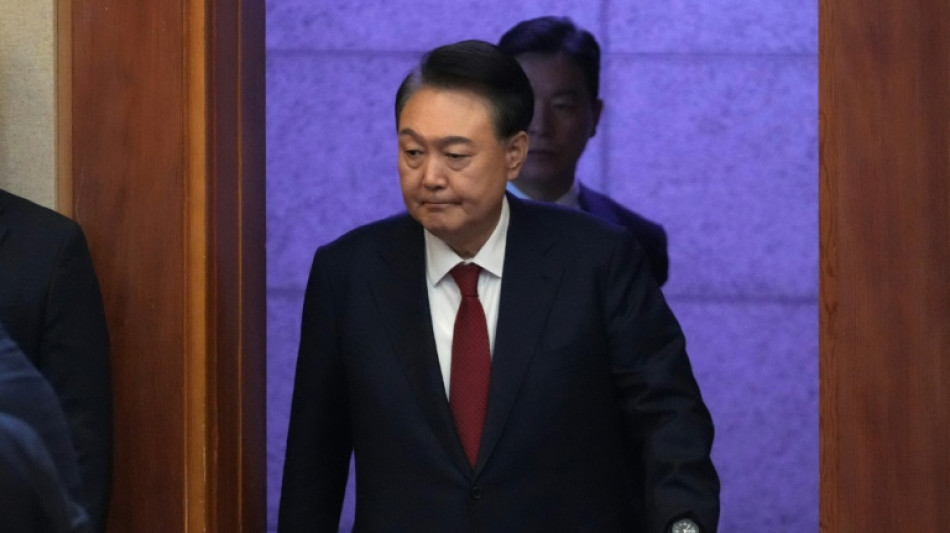
South Korea's Yoon blames 'malicious' opposition for martial law bid / Photo: Lee Jin-man - POOL/AFP

 Malaysia Sues Google for $146m Over Harmful Content

 Black Wind Turbine Blades Reduce Bird Deaths by 74% in Spain Study

 Brazil’s Landless Movement Partners with China to Build Affordable Tractors for Family Farms

 Twickenham Grounds Team Prepares Pitch for Six Matches in Three Days

 Luxembourg Pay Rise Delayed as Regional and World Headlines Develop

 Audience to Choose the Set List at Luxembourg's First FAMIL Jukebox Night

 Raheem Sterling Receives Suspended Sentence After Lamborghini Crash

 Black Friday Discounts Cut Prices on Two Top-Rated Wiper Blades

 Arizona Gun Regulation Battle Intensifies Under New Democratic Legislative Majority
South Korea's suspended President Yoon Suk Yeol blamed the "malicious" opposition for his decision to declare martial law, telling a court on Tuesday that their refusal to applaud him or shake his hand exposed their plans to "destroy" his government.
The former prosecutor plunged democratic South Korea into political turmoil when he declared martial law on December 3, suspending civilian rule and sending soldiers to parliament.
The attempt only lasted six hours as the opposition-led parliament defied troops to vote the declaration down, later impeaching him over the move.
Yoon was detained in mid-January on insurrection charges, becoming the first sitting South Korean head of state to be arrested.
He is regularly being transported from prison to hearings at the Constitutional Court, which will determine whether his impeachment is upheld.
At Tuesday's hearing -- likely the penultimate one -- Yoon complained that the South Korean opposition had failed to offer him due respect while he was in office.
"No matter how much they dislike me, it is the basic principle of dialogue and compromise to listen to me and give me a round of applause for my budget speech in parliament," the 64-year-old told the court.
But, he said, opposition lawmakers "didn't even enter the main hall, and I had to give a speech to a half-empty parliament".
Such a gesture, he claimed, was "deeply malicious" and exposed the "opposition's intent to destroy my government".
He then complained that opposition MPs attending another parliament address "turned their heads away... and refused to shake hands".
In his martial law declaration, Yoon labelled the opposition "anti-state elements" intent on insurrection, saying the decree was required "to safeguard constitutional order".
Thursday's hearing is widely expected to be the last one before the court rules whether to uphold Yoon's impeachment, a move that would trigger a fresh presidential election within 60 days.
Much of his impeachment trial has centred on the question of whether Yoon violated the constitution in declaring martial law, which is reserved for national emergencies or times of war.
Yoon suggested last week that even if he had ordered the arrest of MPs to prevent them from voting down his decree, it would not legally matter because it had not been carried out.
He is also facing a criminal trial on insurrection charges, for which he faces jail time or the death penalty.
F.Ferraz--PC

