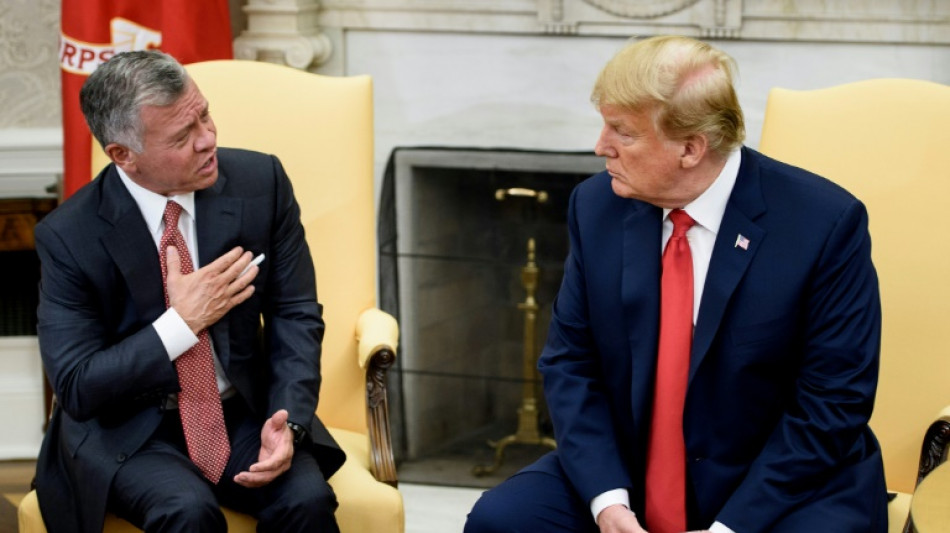
Jordan king set for tense Trump talks over Gaza / Photo: Brendan Smialowski - AFP

 Malaysia Sues Google for $146m Over Harmful Content

 Black Wind Turbine Blades Reduce Bird Deaths by 74% in Spain Study

 Brazil’s Landless Movement Partners with China to Build Affordable Tractors for Family Farms

 Twickenham Grounds Team Prepares Pitch for Six Matches in Three Days

 Luxembourg Pay Rise Delayed as Regional and World Headlines Develop

 Audience to Choose the Set List at Luxembourg's First FAMIL Jukebox Night

 Raheem Sterling Receives Suspended Sentence After Lamborghini Crash

 Black Friday Discounts Cut Prices on Two Top-Rated Wiper Blades

 Arizona Gun Regulation Battle Intensifies Under New Democratic Legislative Majority
Jordan's King Abdullah II faces a tense meeting with Donald Trump at the White House Tuesday as he leads opposition from Arab nations to the US president's controversial Gaza takeover plan.
The talks come a day after Trump said he could "conceivably" halt billions of dollars in US aid to both Jordan and Egypt if they refuse to take in Palestinians that he says should be moved out from their homeland.
The meeting also comes as the Gaza ceasefire appears increasingly fragile with Trump warning that "all hell" would break out if Hamas fails to release all hostages by Saturday.
Abdullah and Jordan's Crown Prince Hussein will meet Trump in the Oval Office before having lunch, the White House said. Both meetings will be behind closed doors.
The pair also met Trump's National Security Advisor Mike Waltz on Tuesday, the Jordanian royal court said on X.
King Abdullah is a key US ally but last week rejected "any attempts" to take control of the Palestinian territories and displace its people after Trump stunned the world with his proposal for Gaza.
He also held talks with Palestinian president Mahmud Abbas on the matter.
Trump unveiled the proposal after Israeli Prime Minister Benjamin Netanyahu became the first foreign leader to visit the White House since the US president's inauguration.
Trump said the United States would "take over" Gaza, envisioning rebuilding the devastated territory into the "Riviera of the Middle East" -- but only after resettling Palestinians elsewhere, with no plan for them ever to return.
The US president has pressed Jordan and Egypt in particular to take in the more than two million Palestinians from Gaza under the plan, while indicating other regional countries could also take them in.
- Aid pressure -
Trump doubled down on the pressure on the eve of his meeting with Abdullah, threatening US assistance to Jordan and Egypt if they continue to oppose the plan.
"Maybe," Trump told reporters on Monday when asked if he would suspend aid if the two countries did not take in the Palestinians. "If they don't agree, I would conceivably withhold it."
Trump made clear in an interview with Fox News channel's Bret Baier broadcast Monday that Palestinians would have no right of return to Gaza after leaving.
His plan has sparked a global backlash and Arab countries have condemned the proposal, insisting on a two-state solution with an independent Palestinian state alongside Israel.
Egyptian President Abdel Fattah al-Sisi, who is expected to visit the White House later this week, urged on Tuesday the reconstruction of Gaza "without displacing Palestinians."
Egypt's Foreign Minister Badr Abdelatty also met with his US counterpart Marco Rubio in Washington on Monday. The Egyptian foreign ministry later issued a statement rejecting "any compromise" on Palestinians' rights.
Analysts say the issue is an existential one for Jordan in particular.
Half of Jordan's population of 11 million is of Palestinian origin, and since the establishment of Israel in 1948, many Palestinians have sought refuge there.
In 1970 in what became known as "Black September". clashes erupted between the Jordanian army and Palestinian groups led by the Palestinian Liberation Organization (PLO).
It resulted in the expulsion of those groups.
But Jordan is also keenly aware of the economic pressure Trump could exercise. Every year, Jordan receives around $750 million in economic assistance from Washington and another $350 million in military aid.
P.L.Madureira--PC

