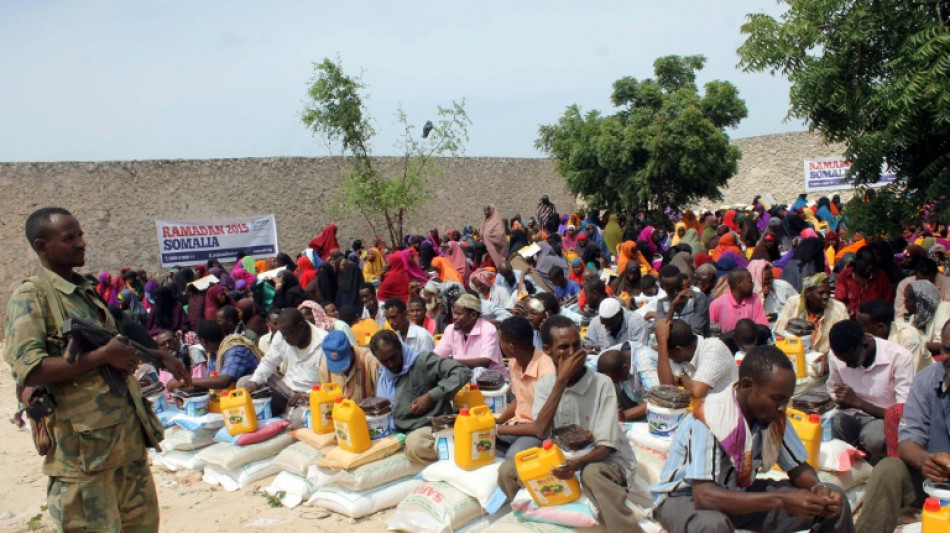
US foreign aid halt to have major hit on poorest countries: report / Photo: ABDULFITAH HASHI NOR - AFP

 Malaysia Sues Google for $146m Over Harmful Content

 Black Wind Turbine Blades Reduce Bird Deaths by 74% in Spain Study

 Brazil’s Landless Movement Partners with China to Build Affordable Tractors for Family Farms

 Twickenham Grounds Team Prepares Pitch for Six Matches in Three Days

 Luxembourg Pay Rise Delayed as Regional and World Headlines Develop

 Audience to Choose the Set List at Luxembourg's First FAMIL Jukebox Night

 Raheem Sterling Receives Suspended Sentence After Lamborghini Crash

 Black Friday Discounts Cut Prices on Two Top-Rated Wiper Blades

 Arizona Gun Regulation Battle Intensifies Under New Democratic Legislative Majority
A suspension of US foreign aid and possible dismantling of the US Agency for International Development (USAID) will have a major impact on some of the world's poorest countries, the Washington-based Center for Global Development (CGD) warned Tuesday.
For more than 20 economies, a year-long pause on US aid could mean a loss of over one percent of their gross national income, the CGD said in a blog post.
And eight economies including South Sudan, Somalia and Afghanistan could face a hit of three percent or more, the group added.
The impact is especially severe for those eight economies as more than a fifth of their foreign assistance comes from USAID.
The value comes up to 35 percent for Afghanistan, 36 percent for South Sudan and 40 percent for Somalia, the post added.
While "US support is too large to be fully replaced," the CGD noted that other providers' official development assistance could be refocused and this could alleviate some of the worst effects.
The poorest countries are among the main beneficiaries of aid from the International Development Association under the World Bank, which provides loans and grants to low-income countries.
Other countries such as Germany, Canada, Japan and Sweden could also step up, the CGD added.
"While there's still time to change course and mitigate some of the worst effects, countries around the world would be wise to act now in response to a less globally engaged United States," said the CGD blog post's authors Ian Mitchell and Sam Hughes.
US President Donald Trump has ordered a 90-day review of USAID, which runs health and emergency programs in around 120 countries, including the world's poorest.
Less than a week after Trump returned to the White House, USAID told non-governmental groups they would have to cease operations immediately because the new administration had frozen its budgets.
A.F.Rosado--PC

