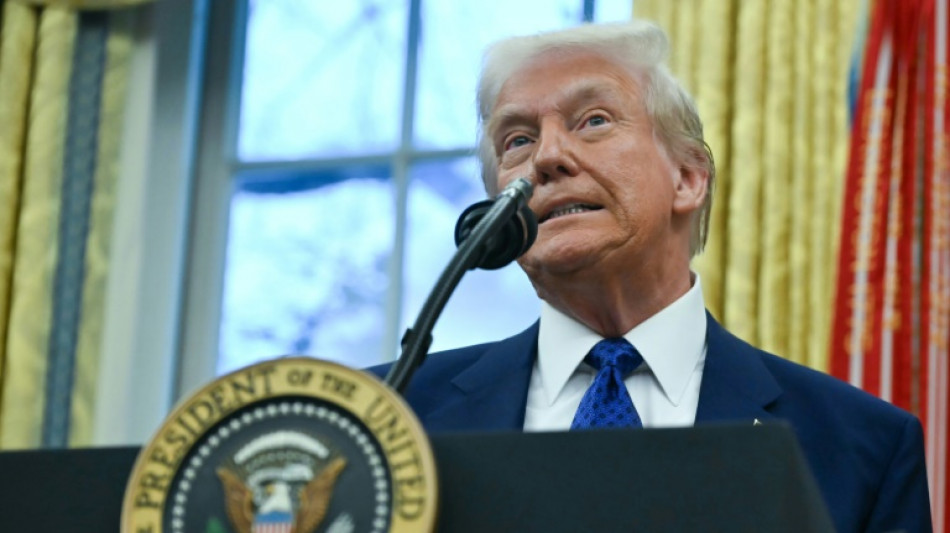
President Trump says US 'reciprocal tariffs' to be announced Thursday / Photo: ANDREW CABALLERO-REYNOLDS - AFP

 Cable car offers small hope for Mongolia's gridlocked capital

 Man City scandal risks damage to Premier League's booming brand

 First-time Sepang F1 racers will master track 'from opening lap'

 Japan tightens rules for foreigners wanting permanent residency

 'Happiest moment': China's Mu first woman to win eSports Games gold

 EU talks deportations as five nations seek migrant centre in Africa

 Kenneth Branagh examines the scars of Iraq war in 'Atonement'

 Hundreds held, dozens wounded as French school protests escalate

 US government's new AI chatbot pulls back from debunking Trump

 US tennis star Navarro reveals health battle, ends season

 Panic, anger, tears: Evan Gershkovich's uneasy journey after Russian jail

 UK PM says 'strong indications' Iran involved in airbase incident
 Google restricts access to new AI model over safety concerns

 Watchdog clears former US Fed chief Powell in renovation probe

 Israel PM hails Indian pilot of rerouted flight for averting disaster
 Fury, Joshua kick off 'battle of Britain' in good spirits

 Ronaldo leaves Portugal training camp after coach says he is dropped

 Florence Pugh stars in 'East of Eden' adaption on Netflix

 Watchdog finds no criminal misconduct over US Fed renovations despite Trump probe

 In Manchester, City fans 'devastated' while rival fans call for relegation

 UK-France Channel migrant exchange deal scrapped: London

 Portugal boss denies 'incident' with Ronaldo

 Israel PM says one of the pilots of rerouted flight tried to crash plane

 Manchester City: Main points of damning judgement and possible sanctions

 Italy looking for 'identity' under Mancini says Scalvini

US President Donald Trump said that he would announce "reciprocal tariffs" on trading partners Thursday, opening new fronts in a trade war economists warn could fuel inflation at home.
Trump has announced a broad range of tariffs targeting some of the United States' biggest trading partners since taking office, arguing that it would help tackle unfair practices -- and in some cases using the threats as a way to influence policy.
He has referred to tariffs as a way to raise revenue, remedy trade imbalances and pressure countries to act on US concerns.
On Thursday, the president said he would hold a news conference on reciprocal tariffs at the White House at 1:00 pm local time (1800 GMT).
"Three great weeks, perhaps the best ever, but today is the big one: reciprocal tariffs!!! Make America great again!!!" Trump wrote in all capital letters on his Truth Social platform.
The move is expected to match the United States' tariff rates on imports to levels that other countries impose on US goods.
Trump's announcement came hours before he was due to meet Indian Prime Minister Narendra Modi in Washington.
Analysts have warned that reciprocal duties could bring a broad tariff hike to emerging market economies such as India and Thailand, which tend to have higher effective tariff rates on US products.
Countries such as South Korea that have trade deals with Washington are less at risk from this move, analysts believe.
- Inflation concerns -
Cost-of-living pressures were a key issue in the November election that saw Trump sweep to power, and the Republican has promised to swiftly reduce prices.
But economists warn that his broad-ranging tariffs on US imports would likely boost inflation, not reduce it, in the near term and could weigh on growth eventually.
Trump's nominee for commerce secretary Howard Lutnick, however, has pushed back on the idea that duties would cause widespread inflation, even as certain costs might rise.
During election campaigning, Trump promised: "An eye for an eye, a tariff for a tariff, same exact amount."
For example, if India imposes a 25-percent tariff on US autos, Washington will have a 25-percent tariff as well on imports of autos from India, explained a Nomura report this week.
Modi will hold talks with Trump at the White House on Thursday and New Delhi offered some quick tariff concessions ahead of his visit, including on high-end motorcycles.
"Trump's objective of implementing reciprocal tariffs is to ensure fair treatment for US exports, which could indirectly also address US trade imbalances with partner countries," analysts at Nomura said.
Among Asian economies, India has a 9.5-percent weighted average effective tariff on US exports, while there is a three-percent rate on India's exports to the United States.
Thailand has a 6.2-percent rate and China a 7.1-percent rate on US products, Nomura noted.
Higher tariffs are often imposed by poorer countries, who use them as a tool for revenue and protection because they have fewer resources to impose non-tariff barriers such as regulatory protectionism, Cato Institute's Scott Lincicome earlier told AFP.
It remains unclear if Trump views reciprocal tariffs as an alternative to a universal tariff of between 10 and 20 percent, which he floated in the lead-up to last year's presidential election, or as a separate policy.
J.Oliveira--PC