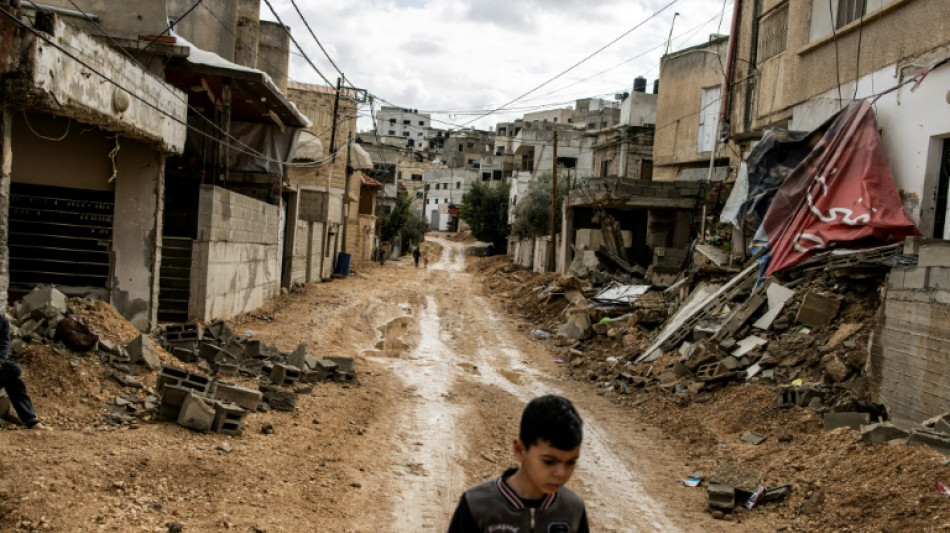
'Bulldozer tore everything apart': Israeli raid expands in West Bank / Photo: JOHN WESSELS - AFP

 Malaysia Sues Google for $146m Over Harmful Content

 Black Wind Turbine Blades Reduce Bird Deaths by 74% in Spain Study

 Brazil’s Landless Movement Partners with China to Build Affordable Tractors for Family Farms

 Raheem Sterling Receives Suspended Sentence After Lamborghini Crash

 Luxembourg Pay Rise Delayed as Regional and World Headlines Develop

 Audience to Choose the Set List at Luxembourg's First FAMIL Jukebox Night

 Twickenham Grounds Team Prepares Pitch for Six Matches in Three Days

 Black Friday Discounts Cut Prices on Two Top-Rated Wiper Blades

 Arizona Gun Regulation Battle Intensifies Under New Democratic Legislative Majority

An intense Israeli military raid had already sent Qusay Farahat fleeing his home in the occupied West Bank, but the offensive has since expanded, threatening a relative's house where he sought shelter.
The raid, which according to Israel aims to dismantle "terrorist infrastructure", has targeted Palestinian refugee camps in the northern West Bank including Jenin where 22-year-old Farhat is from.
But since it began on January 21, the deadly Israeli offensive has gradually encroached upon more cities and towns.
"Here, it feels like the camp all over again," said Farahat, surveying wreckage outside the relative's house in Jenin city where he had gone with his family for safety.
An army bulldozer has ripped through the street, a common sight during Israeli raids which the military says aims to clear roads of explosives.
"When the bulldozer came, it tore everything apart while we were inside," said Farhat.
"We shouted for help," he said, adding the family was left "trapped" as the roaring machine left the front of the house in ruins.
It had thrust a wrecked car and rubble against the house's raised entrance, and further down the street, now stripped of tarmac, disfigured storefronts and tore down walls.
Israel has occupied the West Bank since 1967 and carries out regular raids against Palestinian militants, but the current offensive in the north is the longest continuous one in the territory in two decades.
According to the United Nations, the military operation has killed at least 39 Palestinians and displaced 40,000. The Israeli military said it had taken some 90 Palestinians into custody over the past week alone.
Since last month, according to UN figures, nearly 18,000 people have fled the Jenin camp, normally home to 24,000 residents including the Farhat family.
With much of the camp damaged and Israeli forces still present, few Palestinian residents have been able to return.
- Raided offices -
In Jenin's eastern neighbourhood, on the opposite side of the city from the camp, an elderly man struggled up a hill on an old bicycle ill-suited to deal with the mud left in the bulldozers' wake, and a woman carrying groceries picked her way through the mounds of debris.
One shopkeeper, fixing a bent metal awning, told AFP he already had to repair it just six months ago, following another Israeli raid.
Adding to the destruction, an air strike on Thursday hit a car in the neighbourhood, starting a small fire that burned for hours.
Parents warned their children to stay away from the smouldering remains fearing unexploded ordnance.
The Israeli army said its forces had "located a rigged vehicle and dismantled it", sharing a video of the drone strike.
In one high-rise overlooking the camp, residents said Israeli soldiers had raided offices, searching them and possibly using them as a vantage point -- as troops have done before in that area.
AFP journalists saw safes pried open, their contents scattered on the floor, and glass windows shattered.
In one office, a small Palestinian desk flag was burned and another larger one torn in half.
Another room had portraits of iconic Palestinian poet Mahmoud Darwish defaced with a stamp from the legal office that was raided.
- 'Nothing left' -
Inside the Jenin camp, army jeeps patrolled on a wide dirt road where nearly two dozen houses stood before being demolished in the operation.
Farhat said he felt lucky to have made it out of the camp alive.
In the early days of the raid, "we were surrounded, and suddenly Israeli special forces appeared and began firing intensely," he recalled.
"People died, and others fled", said Farhat.
"Miraculously, we escaped."
Sabha Bani Gharra, a 95-year-old resident of the camp, was receiving treatment for a fracture at a hospital in Jenin city when the raid began.
She has not been able to return home since, living instead in a sewing workshop of a charity based outside the camp.
From a video taken by a neighbour, she has learned that her house was destroyed.
"The house is gone. All I have is one outfit, the one I'm wearing," said the woman, clutching an old cookie tin where she keeps here medicine -- now one of her only few material possessions.
"I have nothing left, except the kindness of strangers who help me survive day to day".
T.Batista--PC

